Brand history and context
François Czapek founded Czapek & Cie in Geneva in 1845 after his partnership with Antoine Patek. The modern brand was relaunched in 2015, and it has spent the last decade building a small but credible catalog around the Quai des Bergues, the Faubourg de Cracovie chronograph, and the Antarctique sports watch. L'Écume des Jours sits apart from those models. It is less about daily utility and more about the poetry of watchmaking: enamel, moonphase, and a movement you wind by hand.
That historical grounding matters. Czapek is not a fashion brand with a watch license. It is an independent with a real archive story, and its modern watches are designed with an eye on classical Geneva watchmaking. The L'Écume des Jours is a good example of that approach. It does not chase trends. It offers a traditional complication in a case that feels contemporary enough for a younger collector.
Case and dial
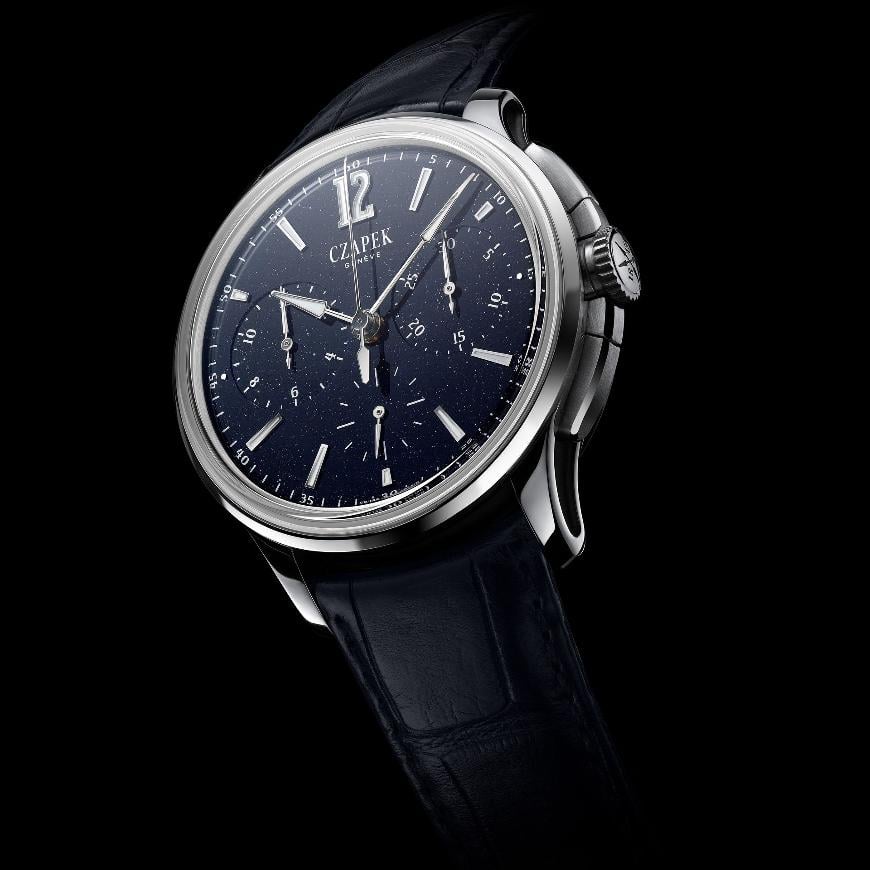
The L'Écume des Jours is built around a 40.5mm gold case. That size is important. It is large enough to give the dial room to breathe, but not so large that it becomes a caricature of a dress watch. The case has the soft, rounded profile you expect from a formal piece, with a thin bezel that lets the enamel dial dominate. The sapphire crystal is clear and unobtrusive, and the watch has no lume, which is exactly right for this kind of object.
The dial is the heart of the watch. It is a Grand Feu enamel dial, and that matters because enamel is not a print or a lacquer. It is fired at high temperature, and the result has a depth and gloss that change with the light. The dial is paired with a moonphase at six o'clock and a power-reserve display at twelve. The layout is balanced, and the moonphase is large enough to read without turning the watch into a novelty. The guilloché pattern adds texture without overwhelming the enamel, and the hands are slender enough to keep the dial feeling open.
This is not a watch that shouts. It is a watch that rewards a close look. The enamel has a slight variation that you do not get from a stamped dial, and the moonphase disc is finished with care. The power-reserve display is useful, but it also adds visual interest to the upper half of the dial. The overall effect is classical, but not stuffy. It feels like a watch made for someone who knows what they are looking at.
Movement and finishing
Inside is the Calibre SXH2, a proprietary hand-wound movement. It uses twin barrels to deliver a seven-day power reserve, which is a generous figure for a dress watch. The frequency is 28,800 vph, so the balance runs at a modern pace, and the movement is designed to be stable across the week. The SXH2 is not COSC-certified, so Czapek does not promise chronometer performance on paper, but the architecture is serious.
The finishing is where the movement earns its keep. The bridges are decorated with Côtes de Genève, the edges are hand-bevelled, and the screws are polished. This is not a movement that hides behind a solid caseback. The L'Écume des Jours is meant to be turned over and examined. The twin-barrel layout gives the movement a technical look, and the hand-wound nature means you interact with it regularly. Winding a seven-day movement is a small ritual, and it suits the watch.
It is worth being precise about the in-house question. The SXH2 is proprietary to Czapek, but it is developed with a specialist partner rather than produced in a fully owned manufacture. That does not diminish the watch. It simply places it in the reality of modern independent watchmaking, where small brands work with expert suppliers and focus their own resources on design, finishing, and assembly. The result is a movement that feels exclusive and is finished to a high standard.
On the wrist
At 40.5mm, the L'Écume des Jours sits in the sweet spot for a modern dress watch. The gold case has presence without feeling bulky, and the alligator strap tapers neatly to a pin buckle, keeping the watch close to the wrist. It is not a light watch, but the weight is balanced. The caseback sits flat, and the lugs curve comfortably, so the watch does not perch or slide.
Because it is a formal watch, the wearing experience is best with a shirt cuff. It slips under a sleeve without fuss, and the moonphase and power-reserve displays are easy to read at a glance. It is not a watch you forget you are wearing, but it is comfortable enough for a full day at a desk or an evening out. The gold case gives it a warm presence, and the enamel dial catches light in a way that a standard lacquer dial cannot.
Accuracy and daily use
The SXH2 is not COSC-certified, so Czapek does not promise chronometer performance on paper. In practice, a well-regulated example should run within a few seconds per day. The seven-day reserve helps stability across the week, and because it is hand-wound, you control the state of wind. Expect something in the range of -5 to +10 seconds per day, with consistency more important than absolute precision.
Daily use is not the primary mission here, but the watch is more practical than its dress-watch appearance suggests. The power-reserve display removes the guesswork from winding, and the moonphase is a pleasant complication rather than a fragile gimmick. It is not a sports watch, and it should not be treated like one. But for an office, a dinner, or a collector's rotation, it is easy to live with.
Occasions and presence
The L'Écume des Jours is a formal and dress watch first. It works with a suit, a jacket, or a dark knit, and it has enough character to hold its own in a collection of more obvious sports watches. It can be worn daily if your daily wardrobe is tailored, but it is not the watch you grab for the beach or the gym. The lack of lume and the gold case make that clear.
On the wrist, it has a presence rating of four out of five. The gold case and enamel dial give it real visual weight, but it is refined rather than loud. It reads as a dress watch first and a statement second. That is the right balance for this kind of piece. It does not need to shout to be noticed.
Variants and family
Reference 1726 is the reviewed version, and it is a limited edition. Czapek has offered the L'Écume des Jours in more than one gold tone, and the white-gold sibling changes the character of the watch without changing its fundamentals. The blue enamel dial is the constant, and it is the element that gives the watch its identity. The alligator strap and pin buckle keep the package traditional.
Within the Czapek family, the Quai des Bergues is the closest reference point. It established the brand's classical language, and the L'Écume des Jours builds on that with a moonphase and a more decorative dial. The Place Vendôme and Faubourg de Cracovie show different sides of the brand, while the Antarctique is the modern sports alternative. The L'Écume des Jours is the romantic option in that lineup.
Similar watches
If you are considering the L'Écume des Jours, you are likely also looking at the A. Lange & Söhne Saxonia Moon Phase, the Vacheron Constantin Patrimony Moon Phase and Retrograde Date, the Jaeger-LeCoultre Master Ultra Thin Moon, and the F.P. Journe Octa Lune. Each has a different personality. The Lange is more German and technical, the Vacheron is more classical Geneva, the JLC is more accessible, and the F.P. Journe is more independent and architectural. The Czapek sits between them: more poetic than the Lange, more niche than the Vacheron, and more traditional than the Journe.
There are also affordable moonphase dress watches that capture part of the idea. The Seagull M199S and various Parnis moonphase models offer the look at a fraction of the price, but they do not offer the enamel, the finishing, or the independent-brand story. They are useful as a way to test whether a moonphase dress watch suits your wardrobe, not as substitutes for the Czapek.
Investment and ownership
The L'Écume des Jours is a limited edition from a small independent, and that gives it collectible appeal. It is not, however, a liquid asset. The market for Czapek is narrow, and buyers are usually collectors who know the brand. Public auction history is limited, and pre-owned data is thin. That means you should buy it because you love the watch, not because you expect to flip it quickly.
The price range is roughly $40,000 to $50,000 depending on configuration and market. For that money, you get a Grand Feu enamel dial, a moonphase, a seven-day hand-wound movement, and a limited edition from a brand with a real history. The value is in the craft and the scarcity. If you want broad recognition and easy resale, a more established name will be safer. If you want something personal and beautifully made, the Czapek makes sense.
Service and long-term care
Czapek recommends service through its authorized network. The SXH2 is a proprietary movement, so independent watchmakers may not have access to parts. That is normal for a small independent, but it is something to factor into ownership. The enamel dial should be treated with care, and the gold case will show wear over time. A safe, regular service interval will depend on use, but the watch should be serviced by someone who knows the caliber.
Pros and cons
The pros are clear: a beautiful Grand Feu enamel dial, a poetic moonphase, a seven-day hand-wound movement, and the appeal of a limited independent. The cons are equally clear: no chronometric certification, a niche resale market, and a gold-and-enamel construction that demands care. This is not a watch for someone who wants one object to do everything.
Final verdict
The Czapek L'Écume des Jours ref. 1726 is a connoisseur's moonphase. It pairs a serious hand-wound movement with a dial that feels made by hand, and it does so in a limited edition that feels personal rather than corporate. It is not the easiest watch to flip, but it rewards the collector who wants craft, rarity, and a dial that invites a second look. For the right buyer, it is a compelling alternative to the usual dress-watch suspects.