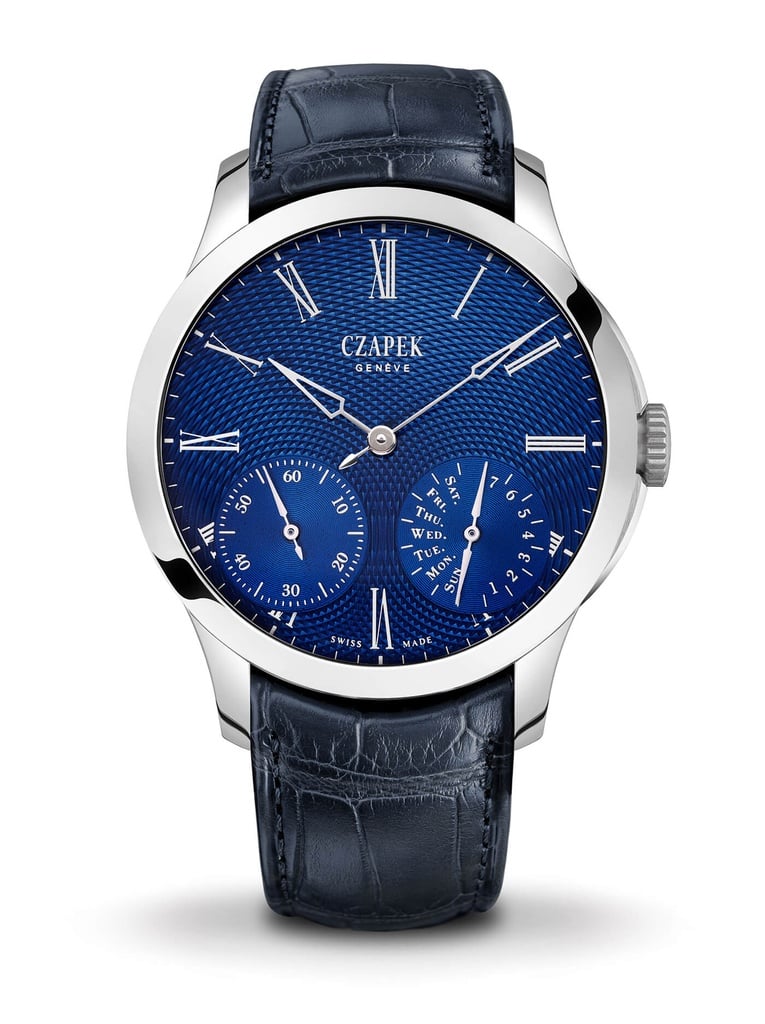
There are dress watches that ask to be noticed and dress watches that ask to be read. The Czapek Quai des Bergues belongs to the second camp. At first glance it is a round, restrained, two-subdial watch with Roman numerals and a leather strap. Look closer and the argument becomes more specific: a hand-wound, seven-day movement, a dial with real surface, and a case that has been resolved rather than merely drawn.
The QdB is the watch that relaunched Czapek & Cie. It was the brand's first modern collection, and it remains the clearest statement of its priorities. The current independent market is full of limited editions and loud collaborations. The Quai des Bergues takes a quieter route: traditional watchmaking, slightly unusual proportions, and a movement you want to turn over.
This review uses the steel Quai des Bergues No. 33 as its reference point. The same architecture runs through the family, including gold and blue-dial variants, but the steel No. 33 is the purest expression of the idea. It is a watch for someone who cares about how a movement is laid out, how a dial catches light, and how a case disappears under a cuff. It is not for someone who needs a date, lume, or a fast resale.
History: A Revived Name With a Real Geneva Thread
François Czapek was a Polish watchmaker who worked in Geneva and, for a time, partnered with Antoni Patek before Patek founded the company that became Patek Philippe. Czapek established his own maison in 1845, and the name has a legitimate nineteenth-century place in Genevan watchmaking. The modern Czapek & Cie was revived in 2015, and the Quai des Bergues was its first major collection.
That history matters because the QdB is not a retro pastiche. It uses a historical name and a historical address, but the watch is a modern independent product: crowdfunded at launch, designed with contemporary collector tastes in mind, and powered by an exclusive calibre developed with a Swiss movement specialist. The result sits between heritage watchmaking and modern independent horology. It has the manners of a dress watch and the conversation piece of a small manufacture.
The Quai des Bergues also gave Czapek a coherent design language. The two subdials, the flinqué dial, the stepped bezel, and the curved lugs are now recognizable as Czapek. Later models such as the Antarctique and Faubourg de Cracovie have taken the brand in sportier and more complicated directions, but the QdB remains the anchor. It is the model that explains why the brand exists.
Movement: Calibre SXH1, Seven Days of Manual Winding
The Calibre SXH1 is the heart of the QdB. It is a hand-wound movement with a seven-day power reserve, or 168 hours. It runs at 21,600 vibrations per hour, which is 3 Hz, and it uses 31 jewels. The architecture is built around twin barrels, and the long reserve is not a gimmick: it changes the ownership experience. You wind the watch once a week, check the power-reserve subdial, and otherwise let it run.
The SXH1 is exclusive to Czapek and was developed with Vaucher Manufacture Fleurier. That makes it a proprietary calibre rather than a fully in-house manufacture movement, and that distinction is worth stating plainly. What matters is the execution. The movement is visible through a sapphire caseback, and the finishing is appropriate to the price: Geneva stripes on the bridges, circular graining, blued screws, and polished bevels. The layout is clean, with the twin barrels and the going train presented without clutter.
The long power reserve has a practical consequence. A seven-day movement can deliver slightly different rates at full wind and near the end of its reserve. The QdB is not COSC-certified, and Czapek does not position it as a chronometer. That is fine. The movement is designed for stability over a week, not for a single timegrapher printout. Wind it fully, wear it consistently, and judge it over a fortnight. The power-reserve indicator at 4:30 is not decorative; it is the useful companion to a movement that asks you to wind on a schedule.
Manual winding is part of the appeal. The crown is easy to reach, the winding action is positive, and the ritual suits the watch. If you want a grab-and-go automatic, this is not it. If you want a dress watch that makes you participate, the SXH1 is the reason to choose the QdB over a generic time-only automatic.
Case and Dial: Compact Steel, Flinqué Depth
The steel case measures 38.5mm in diameter and 11.9mm thick. Those are compact dress-watch numbers, and they are backed by a stepped bezel, curved lugs, and a mix of polished and brushed surfaces. The case is not trying to be a sports watch. Water resistance is 30m, which is enough for handwashing and rain but not for swimming. The crystal is sapphire front and back, and there is no lume on the dial.
The dial is the QdB's other signature. It uses a flinqué treatment, a technique that begins with engraved surface texture and continues with translucent enamel or lacquer. In person, the effect is not a flat silver. The dial shifts as the light moves, and the Roman numerals, railway track, and subdials sit within that texture rather than on top of it. The small seconds is at 7:30 and the power-reserve indicator is at 4:30. The layout is asymmetric but balanced, and it gives the watch a face that is instantly identifiable without being loud.
The hands are polished and faceted, with enough contrast against the dial to remain legible. The Roman numerals are applied or printed with clean edges, and the railway track is fine enough to reward a loupe. The caseback is sapphire, so the movement is part of the ownership experience. This is not a watch that hides its mechanics. The finishing is visible, and the twin barrels give the back a real architectural reason to be shown.
On the Wrist: Discreet, Balanced, Slightly Formal
On the wrist, the QdB reads as a compact dress watch rather than a small one. The 38.5mm case and 11.9mm thickness are supported by curved lugs and a stepped bezel, so the watch sits close and balances well. It does not feel top-heavy, and the alligator strap is supple enough to follow the wrist. The pin buckle keeps the package light and traditional. The watch is at its best when the strap is sized properly, because the curved lugs reward a snug fit.
Under a cuff, it is discreet. In short sleeves, the dial has enough depth and the case has enough polishing to hold attention without flash. The lack of lume is not a problem in this context; this is a watch for dinner, an office, or a gallery, not a night dive. The power-reserve subdial is useful, the small seconds is elegant, and the Roman numerals give the dial a formal, almost architectural order. It is not a daily beater in the sense of a sports watch, but it is perfectly usable as a daily dress watch if you accept its limits.
The wrist presence is best described as considered rather than commanding. It does not wear like a statement piece. It wears like a watch that someone chose because they know what they like. That is a virtue in a dress watch, especially one at independent-brand pricing. The QdB is not trying to dominate a room. It is trying to reward the person wearing it.
Accuracy and Everyday Use
The SXH1 is not chronometer-certified, and Czapek does not market it as a COSC movement. In real-world use, a well-regulated example should run within roughly -5 to +10 seconds per day, with the usual caveat that a seven-day movement can show slightly different rates at full wind and near the end of its reserve. Wind it on the same day each week, let it settle, and judge it over a fortnight rather than a single morning.
The long power reserve is a practical advantage. You are not winding every morning, and the power-reserve subdial removes the guesswork. The watch is stable over a week, and the manual winding action is part of the ritual. If you wear it in rotation, the seven-day reserve means it will still be running when you come back to it after a few days. That is more useful than a date window for many collectors.
Everyday use is limited by the dress-watch brief. There is no lume, water resistance is 30m, and the leather strap is not for swimming. Treat it as a formal watch that can handle a normal day. It will survive a desk, a commute, and a dinner. It will not survive a gym session or a beach holiday, and it does not pretend to. The QdB is honest about what it is, which is rarer than it sounds.
Variants and Family
The Quai des Bergues No. 33 is the reference point: steel case, silver flinqué dial, small seconds, power reserve, and alligator leather. The rose-gold version uses the same movement and layout but changes the temperature of the watch. It is warmer, more formal, and more expensive. The Sapphire Blue variant adds a blue dial and a slightly sportier character while keeping the same SXH1 platform. These are not different watches so much as different moods.
The wider QdB family includes guilloché and chronograph variants, and the name has become a small collection within Czapek. Other notable Czapek models include the Antarctique, a sports-chic integrated-bracelet watch; the Faubourg de Cracovie, a chronograph; the Place Vendôme, a more jewelled and formal proposal; and the Passage de Drake, a sportier take on the brand's language. The QdB remains the classic entry point, and it is the one that best explains the brand's design DNA.
Alternatives and Affordable Stand-Ins
If you are shopping the QdB, you are likely also considering the A. Lange & Söhne Saxonia Thin, the Patek Philippe Calatrava 5196, the Vacheron Constantin Traditionnelle Manual-Winding, the F.P. Journe Chronomètre Bleu, and the Grand Seiko SBGW231. Each answers a different part of the brief. The Lange offers German finishing and hand-wound restraint. The Patek is the default understated dress watch, at a much higher entry point. The Vacheron brings traditional Geneva finishing. The F.P. Journe is the independent alternative with a cult dial and a much higher price. The Grand Seiko is the relative value, with hand-wound mechanics and a quieter case.
The QdB sits between those worlds. It is more accessible than the Patek or F.P. Journe, more distinctive than a standard Calatrava, and more traditional than the Antarctique. It is not the obvious choice, and that is part of the appeal. For a discerning buyer, the question is whether the seven-day movement and flinqué dial are worth the independent-brand premium. The answer depends on how much you value movement architecture over brand recognition.
If you want the look without the price, there are affordable stand-ins. The Orient Bambino 38 offers vintage dress proportions and a clean dial for about $250. The Seiko Presage Cocktail Time brings a textured dial and dress-watch intent for around $300. The Tissot Le Locle adds automatic convenience and a traditional layout for about $450. These are not homages in the counterfeit sense. They are spiritual stand-ins: they capture the mood of a formal, round, leather-strap watch without pretending to be a Czapek. None of them has a seven-day hand-wound movement, and none of them will satisfy someone who wants the real thing.
Value, Investment, and Service
The original crowdfunding-era steel QdB was priced below $10,000. Current retail for a steel example sits around the mid-teens in US dollars, and pre-owned examples tend to trade in the $8,000-$12,000 band. That gap is normal for an independent brand that has raised prices as its reputation has grown. The QdB is not a liquid asset. It is a watch that rewards ownership, not flipping. The trend is best described as stable rather than appreciating, and the auction history is limited. Early crowdfunding examples occasionally surface near retail, but there is no deep secondary market.
Service is handled through Czapek's authorized network. The brand is small, so turnaround and parts availability should be confirmed before purchase. This is not a watch to hand to an independent watchmaker without checking that they can source the right parts and preserve the finishing. The movement is exclusive, and that exclusivity cuts both ways: it is part of the appeal, and it is a reason to use authorized service.
The price buys an independent seven-day dress watch with genuine movement character. It does not buy the instant recognition of a Patek or the liquidity of a Rolex. It buys a watch that is more interesting than most of its peers at the same money, and it holds value better than many small-brand dress watches. That is a reasonable outcome for a collector who buys with their eyes open.
Verdict
The Czapek Quai des Bergues is a dress watch for collectors who read movements before logos. Its seven-day calibre, flinqué dial, and compact steel case make a coherent independent statement, and the lack of date or lume is a discipline rather than a defect. The pros are clear: a seven-day hand-wound movement with twin-barrel architecture, a distinctive dial, and a well-resolved case. The cons are equally clear: no date, no lume, a narrow service network, and modest resale liquidity. Current retail also sits well above early crowdfunding pricing.
Buy it for the architecture and the dial. Keep it because it wears beautifully and ages with restraint. The QdB is not the loudest watch in the room, and it is not meant to be. It is the one you notice when you look closely, which is the best kind of dress watch.