The short version
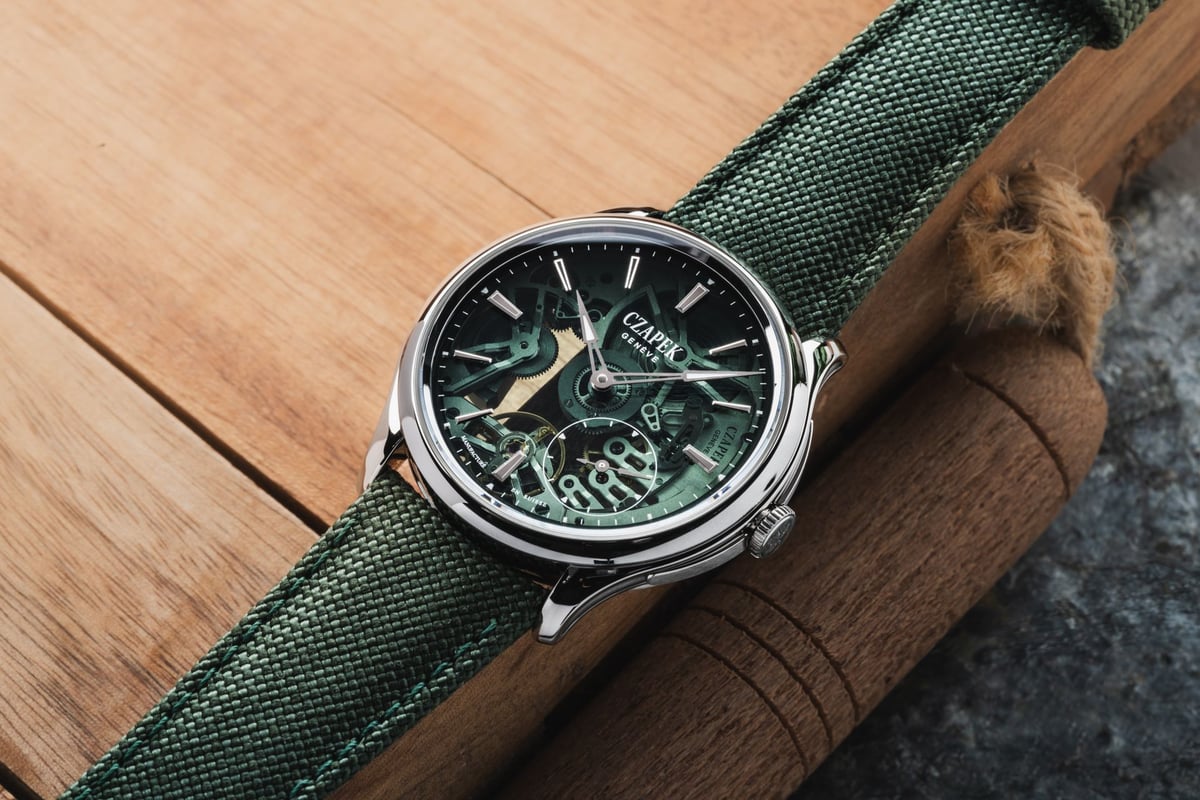
Czapek's Transparencies take the most conservative object in watchmaking — the dial — and replace it with a sheet of sapphire. What sits underneath is not decoration but the movement itself: openworked bridges, hand-bevelled edges, a micro-rotor tucked flush into the calibre so nothing blocks the view. On paper it is a collector's curiosity. On the wrist, over seven days of ordinary life, it turned out to be something considerably more useful than that.
I wore it to a desk, to a dinner, through an airport, and through the sort of weekend where a watch gets knocked against a doorframe at least twice. It came out the other side without a scratch on the crystal and without a single moment where I wished I had worn something else. That is the review in one sentence. The rest is the detail.
The name above the dial you cannot see
François Czapek is one of the great might-have-beens of Swiss horology. A Silesian-born watchmaker, he partnered with Antoni Patek in the 1830s before the two men went their separate ways; Czapek established his own house in Geneva in 1845 and later held an imperial appointment as watchmaker to Napoleon III. Then the trail goes cold, the workshop closes, and the name sits unused for the better part of a century and a half.
The revival came in 2015, when a group of collectors and entrepreneurs — with designer Peter Speake-Marin shaping the first collection — re-established Czapek & Cie in Geneva. What makes the modern brand interesting is the structure as much as the watches: a shareholder model that lets collectors own a slice of the house, which in practice means the people buying the watches are also the people scrutinising the finishing. That kind of pressure shows up in the product. The bridges on a Transparencies are not finished to a press-release standard; they are finished to a standard that survives a loupe held by someone with money in the company.
It also explains the design brief. Czapek has never been a brand that hides its mechanics behind a polite enamel dial. From the twin-barrel architecture of the Quai des Bergues to the micro-rotor of the Antarctique, the house has always leaned toward showing its working. The Transparencies are simply that instinct taken to its logical conclusion.
What "Transparencies" actually means on the wrist
Strip the dial off a watch and three things happen at once. You gain depth. You lose contrast. And you discover whether the movement underneath was designed to be seen or merely housed.
Czapek's answer to the second problem is the interesting one. Rather than fight the loss of contrast with heavy black printing or a busy chapter ring, the Transparencies lean into it: the hands are polished and faceted so they pick up whatever light is in the room, and the bridges below are angled so that there is almost always one edge catching a highlight. In a bright room the effect is dazzling. In a dim one it is atmospheric. In a flat, grey, overhead-lit office — the honest test — it is readable but not effortless, and you will find yourself tilting your wrist a few degrees more than usual.
The third question, though, is where this watch wins. There is genuine depth here, not a flat plate with holes cut in it. The bridges are layered, the mainspring and going train sit at different heights, and the sapphire adds its own faint reflection on top of the whole arrangement. Spend a minute looking at it and you keep finding new planes. That is the difference between a skeletonised watch and a transparent one.
On the wrist: the part the photos cannot show
Here is what the press images never tell you. An openworked watch can be beautiful and still be annoying, because removing material from the dial does not remove it from the case. Many transparency-first pieces end up top-heavy, with a bracelet that fights the case and a head that rolls to the outside of the wrist whenever you reach for a coffee cup.
The Transparencies do not do that. The case sits low against the wrist, the underside is shaped rather than slab-sided, and the bracelet articulates closely enough that the whole assembly stays centred. After two days I stopped adjusting it, which is the milestone that matters. The clasp sits flat enough to rest a forearm on a table without a lump under the wrist, and the case edge does not press into the wrist bone during a long typing session.
Weight is on the polite side of substantial — enough that you know it is there, not so much that it becomes a workout. What surprised me most was how it behaved in a shirt cuff. Openworked watches often catch on fabric because of the crown or the case profile; this one slid in and out without complaint. It is, genuinely, a watch you can wear from breakfast to a late dinner without thinking about it.
Reading it in real light
Legibility is the tax you pay for transparency, and I would rather be honest about it than pretend otherwise. In daylight, or under a decent lamp, the Transparencies read perfectly well: the hands are long enough to reach the track, the tips are easy to locate, and the contrast between polished steel and dark bridge is sufficient. Reading the time takes perhaps a beat longer than on a plain dial. Not a problem.
In low, diffuse light — a restaurant at the far end of the evening, a car at dusk — the effect changes. The hands disappear into the architecture and you have to hunt for them. There is no luminous treatment here, and I would not want there to be; lume on an openworked dial tends to look like graffiti on a cathedral. The trade is explicit: you are buying an object that is at its best when there is something to reflect.
What helps is the seconds hand. Because it is constantly moving over a static background, your eye learns to find it first and then locate the hour and minute hands relative to it. It sounds fussy. Within a day it becomes automatic, and that is the point at which you stop noticing the compromise and start enjoying the view.
The movement, and why the back matters as much as the front
The engine is Czapek's in-house micro-rotor automatic, the SXH5, with a power reserve of around sixty hours and a balance running at 28,800 vibrations per hour. The micro-rotor is the crucial design decision: a conventional rotor would sit across the middle of the movement and block exactly the view you paid for. Sinking it flush into the calibre keeps the whole back plate visible, and in practice the caseback becomes the more meditative of the two sides.
Finishing is where Czapek earns its money. Bridges are openworked, bevelled by hand, and anglaged to a standard that holds up under magnification — a phrase I use deliberately, because plenty of watches in this bracket look convincing at arm's length and fall apart under a loupe. The architecture is also sensible rather than merely picturesque: there is a clear visual hierarchy from the balance out to the barrel, so the eye can follow the path of power even if you are not a movement specialist.
Sixty hours is the right number for a watch like this. It means Friday evening to Monday morning without a reset, and it means the movement is usually well wound during a working week, which is when accuracy is at its best.
Accuracy over a week
This is not a chronometer-certified calibre, and Czapek does not market it as one. What I look for in a watch at this level is consistency rather than a headline figure, and here it delivered: the rate stayed stable across the week, drifting slightly fast rather than slow, which is the direction you want from a new movement.
Expect positional variation of a few seconds a day depending on how it rests overnight. Left dial-up, mine pulled back toward zero after a day of running slightly ahead; worn continuously, it settled into a comfortable rhythm. The practical upshot is that you can go a week without adjusting it and stay within a handful of seconds of your phone. If you are the sort of person who times a watch against a reference signal every morning, you will find it dependable rather than remarkable — which, for a daily wearer, is the better outcome.
The bracelet, the clasp, and the small frictions
An integrated bracelet is a commitment: you cannot swap it for a NATO on a whim, and if it does not fit, the watch does not fit. Czapek's is well-judged — the taper is gentle, the links articulate without rattling, and the polished outer surfaces contrast with brushed inner links in a way that catches light when you move. The deployant clasp is secure and sits flat, though the release is stiff enough in the first weeks that you will use two hands. It loosens with use.
Small frictions, in the interest of honesty. The sapphire dial is a fingerprint magnet, and because it is transparent you see smudges from both sides. A microfibre cloth lives in my desk drawer now. The caseback — inevitably — is the part everyone wants to see, which means you will take it off at dinner more often than you would with a normal watch, and there is a faint anxiety that comes with handing a hand-finished movement to a friend who has had two glasses of wine. And with no luminous treatment and no date, you need to be the sort of person who does not mind either. I did not, but it is a choice worth making consciously.
Water, weather, and the real world
Czapek does not build this as a sports watch, and I would not treat it as one. It handled rain, handwashing, and a splash at a sink without complaint, but this is a piece to take off before a swim and to keep away from a sauna. That is not a criticism so much as a description of the genre: transparency and heavy gaskets are not natural bedfellows, and the tolerances here are tuned for finishing rather than for pressure.
What it does handle is a real week. It survived a flight without a strap change, an evening of handshakes without snagging on a cuff, and a Saturday of errands without looking absurd. That versatility — dressy enough for a dinner, understated enough for a supermarket — is the argument for owning one watch of this type rather than a safe full of untouchable pieces.
What it costs, and what that buys
You are in the low-to-mid thirty-thousand-dollar range depending on configuration and timing, which puts the Transparencies in direct conversation with an openworked Royal Oak and a rung below the more elaborate independents. What the money buys is not rarity theatre but finishing: hand-bevelled bridges, a micro-rotor architecture that lets the back be as interesting as the front, and a case-and-bracelet combination that is genuinely comfortable rather than merely photogenic.
On the secondary market, expect a modest haircut from retail in the early years. Czapek's production is small and its collector base is engaged, which gives the brand a firmer floor than most young independents, but openworked watches as a category do not appreciate the way steel sports chronographs do. Buy this one because you want to look at it every day, not because you want to sell it in five years. If you do buy it, buy the configuration you actually want to wear — the resale spread between variants is narrower than the spread between a well-chosen watch and a compromise.
Service and the long game
Servicing runs through Czapek's Geneva atelier and a small authorized network, which means a factory return rather than a local bench. That is the correct answer for a hand-finished openworked movement — no independent watchmaker should be let near those bridges — but it does mean planning ahead and accepting a period without the watch. Ask about turnaround at the point of sale and get it in writing; independent brands vary in how quickly they can absorb service work, and a watch you love but cannot service is a paperweight with a story.
Alternatives worth trying on
If you are shopping in this territory, try the Parmigiani Tonda PF Skeleton before you commit. It is quieter, every bit as architectural, and it suits a slightly more conservative wardrobe. The Girard-Perregaux Laureato Skeleton is bolder and more obviously sporty, with a design language that will either delight you or exhaust you within an hour. And the Royal Oak Openworked remains the benchmark for the category — try it on if only to calibrate what a truly great integrated bracelet feels like, then decide whether the Czapek's more classical case shape suits you better.
At the other end of the scale, the Baltic MR01 is a genuinely useful experiment: it brings micro-rotor architecture to a fraction of the price and will tell you within a month whether you actually enjoy living with an open dial or whether you secretly just want a plain, legible face. There is no shame in discovering it is the latter.
The verdict
The Transparencies are the rare openworked watch that survives a real week rather than a photo shoot. They are comfortable, quietly confident, and legible enough if you are honest about how you read the time — which is to say, not in a dark cinema. The movement is the star, the finishing is the justification, and the bracelet is what makes it a daily rather than an occasion.
It is not the watch for someone who wants one do-everything piece and nothing else, and it is not cheap. But if you already own a plain three-hander and want a single piece that makes you look twice at your own wrist, this is a considered, well-made, genuinely wearable answer. Light through steel, and rather more sense than that usually implies.