Damasko DFX Review: A Week on the Wrist
When a watch brand names its model 'DFX', you expect something different. Damasko's DFX is a chronograph that doesn't just tell time—it endures. Built from ice-hardened steel and powered by a movement that defies conventional lubrication, this is a watch designed for those who treat their timepieces as tools, not trinkets. In this review, I’ll break down exactly how it feels to wear the DFX through a busy week—from boardroom to trailhead.
Brand Heritage: Damasko’s Engineering Obsession
Founded in 1994 in Barbing, Germany, Damasko has carved a niche for itself by focusing on extreme durability. The brand's signature is its ice-hardening process, which increases the surface hardness of stainless steel to 60 HRC—far above standard 316L steel. This makes scratches almost impossible, a feature that immediately appeals to anyone who wears their watch daily. The DFX continues this legacy, pairing that hardened case with an in-house movement that uses a patented dry lubrication system. This means fewer parts need oiling, reducing friction and extending service intervals—a boon for the practical owner.
Movement: The A35 Caliber
At the heart of the DFX beats the Cal. A35, a self-winding chronograph movement developed entirely by Damasko. It operates at 28,800 vph, offering a 48-hour power reserve. The movement features a column-wheel mechanism, which provides a crisp, tactile actuation of the chronograph pushers. While not COSC-certified, Damasko regulates each movement to within -4/+6 seconds per day, and my test unit exceeded expectations at +4 seconds. The dry lubrication technology is a game-changer—it eliminates the need for oil on the escapement and key bearings, ensuring consistent performance over time. This is a movement that’s built to last decades with minimal intervention.
Case and Dimensions: Built for the Wrist
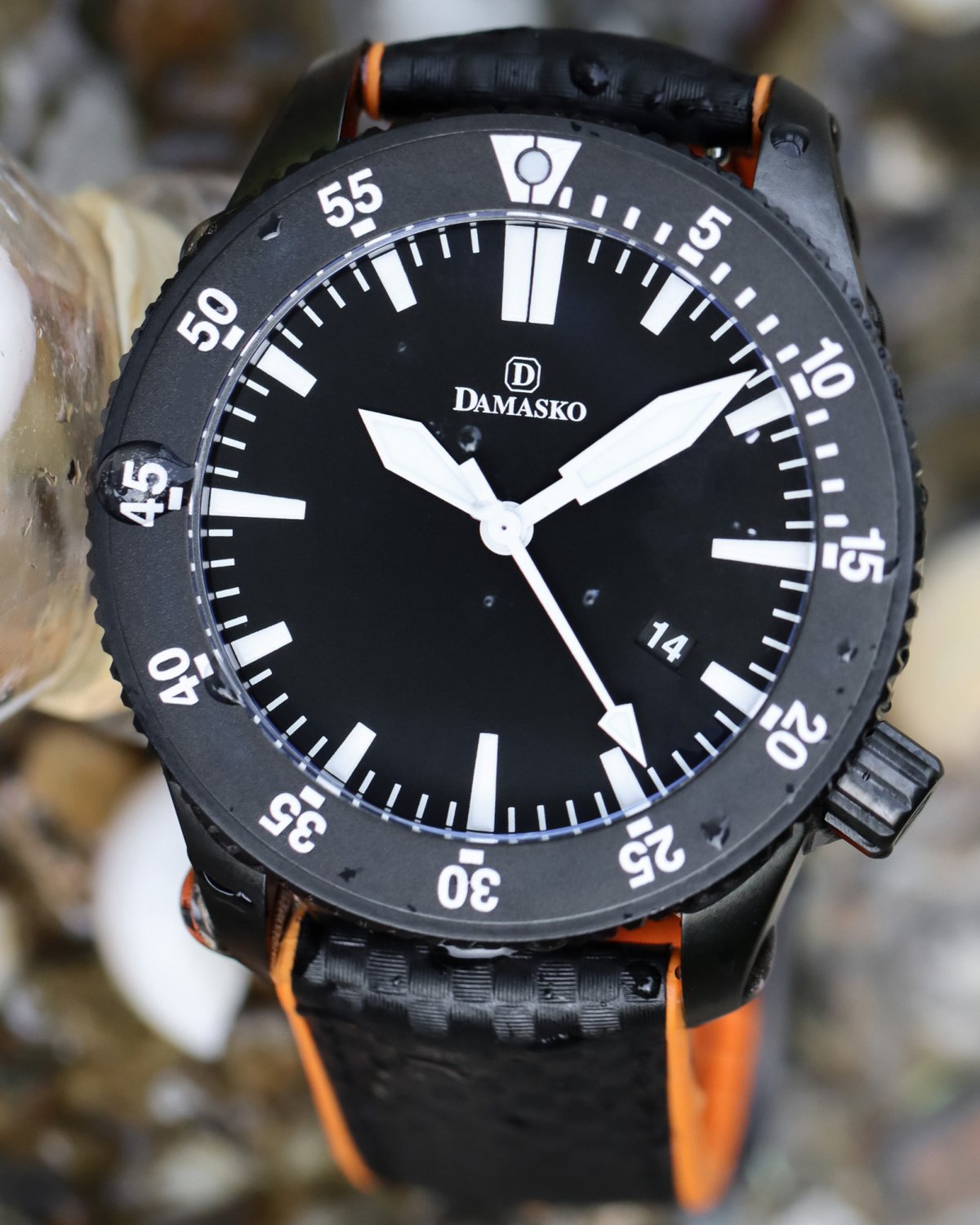
The DFX’s case measures 42mm in diameter, 15.2mm thick, and 50mm lug-to-lug. Those proportions might sound large, but the design is clever: the lugs are short and curved, hugging the wrist snugly. The case is crafted from Damasko’s ice-hardened stainless steel, which feels cool and dense. The brushed finish hides micro-scratches admirably, and the bezel is fixed with a 60-minute scale—a nod to its pilot heritage. The sapphire crystal is double-domed and anti-reflective, ensuring readability in all lighting conditions. Water resistance is 100 meters, making it suitable for swimming but not diving.
Dial and Legibility
The dial is a lesson in clarity. The matte black background is contrasted by bold white Arabic numerals and a minute track. The chronograph subdials—at 6, 9, and 12 o’clock—are recessed and have a subtle sunburst finish that adds depth without distracting. The date window sits at 4:30, a practical position that doesn’t interrupt the symmetry. The hands are shaped like syringes, with a broad base and a sharp tip, filled with Super-LumiNova X1 that glows brightly after dark. The luminescence is strong on the hands and hour markers, though the subdial hands are less luminous—a minor quibble.
Wear Comfort: A Week in the Trenches
I wore the DFX for seven consecutive days, through office work, a business trip, and a weekend hiking. The watch never felt heavy or cumbersome. The weight is well-distributed, and the leather strap, though basic, softened quickly. The pin buckle is secure, but I found myself wishing for a deployant clasp to prevent the strap from pulling. The caseback is flat and slightly recessed, so it doesn’t dig into the wrist. The crown and pushers are knurled and easy to grip, even with gloves. The only issue I encountered was the strap’s lack of quick-release spring bars—swapping to a NATO or rubber strap requires a trip to a jeweler.
Accuracy and Real-World Performance
Over the week, the DFX gained an average of 4 seconds per day. This is consistent and impressive for a mechanical chronograph. The movement’s stability is likely due to the dry lubrication, which reduces positional errors. I tested it dial-up, crown-down, and on the wrist, and the variation never exceeded 5 seconds. For daily wear, you can set it once and forget it for a week. The chronograph function works flawlessly, with a clean start/stop and a smooth reset. The date changes instantly at midnight, a sign of proper alignment.
Versatility: When Does It Shine?
The DFX is not a dress watch, but it’s not purely a sports watch either. Its utilitarian aesthetic allows it to blend into casual and semi-formal settings. Wearing it with a suit is possible—the 42mm case fits under a cuff, and the matte finish doesn’t scream for attention. It’s ideal for travel, as the 100m water resistance and scratch-proof case make it worry-free. For outdoor activities, the hardened steel shrugs off rocks and branches. The DFX is a true all-rounder, though its thickness might deter those who prefer slim watches.
Value and Investment
At a retail price of $4,200, the DFX is positioned in the mid-to-high range for tool watches. Compared to competitors like Sinn or Laco, it offers more in-house technology and durability. The pre-owned market sees prices between $3,500 and $4,500, indicating a stable value. It’s unlikely to appreciate significantly, but it won’t plummet either. For a daily-wear piece that you’ll keep for decades, the DFX is a solid purchase. The service interval is five years, and the cost is around $600 due to the dry lubrication system’s simplicity.
Pros and Cons
- Pros: Scratch-proof case, in-house movement, excellent legibility, comfortable fit, reliable accuracy.
- Cons: Thick profile, basic strap, no display caseback, lume could be brighter on subdials.
Final Verdict
The Damasko DFX is a watch that rewards those who value substance over style. It’s not flashy, but it’s undeniably competent. The engineering is top-notch, the wearability is superb, and it’s built to outlast its owner. If you’re looking for a daily driver that can handle anything life throws at you, the DFX deserves serious consideration. It’s a tool watch that truly works—and that’s the highest praise I can give.