Why the DK3X matters
Most of what reaches this publication sits in the four- and five-figure bracket where the purchase decision is as much about scarcity and status as it is about the object. The Damasko DK3X does not belong in that conversation, and that is exactly why it deserves one. Here is a watch built around a movement the company makes itself, cased in a steel that has been hardened past the point where most manufacturers bother, from a workshop in Bavaria that employs people rather than marketing agencies — and it sells for less than a mid-range Swiss chronograph.
That combination is rarer than it should be. In-house movements at this price point usually mean a heavily modified supplied caliber with a proprietary rotor and a press release. Damasko's movement is its own design, machined and assembled in the same building where the cases are turned. The cost of that vertical integration shows up in a hundred small decisions: the crown system, the sealing arrangement, the surface hardness, the way the case edges hold up after five years of desk bumps. None of them photograph well. All of them matter if you actually wear a watch.
So this review will spend less time on heritage mythology than usual and more on the two things serious collectors ask us about: how the DK3X behaves as a daily object, and what happens to your money when you sell it.
Barbing, Bavaria: the engineering heritage
Konrad Damasko founded the company in 1994, but the firm did not begin as a watchmaker. It began as a precision component supplier — machining parts for the aerospace and medical industries, and for a period supplying components to other watch brands. That background is the whole story. When you spend years cutting hardened steels to tolerances measured in microns for industries where failure is not an option, you develop a set of priorities that is fundamentally different from a company that started out assembling cases from a catalogue.
Damasko's first watches arrived in the mid-nineties and immediately leaned on that engineering inheritance: ice-hardened stainless steel cases, a proprietary crown and sealing system, ceramic bezel components, and a refusal to chase fashion. The brand's reputation was built slowly and largely through enthusiast forums rather than retail floors, which explains both its loyal following and its near-total invisibility to the general public.
The move into in-house movements in the early 2010s was the pivotal moment. It transformed Damasko from a company making extremely well-built vessels for other people's engines into a genuine manufacturer. It also raised the stakes: an in-house caliber means the service relationship runs through the factory, and it means the buyer is betting on one small company's long-term stability rather than on a Swiss movement that any competent watchmaker can overhaul. That is a real consideration and we will come back to it.
Case, dial and the hardening advantage
The DK3X's case is the part you cannot evaluate from a photograph, which is why so much of the online commentary about Damasko misses the point. The steel is nickel-free and ice-hardened before final machining, producing a surface hardness far beyond conventional 316L stainless. In practical terms this means the case resists the micro-scratches that accumulate on ordinary watches with startling efficiency — the swirl marks, the hairlines along the lug tops, the bright spots where a bracelet has rubbed. A five-year-old Damasko frequently presents better than a two-year-old watch from a more famous brand.
For a collector, this is not a cosmetic nicety. Case condition is one of the largest single drivers of secondary pricing, and a watch whose case holds its crispness is a watch that holds its value. Damasko has essentially built a resale advantage into the metallurgy, even if the brand has never marketed it that way.
The crown system deserves its own sentence. Damasko's design uses a hardened steel tube and a sealing arrangement that operates without the conventional lubrication dependency, which is the component most likely to fail or feel gritty on a watch of this type after a few years of use. It is the kind of detail that never appears in a spec sheet and quietly determines whether you still enjoy wearing something in year six.
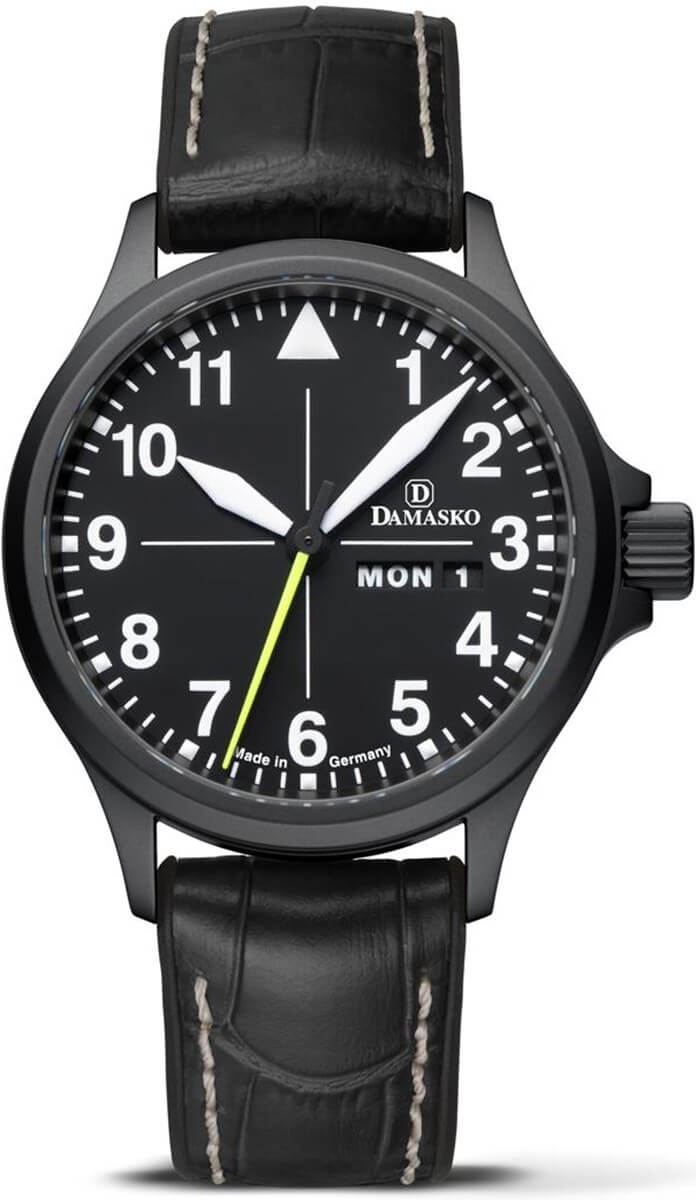
The dial is exactly what it should be: matte, low-reflectance, ruthlessly legible, with high-contrast markers and Super-LumiNova X1 that charges quickly and reads clearly in the dark. There is a date aperture, cleanly executed. There is no decorative text, no applied logo theatre, no guilloché. If you have spent time with German tool watches, it will feel immediately familiar; if you have spent your life with Swiss sports watches, the restraint may take a day or two to appreciate. Sapphire crystal front and back, with anti-reflective coating, completes a package that is entirely functional and entirely consistent.
The movement: in-house, on purpose
The DK3X runs Damasko's own automatic caliber from the A35 family — a four-hertz design beating at 28,800 vibrations per hour with roughly 42 hours of power reserve. Those figures are unremarkable in isolation, and deliberately so. Damasko has not tried to win a specification war. What matters is that the movement is designed, machined and assembled by the same company that makes the case, which means the tolerances and the finishing philosophy are consistent across the whole watch.
The finishing is industrial rather than decorative. Bridges are cleanly executed but not angled and polished for a display case; the rotor is functional. This is a movement built to run for decades and be serviced economically, not to be admired under a loupe. Collectors who judge calibers primarily by hand-finishing will find it plain. Collectors who judge them by the integrity of the design — the efficiency of the winding, the stability of the rate, the ease of service — will find it honest and well-considered.
It is not chronometer-certified and Damasko does not claim otherwise. That is a point of honesty rather than a weakness; the brand also produces certified chronographs elsewhere in the range, so the decision here is clearly about keeping the price where it is.
How it actually wears
The DK3X is a compact watch by contemporary standards, and it wears smaller than its nominal dimensions suggest thanks to a case profile that sits low against the wrist and lugs shaped to curve rather than extend. It tucks under a shirt cuff without complaint. On a smaller wrist it reads as a properly proportioned tool watch rather than something borrowed; on a larger wrist it reads as disciplined rather than undersized. This is a versatile geometry, and it is one of the reasons the model works as a genuine one-watch option.
The hardened steel has a slightly cooler, drier tactile quality than conventional stainless, and the whole assembly feels dense in the way well-machined objects do. Weight is not an issue — this is not a heavy watch, and the balance point sits comfortably on the top of the wrist rather than pulling forward. The supplied leather strap is supple out of the box and breaks in quickly; the pin buckle is straightforward and appropriate.
One piece of practical advice: if there is any chance you will want the steel bracelet, order it with the watch. Buying the bracelet separately later is significantly more expensive, and a Damasko sold as a complete set on the secondary market is meaningfully easier to move than one sold on a third-party strap.
Real-world accuracy
Damasko regulates and tests each movement before it leaves Barbing, and owners report watches that run within a handful of seconds a day. Our expectation, based on the caliber family and consistent owner feedback, is a watch that holds somewhere in the range of plus or minus five to ten seconds daily depending on position and wearing habits. Resting it crown-up overnight rather than dial-up will shift the rate by a second or two, which gives you a simple lever to fine-tune performance without opening the case.
This is not chronometer-grade timekeeping and nobody at Damasko pretends it is. It is, however, entirely adequate for daily wear, and the movement is stable — the kind of caliber that settles into a consistent rate rather than drifting unpredictably. If you are the sort of person who resets a mechanical watch once a week and does not think about it again, you will be perfectly content.
The market: what it costs and what it returns
Here is where the DK3X becomes genuinely interesting from an investment-analyst perspective. At retail it is a strong value proposition: an in-house automatic in a hardened case, from an independent manufacturer, at a price where the Swiss competition is still buying movements from third parties. There is no comparable product at this number from any established European brand.
The secondary market tells a different and more nuanced story. Damasko is a small manufacturer with batch-based production, which means the market is never flooded — a genuine positive for price stability. But it is also a brand with limited recognition outside enthusiast circles, a small dealer network, and no meaningful auction presence. The result is a market that is stable rather than strong: watches trade privately, largely between informed buyers on collector forums, at roughly 55 to 70 percent of current retail depending on condition, completeness and whether the original bracelet is included.
Practically, that means the DK3X is not an appreciating asset and should not be bought as one. It is, however, a low-volatility one. Values do not collapse the way they do for fashion-driven micro-brands, because the underlying product is genuinely well made and the supply is naturally constrained. If you buy sensibly — pre-owned, complete, with the bracelet — you can own and wear one for several years and exit at a modest loss that compares favourably with the depreciation on almost anything else in the category.
Our hold-versus-sell judgment is therefore simple. Buyers today are getting a good deal; anyone paying full retail should plan to keep the watch long enough for the ownership experience to justify the spread. There is no auction history to speak of, so do not expect a liquidity event to rescue a bad entry price.
Ownership costs and service
The in-house movement is the DK3X's greatest technical strength and its main ownership complication. Because the caliber is proprietary, service work runs through Damasko in Barbing or an authorized partner rather than your local independent watchmaker. That is not a hardship — the brand is responsive and the factory is the best place for the work — but it does mean planning ahead, particularly for collectors outside Europe.
Damasko does not publish a fixed service tariff, and pricing is quoted on the condition of the individual watch. Budget for the process rather than a number: allow for shipping, insurance and a turnaround measured in weeks rather than days. In exchange you get a movement serviced by the people who designed it, which for a watch of this type is the correct outcome.
Alternatives worth cross-shopping
The most obvious comparison is the Sinn 556 I, which occupies similar territory in German tool-watch design and has stronger brand recognition. It is the safer resale bet, but it uses a supplied movement and lacks Damasko's case hardening; on engineering purity the DK3X wins.
Nomos is the other German independent worth considering, particularly the Club Automat. Nomos has genuine in-house movements and a far stronger design identity, but it competes on aesthetics and Glashütte heritage rather than on durability engineering. If you want a watch that looks beautiful, buy the Nomos. If you want a watch that survives a decade of hard wear without evidence, buy the Damasko.
Stowa offers a similar small-batch German proposition at lower prices with excellent finishing, though the character is softer. Formex occupies the modern micro-brand engineering space with a younger, more design-forward approach. And for buyers who simply want the German tool-watch look at a fraction of the cost, entry-level fliegers from Laco and the better Chinese micro-brands deliver the aesthetic without the metallurgy or the in-house caliber — a reasonable choice if the engineering argument is not what draws you in.
Verdict
The DK3X is the model that justifies Damasko's entire existence. It is a real in-house movement, a case hardened to a standard the Swiss do not match at this price, and a design that will still look correct in twenty years — all delivered by a family-scale manufacturer that has never once tried to sell you a lifestyle.
The trade-off is liquidity. This is not a watch you buy to flip, and the secondary market is thin enough that an impatient seller will take a haircut. Buy it because you want the engineering, treat the depreciation as a cost of ownership, and the DK3X becomes one of the most rational purchases in modern watchmaking.