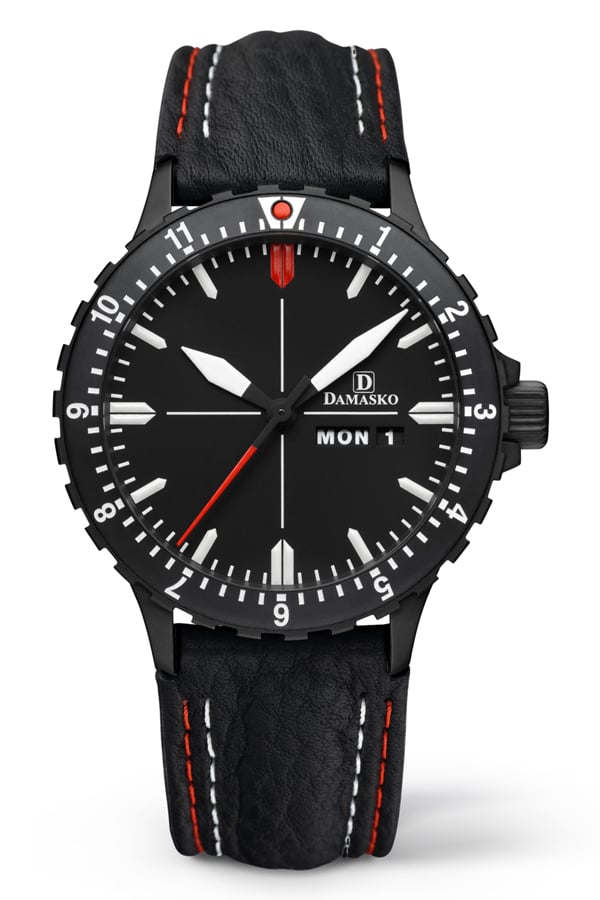
Damasko DK44 Review: The In-House German Tool Watch That Rewards Owners, Not Flippers
Damasko is not a brand that chases trends. It builds watches the way an engineer would: start with the case, harden it, make the movement in-house, and design the dial for legibility before beauty. The DK44, reference SW10361, is one of the clearest expressions of that philosophy. It is a three-hand automatic with a date, a bead-blasted stainless steel case, and a dial that reads instantly in any light. It is also a watch that divides the market: enthusiasts love it, while casual buyers often overlook it because it lacks the obvious luxury signals they expect at this price.
That is precisely why the DK44 deserves a closer look. In a market full of heritage reissues and hyped collaborations, Damasko keeps doing its own thing. The DK44 is not a limited edition, and it is not likely to appear at a major auction house. But for a collector who wants a durable, accurate, in-house automatic that can be worn hard and serviced properly, it is a seriously compelling option. This review breaks down the movement, the case, the wrist feel, the real-world accuracy, and the resale dynamics that matter when you are deciding whether to hold or sell.
Brand History: Precision Before Marketing
Damasko was founded in 1994 by Konrad Damasko in Barbing, Germany. The company began in precision components and built a reputation for hardened steel technology before moving into complete watches. That background matters because Damasko does not buy a generic case and drop a movement into it. It makes its own cases, hardens them in-house, and has developed its own automatic movements. The brand remains family-owned and vertically integrated, which is rare at its price point.
The DK44 sits within Damasko’s DK family, a line defined by in-house movements and a no-nonsense tool-watch aesthetic. It is not the brand’s most famous model—that honor probably goes to the DA series or the DSub dive watches—but it is one of the purest expressions of what Damasko does best. The DK44 is a watch for people who care about how something is made, not just how it looks on Instagram. That has earned the brand a loyal following among pilots, engineers, and collectors who value function over flash.
Movement: The Damasko A35
The DK44 runs Damasko’s in-house automatic caliber A35. It is a 28,800 vph movement with a 42-hour power reserve and a date function. Those are sensible, modern numbers: the frequency is high enough for stable timekeeping, and the power reserve is adequate for a daily wearer that comes off the wrist at night. The A35 is not decorated for exhibition, and it is not COSC-certified. What it offers instead is robustness, serviceability, and the satisfaction of an in-house movement at a price where most brands still rely on modified third-party calibers.
Damasko’s approach to movement design is industrial rather than ornamental. The A35 is built to keep time reliably for years, not to win beauty contests through a sapphire caseback. That is consistent with the rest of the watch. If you are the kind of collector who wants to see Geneva stripes and anglage, this is not the watch for you. If you want a movement that feels engineered for real life, the A35 delivers. The date function is a useful daily complication, and the movement’s architecture is straightforward enough that authorized service should be able to keep it running for decades.
Case, Dial, and Build Quality
The DK44’s case is made from ice-hardened stainless steel, which is one of Damasko’s signature technologies. The hardening process increases surface hardness and improves resistance to scratches and wear. In practice, that means the bead-blasted finish stays looking fresh for longer than a standard brushed case. The sapphire crystal is another practical touch: it resists scratches and keeps the dial legible even after years of daily use. The watch is not overbuilt in the way a dive watch might be, but it is clearly designed to survive real-world conditions.
The dial is pure tool watch. The black surface is matte and non-reflective, and the markers are large and applied for easy reading. The hands are straightforward and legible, with Super-LumiNova X1 providing strong low-light visibility. The date window is positioned at three o’clock and does not disrupt the symmetry too much. There is no unnecessary text, no decorative flourishes, and no attempt to be something it is not. The DK44 knows exactly what it is: a watch you can read at a glance, in any light, without thinking about it.
The leather strap and pin buckle complete the package. The leather is comfortable from the start and suits the tool-watch character, though some owners will prefer to swap it onto a bracelet or a NATO for variety. The pin buckle is simple and secure, and it keeps the overall weight down. This is not a watch that needs a fancy clasp to feel complete.
On the Wrist: Comfort and Balance
The DK44 wears like a proper tool watch. It has enough presence to feel substantial, but it is balanced enough to stay comfortable through a full day. The case sits flat on the wrist, and the lugs are shaped to keep the strap close, so it does not flop around or feel top-heavy. The bead-blasted finish softens the visual weight, which makes it easy to wear with casual clothing. It is not a delicate watch, but it is not a brick either.
One of the DK44’s strengths is that it disappears on the wrist in the best sense. You notice it when you check the time, and then you forget about it. That is exactly what you want from a daily wearer. The crown is easy to grip, the date is legible, and the strap breaks in quickly. For collectors who rotate watches frequently, the DK44 is an easy one to leave on for days at a time. It does not demand attention, but it rewards ownership.
Accuracy: What to Expect Day to Day
Damasko regulates the A35 to a working tolerance, but it is not COSC-certified. In real-world use, expect rates to settle somewhere in the range of plus or minus five to ten seconds per day after break-in. That is respectable for an in-house automatic at this price point. The movement is more about stability and durability than chronometric superlatives, and examples tend to hold their rate well when worn regularly. If you demand certified precision, look elsewhere; if you want a dependable daily rate, the DK44 delivers.
It is worth noting that real-world accuracy depends on how you wear the watch. If it sits on a desk for days at a time, the rate may drift. If you wear it consistently, the A35 will settle into a stable pattern. That is true of most automatics, but it is especially relevant here because the DK44 is designed to be worn. Treat it as a daily companion rather than a safe queen, and it will perform accordingly.
Occasions and Wrist Presence
The DK44 is at home in daily wear, sport, and travel. It is legible enough for formal settings, but it is not a dress watch in the traditional sense. The bead-blasted case and matte dial give it a utilitarian look that works best with casual and smart-casual clothing. It can be worn with a suit, but it will read as a tool watch rather than a formal accessory. That is not a criticism; it is simply a matter of intent.
On the wrist, the DK44 has a presence rating of four out of five. It reads as a purposeful instrument rather than a luxury statement. The bead-blasted case and stark dial give it quiet authority. It is not flashy, but it is confident. For collectors who want a watch that feels engineered rather than styled, that is exactly the right balance.
Market and Investment: The Reality of Damasko Resale
Damasko is a cult brand, and cult brands have thin resale markets. The DK44 is not a watch you buy to flip. Current retail is roughly $3,150 in the U.S., and pre-owned examples typically trade between $2,000 and $2,800 depending on condition, age, and accessories. That is a meaningful depreciation from retail, which is typical for niche German tool watches. The trend is stable rather than appreciating, and there is no major auction history to speak of. Damasko rarely appears at flagship auctions, and the DK44 is not a speculative collectible.
That does not mean the DK44 is a bad value. It means you should buy it with the right expectations. If you find one in the low-$2,000s, you are getting an in-house automatic movement, an ice-hardened case, and a watch that can be worn hard without worry. That is a lot of engineering for the money. The hold recommendation is straightforward: buy it to wear, not to flip. Hold if you bought near the pre-owned range; sell only if you need liquidity or have moved on to a more collectible reference. The buyer pool is knowledgeable, but it is not deep. Do not expect to liquidate quickly at retail.
Variants and Family References
The DK44 is the base reference in this review, with a black dial and a leather strap. Damasko’s DK family includes siblings such as the DK10, DK11, DK12, and DK20. These models share the brand’s in-house movement philosophy and tool-watch aesthetic, but they differ in dial layout, case finishing, and strap options. The DK44 is a strong entry point if you want a central-seconds watch with a date and a clean, legible dial.
Other notable Damasko models include the DA36 and DA38, which are classic flieger-style watches, the DC56 chronograph, and the DSub1 dive watch. Each of these has its own following, but the DK44 occupies a useful middle ground: it is more sophisticated than a basic flieger but less specialized than a dive watch. That versatility is part of its appeal.
Similar Watches and Alternatives
If you are shopping the DK44, you should also consider the Sinn 556 I. It shares the German tool-watch ethos, but it uses a simpler movement and has softer resale. The Archimede Outdoor Automatic is another alternative with comparable legibility and case philosophy at a lower entry point. The Fortis Flieger Classic offers a broader distribution network and easier service, though it lacks Damasko’s in-house movement and hardened case.
For a low-cost alternative, the Laco Augsburg 39 delivers flieger-style legibility and utility for around $400. It is not an homage to the DK44 in the strict sense, but it scratches a similar itch for buyers who want a functional, legible tool watch without the in-house engineering. The trade-off is obvious: you give up the hardened case, the in-house movement, and the long-term serviceability that Damasko offers.
Service and Ownership
Damasko recommends service through authorized channels. That is important because the hardened case and in-house movement require correct handling and parts access. The authorized-only approach protects the watch’s long-term health, but it also means you should factor service logistics into your ownership plan. If you live outside Germany, you may need to ship the watch to an authorized partner. That is a minor inconvenience, but it is worth knowing before you buy.
The good news is that the A35 is a robust movement, and the DK44 is built to go years between services. Treat it well, avoid hard shocks, and keep it away from magnetic fields, and it should provide reliable service for a long time. The leather strap will wear out before the movement does, so plan on replacing it at some point. That is a small cost relative to the watch itself.
Pros and Cons
- Pros: In-house automatic movement; ice-hardened stainless steel case; excellent legibility; strong cult following among enthusiasts.
- Cons: Niche resale market; limited authorized service network; not COSC-certified; thin dealer presence outside Germany.
Final Verdict
The Damasko DK44 is a tool watch for collectors who value engineering over brand theater. It delivers an in-house automatic, a hardened case, and superb legibility in a package that wears comfortably every day. It is not a liquidity play, but as a long-term wearer it makes a compelling case for itself. If you want a watch that rewards ownership rather than speculation, the DK44 deserves a place on your shortlist.