The brief, stated plainly
There is a question every tool watch forces a collector to answer: what are you actually buying? In most cases the honest answer is a design, a story, and a movement supplied by somebody else. Damasko has spent three decades refusing that answer. The DK46, with its fully hardened case and its own automatic caliber, is the firm's most complete rebuttal.
Konrad Damasko's company began as a supplier — machining, hardening, precision components — and that origin still shapes everything it makes. The DK46 reads like a part number rather than a product name, and that is appropriate. It is a watch designed by people who think in tolerances, and it shows in ways both obvious and subtle.
Barbing, and what it means
Damasko was founded in 1994 in Barbing, near Regensburg, and for its first two decades the brand's reputation rested on metallurgy rather than movements. Its cases were hardened to a degree that rivaled — and in some respects exceeded — the surface treatments used by other German tool-watch houses, and its engineering solutions were patented rather than borrowed.
The DK line marked a genuine step change. Rather than buying an ébauche, Damasko developed and produced its own automatic calibers, joining a very small group of independent German manufacturers with that capability. The DK46 is one of the models built around that in-house architecture, which places it in a different category from the brand's outsourced-movement offerings even before you handle it.
What has not changed is the philosophy. Damasko does not produce grand feu enamel, hand-engraved rotors, or dials that shift from green to slate depending on the light. It produces tools, and it produces them with a consistency that larger brands frequently fail to match.
The case: hardened through, not coated over
The most consequential thing about the DK46 is the steel. Damasko's case is ice-hardened throughout its full cross-section rather than being surface-treated, which means a scratch that would leave a bright mark on ordinary stainless steel leaves a mark of the same matte grey as the surrounding metal. The practical effect is remarkable: after years of daily wear, the case develops a mottled, lived-in patina rather than the constellation of bright scars that afflict conventional brushed cases.
The finish itself is bead-blasted to a uniform, light-absorbing grey. There is no polished bevel, no contrasting chamfer, no decorative brushing on the flanks. What you get instead is a set of crisp, precisely machined transitions between planes — the kind of geometry that only comes from proper tooling and tight process control. Running a fingertip around the case reveals no burrs, no soft edges, no evidence of the hand-work that would be necessary to correct a sloppy machining operation.
The crystal is sapphire, with anti-reflective treatment that keeps reflections to a minimum without the milky blue cast that afflicts over-coated crystals. The crown screws down and is protected by subtle integral guards. Everything here is designed to be used rather than admired, and yet the execution is admirable precisely because of that.
The dial: contrast as a discipline
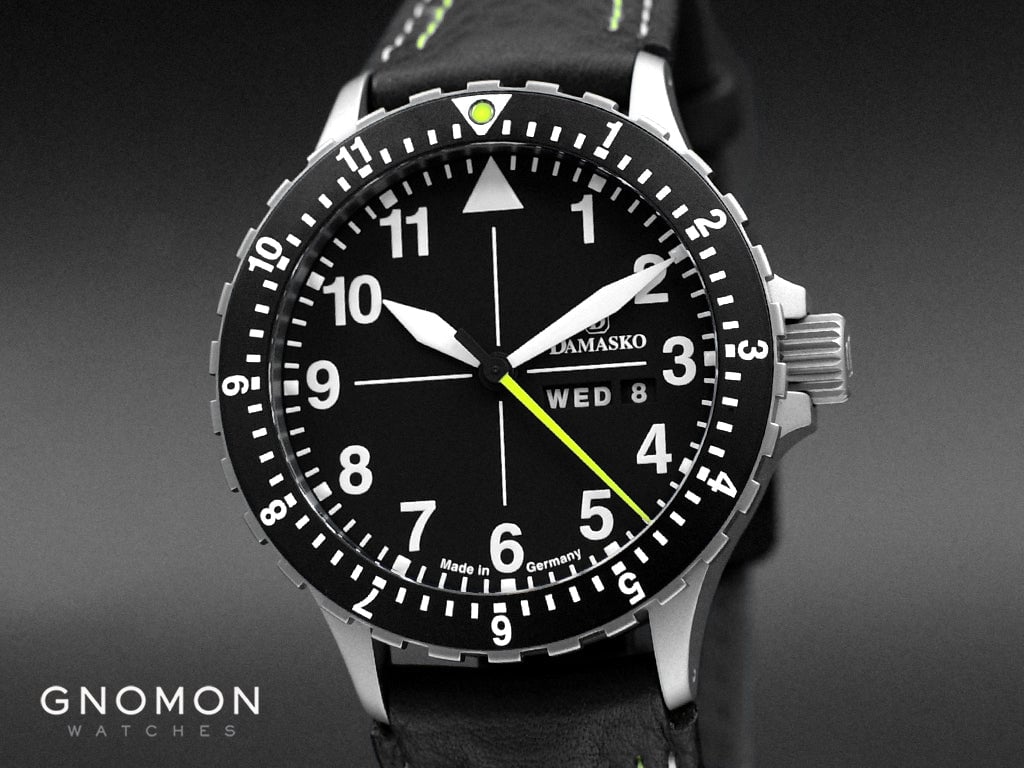
Damasko's dials follow a house template, and the DK46 is no exception: a deep matte black ground that absorbs light rather than reflecting it, applied baton markers, a clean date aperture, and hands with generous luminous fill.
The matte finish is the key detail. Gloss dials photograph beautifully and read poorly; the DK46's surface kills reflections at oblique angles, which is exactly when you need to read it — in a car, on a flight deck, under a workshop lamp. The markers are large enough to be legible at a glance and geometrically simple enough to be unambiguous. The luminous material on the hands and markers is even and bright, with a clean charge that does not need to be coaxed.
There is no texture, no gradient, no applied logo with polished facets. This is a dial designed by someone who considered the readability problem first and stopped when it was solved. For a certain temperament — and I count myself among it — that restraint is more satisfying than any amount of guilloché.
The A26-1: engineering over ornament
The in-house A26-1 is a full-rotor automatic running at 28,800 vibrations per hour with a power reserve of around 42 hours and a date function. Those figures are unremarkable on paper, and that is precisely the point: Damasko is not chasing specifications, it is controlling production.
The architecture is conventional and sensible — bidirectional winding, a robust going train, a hacking seconds for precise setting. The finishing is industrial in the best sense: grained surfaces, straight-grain striping on the bridges, a restrained rotor, and no decorative plating that will tarnish or flake. There is nothing here to satisfy a loupe-and-tweezers collector, and Damasko has never pretended otherwise. What there is instead is the knowledge that the entire movement, from mainplate to balance, came out of a workshop the company controls.
The value of that arrangement is not romantic. It is practical. Independent in-house production means Damasko can specify its own tolerances, regulate each movement to its own standard, and revise the design when a weakness appears. That is a meaningful difference from a brand that buys a finished caliber and adjusts it.
On the wrist
The DK46 sits flat and low against the wrist, with lugs that curve down decisively rather than projecting outward. There is no top-heaviness, no tendency to rotate, and no crown pressure on the back of the hand. The bead-blasted case has a slightly dry, grippy texture that keeps the watch in place on the wrist without needing to be worn tight.
On the supplied leather strap the watch is quiet and unobtrusive, and the pin buckle is exactly as simple as it needs to be. Fitted with Damasko's hardened steel bracelet, the character shifts — the watch gains real mass, the clasp and links feel engineered rather than assembled, and the whole package reads as a piece of equipment rather than an accessory. Both configurations are comfortable; the bracelet version is the more honest expression of what the watch is.
It is worth noting that the case's matte finish makes the watch visually smaller than its physical presence. There is no flash to catch the eye across a room, no polished bevel to glint under office lighting. It disappears under a cuff and reads as an anonymous grey disc on the wrist. Some will find that disappointing. Others will find it the reason to own it.
Rate and reliability
Damasko regulates each A26-1 before dispatch, and the results in the field are consistent with that care. Owners typically report rates within a few seconds per day of zero, with the usual positional variation — a slight gain dial-up, a slight loss crown-down — that can be exploited by resting the watch overnight in a chosen orientation. Over a week of mixed wear, a well-adjusted example should hold within roughly ±5 to ±10 seconds per day, and frequently better.
The movement is not COSC-certified, and Damasko does not market it as such. That is the correct decision: certification adds cost and paperwork without adding much to a watch regulated by the people who built it. What matters is stability, and the A26-1 delivers a rate that is predictable rather than merely accurate on day one.
Ownership, service, and value
Because the caliber is in-house, service should go through Damasko or an authorized partner rather than a generalist watchmaker. That is a limitation, and buyers outside Germany should factor it in. On the other hand, the movement is robust and the case is effectively immune to the cosmetic wear that drives most service decisions, so the practical ownership burden is light.
Financially, the DK46 occupies the usual position for a serious independent: it depreciates from new and then flattens. Buyers who require their watches to hold value should look elsewhere. Buyers who want a hardened-steel case, an in-house German automatic, and a dial that prioritizes legibility over photography will find the DK46 difficult to beat at its price.
Alternatives worth considering
The obvious comparison is Sinn's 856, which uses Tegimented steel and offers a similar German tool-watch brief, though its hardening is a surface process rather than through-hardening. Archimede's Outdoor Protect delivers a comparable concept at a lower price with an outsourced movement. And for those who want a more polished, more expensive interpretation of the same idea, IWC's Mark XX is the natural step up — at roughly three times the money.
Each of those watches is excellent. None of them offers the specific combination of through-hardened steel and an in-house caliber that defines the DK46. That combination is the argument.
Verdict
The DK46 is not a watch that flatters its owner. It is a watch that solves a set of problems — scratch resistance, legibility, mechanical independence, long-term durability — and then stops. In an industry increasingly built on narrative, that restraint is both its limitation and its distinction.
If you want a daily watch you can wear hard for a decade without visible damage, powered by a movement built by the same company that hardened the case, the DK46 is one of the most honest propositions available. If you want a watch that draws comment at dinner, it is not. Damasko would tell you, without any apparent regret, that this is exactly as intended.