The Metallurgical Flex: Why Submarine Steel Matters
In the landscape of luxury watches, we often talk about gold, platinum, and the occasional titanium. But for the collector who actually does things—whether that's sailing the Mediterranean or just navigating the urban jungle—the material of the case is the most important 'spec.' The Damasko DS30 is forged from German Submarine Steel (U-Boot-Stahl). This isn't just a marketing buzzword. This steel is non-magnetic and possesses the highest level of corrosion resistance, originally designed for the hulls of the 212 class submarines of the German Navy.
For the trust-fund collector, this is the ultimate insurance policy. You can bang this against the side of a yacht or a granite countertop, and it simply will not scratch. While your friends are worrying about the 'desk diving' marks on their polished Oyster bracelets, your DS30 remains in mint condition. In terms of resale value, this is a massive advantage. A watch that looks brand new after five years of wear will always command a premium on the secondary market.
Thin is King: The 9.9mm Profile
One of the biggest gripes with modern tool watches is their 'chunkiness.' Many brands think that to be tough, a watch needs to be 14mm thick. Damasko disagrees. The DS30 clocks in at a mere 9.9mm. This is thin enough to qualify as a dress watch by many standards, yet it maintains a 200-meter water resistance. This versatility is where the DS30 wins. It transitions from a morning workout to a high-level board meeting without missing a beat.
The lug-to-lug distance of 48mm ensures that it has enough 'presence' on the wrist to not feel like a vintage piece, but the slimness keeps the center of gravity low. It doesn't wobble. It doesn't snag. It just performs.
The Movement: Reliable, Not Radical
Inside the DS30 beats the Sellita SW200-1. Now, if you're looking for a hand-finished in-house caliber with a tourbillon, look elsewhere. But if you're looking for a movement that can be serviced by any competent watchmaker in Geneva, London, or New York, this is it. Damasko uses the Elabore grade and regulates it in-house. They also incorporate their patented crown system. The crown is not just screwed in; it’s decoupled when screwed down, preventing wear on the gaskets and the movement. It’s also lubricated with a permanent cell, a detail usually reserved for much higher-priced horology.
Market Analysis: Hold or Flip?
Let's talk numbers. The DS30 retails for approximately $1,080. On the pre-owned market, you'll see them moving quickly at the $850 to $950 mark. That is a remarkably low depreciation rate of about 15-20%. Compare that to a mid-tier Swiss brand that might lose 40% the moment you walk out of the boutique.
The DS30 is a 'Strong Hold.' It’s the kind of watch you buy and keep as the baseline of your collection. It’s the 'control' in your horological experiment. Because Damasko produces in limited quantities compared to the giants like Longines or Tissot, the supply-demand curve remains in the collector's favor. There is no 'hype cycle' here to crash; there is only a steady, growing appreciation for German engineering.
The Aesthetic: Minimalist Competence
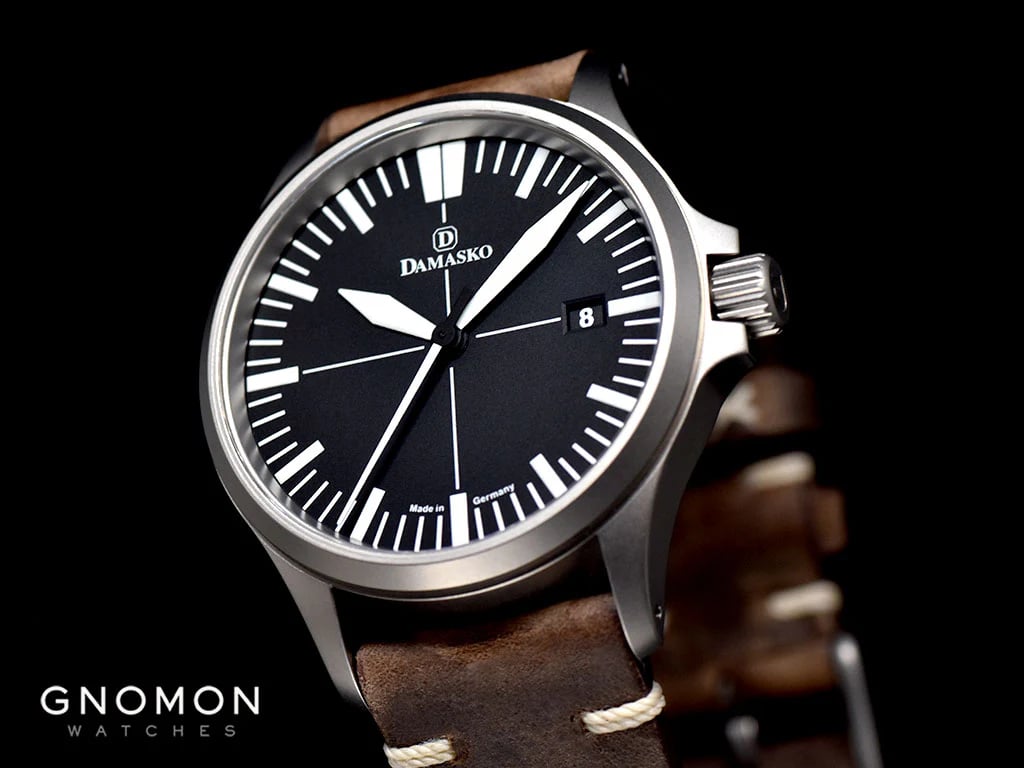
The dial of the DS30 is a lesson in legibility. Crosshair design, bold sword hands, and a date window at 3 o'clock that is actually readable. It takes cues from cockpit instruments, which is Damasko's heritage. There is no 'fauxtina' here, no unnecessary flourishes. It is a pure expression of function. For the young collector, this 'industrial-chic' look pairs perfectly with everything from a Loro Piana cashmere sweater to a technical shell from Arc'teryx.
Conclusion: The Smart Money Choice
In conclusion, the Damasko DS30 isn't just a watch; it's a piece of equipment. It represents a pivot away from the 'look at me' culture of the last decade towards a 'know what I have' philosophy. It's durable, it's thin, and it's built by a family-owned company that cares more about metallurgy than Instagram influencers. If you're building a portfolio, the DS30 is your rock-solid foundation.