The Genesis of a New Aesthetic
To understand the De Bethune DB2, one must first understand the climate of 2002. At the time, the term 'independent watchmaker' was largely synonymous with the AHCI (Académie Horlogère des Créateurs Indépendants). While giants like George Daniels and François-Paul Journe were beginning to capture the imagination of the public, the idea of a 'manufacture' that could produce its own movements, cases, and dials under one roof in the Jura mountains was still revolutionary. Enter Denis Flageollet and David Zanetta. Their goal was not to replicate the past, but to use the tools of the present to perfect it. The DB2 was the first pure expression of this philosophy.
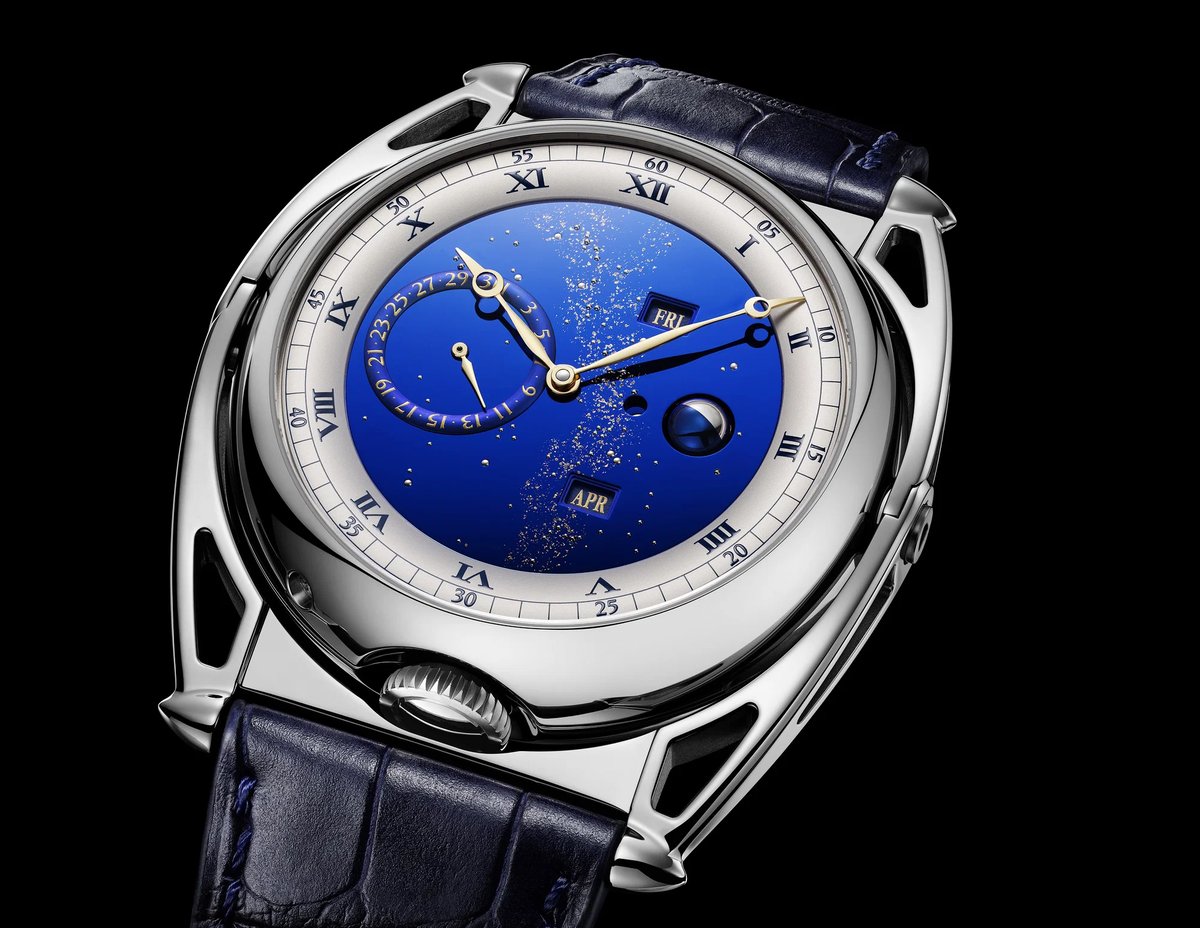
Reference DB2W, rendered in 18k white gold, is the monochromatic purist's choice. While the DB1 was a chronograph—a nod to classical complications—the DB2 was a time-only (with power reserve) vessel designed to showcase the brand's proprietary movement architecture and its radical case design. The most striking feature, and the one that has become the brand's visual signature, is the ogival lug. These lugs are not merely attachments; they are sculptural extensions of the case midsection, tapering to a point that evokes the vaulted ceilings of the great European cathedrals. In the DB2, these lugs are fixed, providing a rigid, architectural frame for the dial.
Movement Architecture: Caliber DB2002
The heart of the DB2W is the Caliber DB2002. This was a significant milestone for De Bethune, as it represented their first fully in-house manual-wind movement. At a time when many independents were still modifying ETA or Valjoux ebauches, Flageollet was designing a movement from the ground up with a focus on chronometric stability and long-term power delivery. The DB2002 features a twin-barrel system that provides a staggering 144 hours (six days) of power reserve. This is not just about convenience; by using two barrels, the movement can deliver a more constant torque to the escapement, reducing the drop-off in amplitude as the power reserve depletes.
The finishing of the DB2002 is a masterclass in the 'De Bethune style.' The bridges are fashioned into a central delta shape, a motif that would later evolve into the 'starship' bridges of the DB28. These bridges are decorated with Côtes De Bethune—a refined variation of Côtes de Genève characterized by much finer, more densely packed lines. The edges of the bridges are hand-beveled (anglage) to a mirror shine, a process known as 'bercé' polishing. This creates a play of light that contrasts beautifully with the brushed surfaces of the movement plates. Furthermore, the movement features a titanium and platinum balance wheel, an early example of Flageollet’s obsession with optimizing the mass and aerodynamic properties of the regulating organ.
The Dial: A Study in Depth and Texture
The dial of the DB2W is deceptive in its simplicity. At first glance, it appears to be a standard silvered dial with Roman numerals. However, closer inspection reveals a complex multi-part construction. The central portion features a deep, hand-engraved guilloché pattern that radiates from the center, creating a sense of movement and depth. This is surrounded by a raised chapter ring for the hours, which in turn is framed by a peripheral railway track for the minutes. The hands are flame-blued by hand, a process that requires immense skill to ensure a perfectly uniform deep azure hue across the entire surface.
The power reserve indicator is cleverly integrated, often found on the movement side or via a subtle aperture, allowing the dial to remain uncluttered and focused on symmetry. The use of white gold for the case provides a cold, technical brilliance that complements the silver and blue tones of the dial. It is an exercise in tonal harmony, eschewing the flashiness of yellow or rose gold in favor of a more intellectual, 'stealth-wealth' appeal.
On the Wrist: Ergonomics and Presence
On the wrist, the DB2W is a study in contradictions. It is 42mm, which by 2002 standards was quite large for a dress watch, yet it feels remarkably slim at 11mm thick. The fixed ogival lugs are the defining factor of the wearing experience. Because they curve so sharply downward, the effective lug-to-lug distance is minimized, allowing the watch to sit centered on the wrist without the 'overhang' often associated with 42mm cases. The weight of the 18k white gold is substantial, giving the watch a 'hearth-like' warmth on the skin that titanium models lack.
There is a certain gravity to wearing an early De Bethune. It does not shout for attention with a loud dial or a bulky case. Instead, it commands the room through the sheer quality of its construction. It is a watch for the collector who has moved past the need for brand recognition and is now seeking mechanical and aesthetic purity. It pairs as easily with a charcoal Savile Row suit as it does with a cashmere sweater, though its 30m water resistance and precious metal construction certainly keep it within the realm of 'dry' activities.
The Collector’s Verdict
In the secondary market, the DB2 has seen a significant resurgence. For years, these early models were overshadowed by the more radical DB28 and DB27 models. However, as the market for independent watchmaking has matured, collectors have begun to look back at the 'foundational' pieces of the great modern houses. The DB2 is to De Bethune what the Chronomètre Souverain is to F.P. Journe—a pure distillation of the founder’s vision.
The DB2W, in particular, is highly sought after for its versatility and its role as a bridge between the classical and the contemporary. It is a watch that will never look dated because its design is rooted in architectural principles that are centuries old, yet its execution is undeniably modern. For the sophisticated young collector, the DB2W represents more than just a timepiece; it is a piece of horological history, a testament to what can be achieved when a master watchmaker is given the freedom to innovate without compromise.
In conclusion, the De Bethune DB2 reference DB2W is a triumph of horological engineering and aesthetic design. It offers a level of movement finishing and technical innovation that puts many of the 'Big Three' to shame, all while maintaining a unique visual identity that is instantly recognizable to those in the know. It is, quite simply, one of the most important watches of the early 21st century.