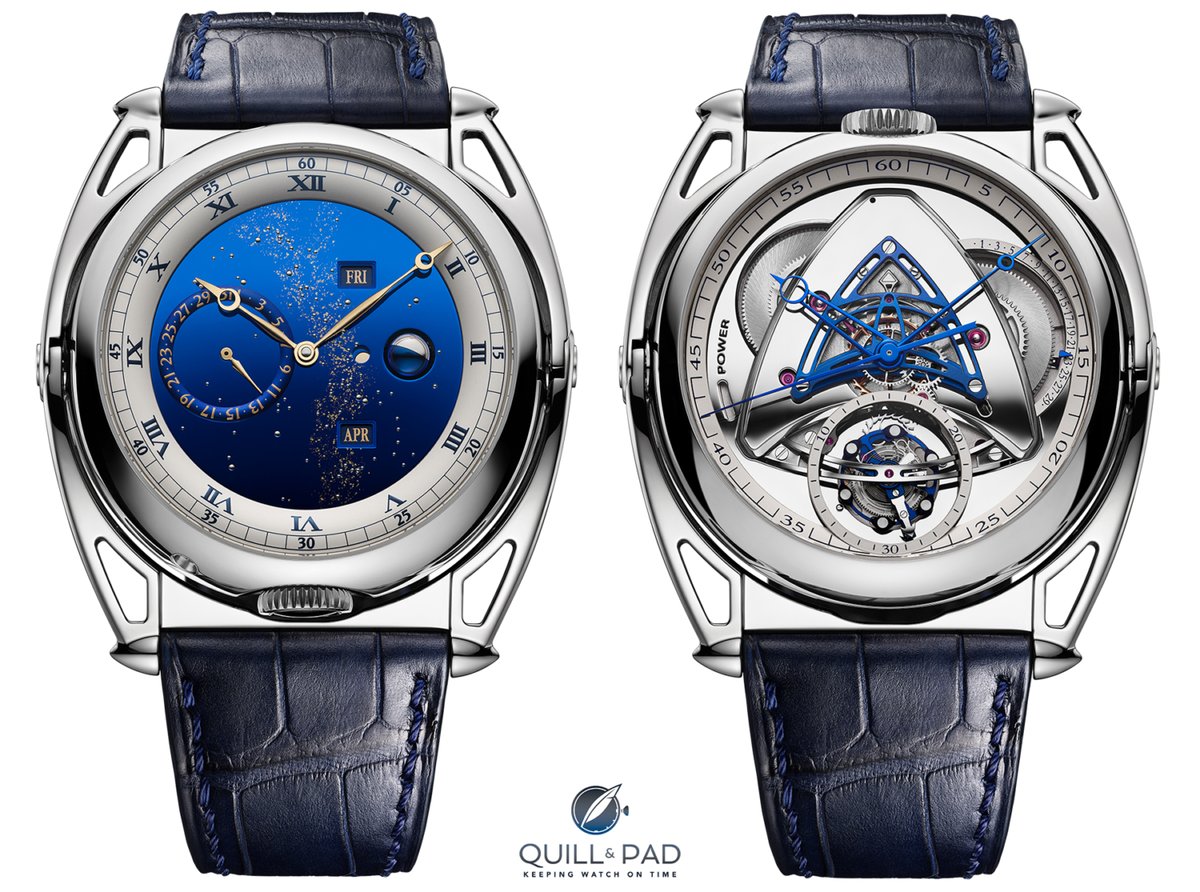
The Genesis of a Giant: Why the DB3 Matters
In the world of high-stakes horology, the term 'independent' is often thrown around with reckless abandon. But to understand the true weight of that word, one must look at the early 2000s—a period where the industry was waking up from its post-quartz slumber and beginning to experiment with the very definition of a 'luxury watch.' It was in this crucible that De Bethune was born. While brands like Richard Mille were pushing the boundaries of material science and marketing, Denis Flageollet was doing something far more subversive: he was reinventing the classical watch from the inside out.
The DB3, the third reference released by the manufacture, is the purest expression of this early philosophy. It doesn't have the silicon hairsprings or the triple-parachute shock-absorbing systems that would later define the brand's 'Star Trek' era. Instead, it offers a refined, almost poetic take on the monopusher chronograph. For the analyst, this is the 'Series 1' of the De Bethune world. Just as collectors scramble for early F.P. Journe pieces with brass movements, the market is currently waking up to the rarity and significance of the DB3.
Design Language: The Architecture of the Ogival Lug
If you want to spot a De Bethune from across a room at the Hôtel des Bergues, you look for the lugs. The DB3 features the 'ogival' or bullet-shaped lugs that have since become a hallmark of the brand's more classical collections (like the DB25). These are fixed lugs, unlike the articulated floating lugs found on the DB28, but they serve the same purpose: creating a silhouette that is entirely unique in a sea of Oyster cases and Calatravas.
The case, measuring a perfect 40mm, is a study in curves. There isn't a sharp angle to be found. The crown, which houses the monopusher for the chronograph, is oversized and tactile, a nod to the vintage stopwatches that inspired Flageollet. The dial is where the wealthy collector aesthetic really shines. It's usually finished with a deep, hand-turned guilloché pattern that catches the light in a way that suggests old money and quiet evenings in Gstaad. The blued steel hands—a De Bethune signature—are flame-blued to a specific shade of cobalt that is nearly impossible to replicate by machine.
The Engine: Caliber DB 2001
Under the hood of the DB3 lies the Caliber DB 2001. Now, for the technical purists, it’s important to note that this is not a ground-up in-house caliber in the way the DB 2115 is. Instead, it is a 'manufacture-modified' movement based on the legendary Lemania 2310 architecture. But to call it a 'base' movement is like calling a Singer Porsche a 'base' 911. Flageollet took the bones of the Lemania—the same movement that powered the Patek 5070 and the Omega Speedmaster—and elevated it to a level of finishing that is frankly startling.
The bridges are reshaped, the polishing is done by hand to a mirror finish, and the monopusher integration is seamless. It operates at 21,600 vph, a slower, more deliberate beat that feels appropriate for a watch of this stature. When you engage the chronograph, the click is tactile and mechanical, a far cry from the mushy feel of a mass-produced Valjoux. This is a movement built for the connoisseur who wants to see the soul of the machine through the sapphire caseback.
Market Analysis: The Investment Thesis
Let’s talk numbers, because at Vivir.com, we know that a watch is an asset as much as it is an accessory. Five years ago, you could pick up a DB3 in white gold for roughly $25,000 to $30,000. They were the 'forgotten' De Bethunes, overshadowed by the more aggressive DB28. That has changed. Following the acquisition of a majority stake in De Bethune by WatchBox (now 1916 Company), the brand has seen a massive surge in global visibility.
The result? The secondary market for early pieces has exploded. We are currently seeing DB3s trade in the $65,000 to $95,000 range, with rare dial configurations or platinum cases occasionally pushing toward the six-figure mark. Why the surge? It’s a supply and demand play. It is estimated that De Bethune produces fewer than 200-300 watches per year *today*. In the early 2000s, those numbers were significantly lower. There are likely fewer than 100 DB3s in existence for each metal. In a world where Rolex produces a million watches a year, the DB3 is true scarcity.
From a portfolio perspective, the DB3 is a 'Hold.' We are seeing a generational shift where younger collectors are moving away from the 'hype' brands and toward 'intellectual' watchmaking. De Bethune is the poster child for this movement. As the brand continues to grow and its modern pieces become even harder to obtain, these early foundational models will act as the 'Blue Chips' of the independent world.
The Wrist Experience: More Than Just a Flex
Wearing a DB3 is a different experience than wearing a Royal Oak. It doesn't announce itself with the glint of integrated steel. Instead, it’s a slow burn. The 40mm size is the 'Goldilocks' zone for luxury watches—large enough to have presence, small enough to remain elegant. The weight of the gold case is balanced perfectly by the ogival lugs, which wrap around the wrist and keep the watch centered.
The dial legibility is surprisingly good for a chronograph, thanks to the high contrast between the blued hands and the silvered dial. But let’s be honest: you aren't buying this to time your laps at the Nürburgring. You’re buying it because when you’re sitting in a board meeting or a gallery opening, you want the person across from you to know that you didn’t just walk into a boutique and buy what the salesperson told you to. You did the research. You found the DB3.
Final Verdict: The Alpha Move
Is the De Bethune DB3 for everyone? Absolutely not. If you need 100 meters of water resistance and a luminescent dial to feel secure, look elsewhere. But if you are a collector who views horology as an art form and a store of value, the DB3 is one of the most compelling propositions on the market today. It represents the dawn of a manufacture that has since become a legend. It offers a level of hand-finishing that puts the big Swiss 'Maisons' to shame. And most importantly, it is an asset that is currently on an upward trajectory with no sign of slowing down. In the game of horological chess, the DB3 is the ultimate alpha move.