The Dawn of the L'Auberson Alchemists
To understand the De Bethune DB5, one must first understand the landscape of horology in 2002. The industry was at a crossroads. The Quartz Crisis was a fading memory, and the mechanical renaissance was in full swing, but it was a renaissance largely defined by the past. Brands were looking at their archives, dusting off mid-century designs, and playing it safe. Then came Denis Flageollet and David Zanetta. They didn't just want to make watches; they wanted to redefine the physics of timekeeping.
Operating out of L'Auberson, a remote village in the Swiss Jura, De Bethune was founded on a paradox: the belief that watchmaking is a living art that must innovate, rather than a museum piece to be preserved. The DB5 was one of the earliest expressions of this philosophy. While it looks more 'traditional' than the sapphire-clad spaceships the brand produces today, it contains the DNA of every innovation that would follow. It was the first step in a journey toward the perfect watch.
Aesthetics: The Power of the Ogival Lug
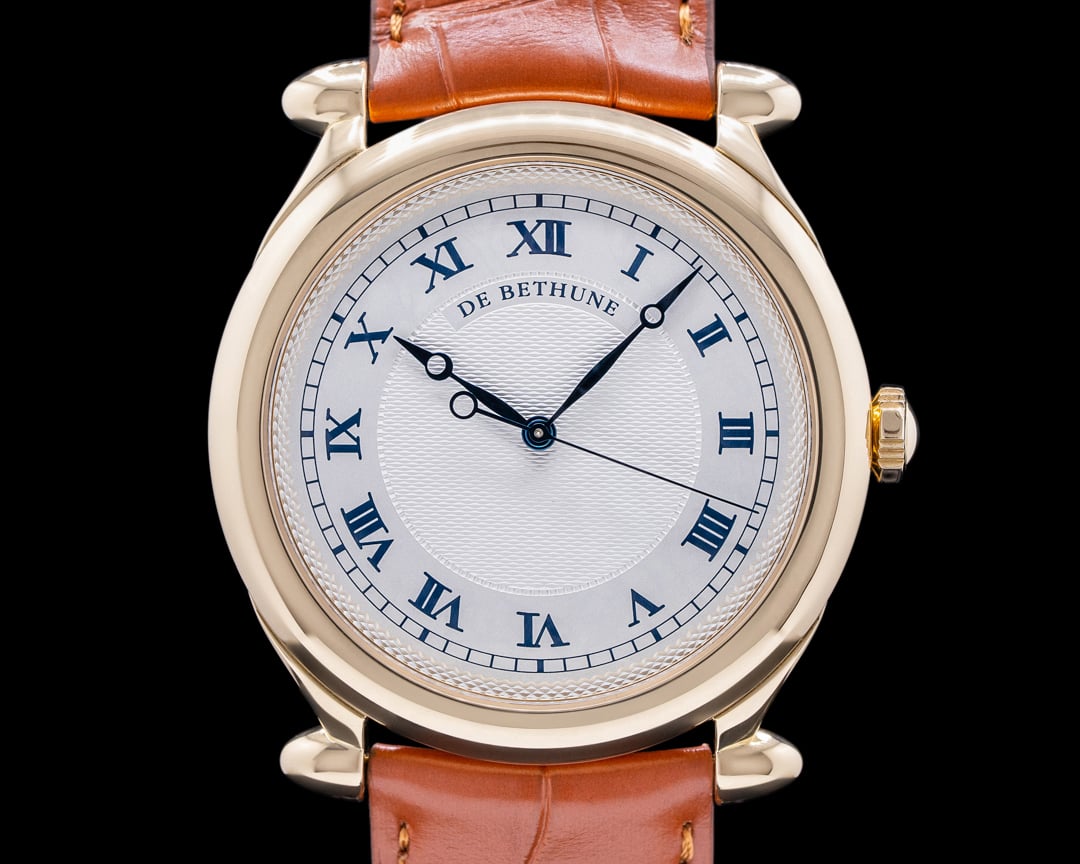
The most striking feature of the DB5—and the element that makes it instantly recognizable to any serious collector—is the ogival lugs. These bullet-shaped protrusions are a masterstroke of design. They evoke the streamlined aesthetics of the Art Deco movement and the aerodynamic curves of 1950s aerospace engineering. In the DB5, these lugs are integrated into a perfectly round case, creating a silhouette that is both muscular and graceful.
The dial is a further testament to the brand's obsession with detail. Featuring a central guilloché pattern that radiates outward, it creates a sense of depth and movement. The hands are flame-blued steel, a process that requires immense skill to achieve a uniform, deep azure hue. The contrast between the warm rose gold of the case and the electric blue of the hands is a signature De Bethune trope that remains a favorite among the brand's cult following. This isn't just a dial; it's a landscape of textures and tones.
The Engine: Caliber DB2002
Beneath the surface lies the Caliber DB2002. In an era where many 'independents' were still using modified ETA or Lemania movements, De Bethune was already pushing the boundaries of in-house manufacturing. The DB2002 is a manual-wind movement that offers a staggering 144-hour (6-day) power reserve. This is achieved through a self-regulating twin barrel system that ensures a constant flow of energy to the escapement, improving accuracy over the entire duration of the wind.
But the real magic is in the balance wheel. Flageollet is obsessed with the heart of the watch. The DB5 features a titanium and platinum balance wheel, designed to minimize the effects of temperature changes and maximize aerodynamic efficiency. The finishing is equally impressive, with hand-polished bevels and mirror-polished steel parts that catch the light in a way that mass-produced movements simply cannot. It is a movement built for the long haul, designed to be as reliable as it is beautiful.
On the Wrist: The Rina Park Perspective
Wearing a DB5 is a different experience than wearing a Patek or a Vacheron. There is a sense of rebellion attached to it. When I strap the DB5 on, I’m not just wearing a status symbol; I’m wearing a piece of intellectual property. It’s the watch I wear to Art Basel or a private dinner in Tribeca—places where 'loud' luxury is frowned upon, but 'smart' luxury is the ultimate currency. At 42mm, it has presence, but because it is so thin, it slips under a silk cuff with ease.
The way the light plays off the ogival lugs is addictive. In the midday sun, they look like polished chrome; in the low light of a cocktail bar, they take on a darker, more mysterious character. It is a watch that demands a second look. It doesn't scream for attention, but it holds it once captured. For the young collector who wants to signal that they know their history but aren't beholden to it, the DB5 is the ultimate flex.
The Market and Investment Reality
For years, De Bethune was the industry's best-kept secret. You could find early DB models at auction for a fraction of their original retail price. Those days are over. Since the brand was acquired by WatchBox, the secondary market has been set ablaze. Collectors have realized that the production numbers for early pieces like the DB5 are incredibly low—often estimated in the dozens rather than the hundreds.
The DB5 is currently in a 'sweet spot' of appreciation. It hasn't yet reached the astronomical heights of the DB28 'Kind of Blue' or the Starry Varius, but its trajectory is clear. As more collectors pivot away from the 'hype' steel sports watches and toward high-art independent horology, the DB5 stands as a foundational piece. It is an investment in both capital and culture.
Final Verdict
The De Bethune DB5 is more than just a watch; it is a bridge between two worlds. It honors the traditions of the past while boldly claiming the future. If you are lucky enough to find one on the market, do not hesitate. It is a rare opportunity to own a piece of the legend that Denis Flageollet is still writing today. It is, quite simply, the genesis of cool.