The Audacity of the Golden Orange
In the hierarchy of horological 'flexes,' there is the obvious—the iced-out Nautilus, the Rainbow Daytona—and then there is the intellectual. The Doxa SUB 200 T.GRAPH in 18k solid gold (ref. 805.10.351.10) falls squarely into the latter category. It is a watch that, at first glance, seems like a contradiction in terms. Why would a brand synonymous with the grit of saturation diving and the utilitarian needs of the US Navy Sea Lab project produce a watch made of 18k yellow gold? The answer lies in the celebration of an icon.
To understand this watch, you have to understand 1969. This was the year Doxa released the original T.GRAPH, a manual-wind chronograph that became a cult favorite among professional divers. Fast forward to 2019, and Doxa decided to celebrate that 50th anniversary by doing something truly insane: they cased 13 original, New Old Stock Valjoux 7734 movements into solid gold cases. This isn't a 'tribute' movement; it is the movement from the era, preserved in amber, now wrapped in precious metal.
Design Language: The Cushion and the Table
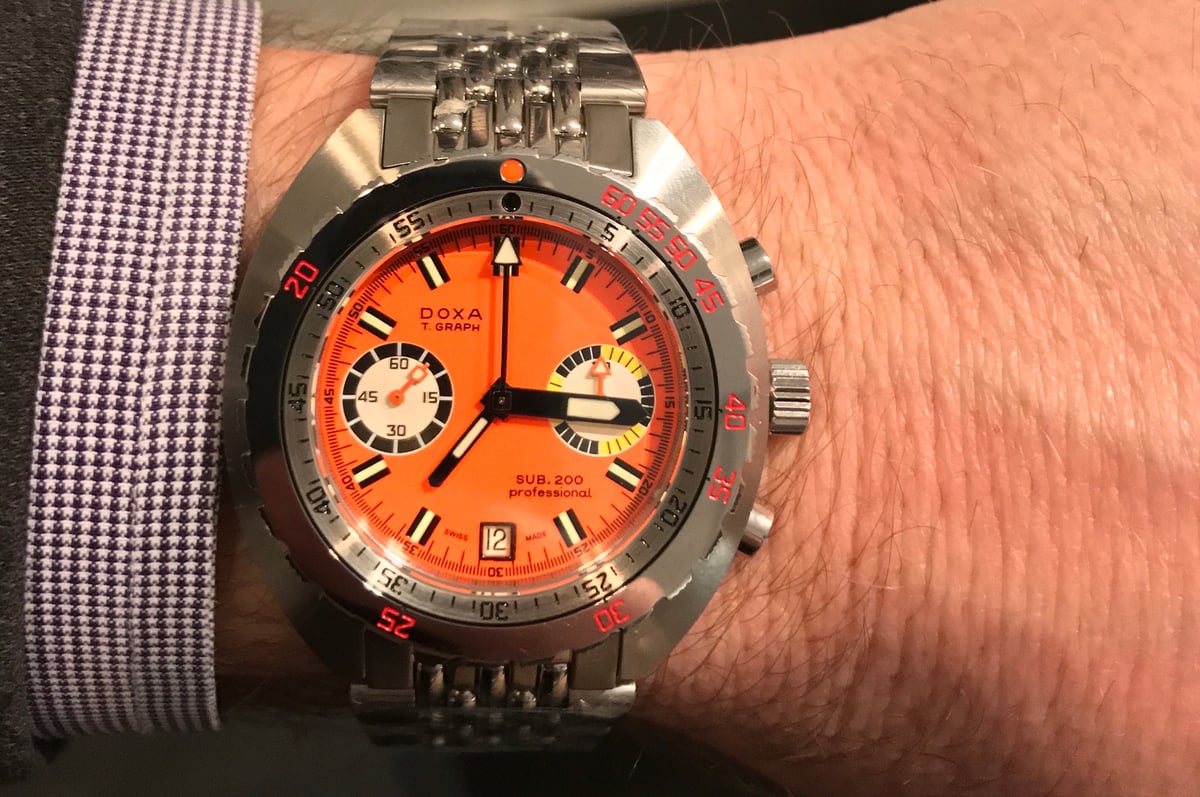
The silhouette of the T.GRAPH is unmistakable. The 43mm cushion case is a hallmark of late-60s design, intended to protect the crown and provide a stable platform on the wrist. In 18k gold, the facets of this case take on a new life. The brushing on the top surface contrasts with the high-polish sides, creating a play of light that you simply don't get with the standard stainless steel models. It is bulky, yes, but it is a purposeful bulk.
Then there is the bezel. Doxa’s patented non-decompression dive table bezel is rendered here in gold, with its dual scales (depth in feet on the outer ring, time on the inner ring) filled with black and orange paint. It remains fully functional, a nod to the watch's origins, even if the closest this particular reference gets to the water is the edge of an infinity pool in St. Barts. The dial is the classic 'Professional' orange—a color Doxa pioneered because it was the most visible hue in murky water. Against the yellow gold of the case, the orange pops with an intensity that is both retro and incredibly modern.
The Heart of the Beast: Valjoux 7734
For the movement nerds, this is where the T.GRAPH 18k justifies its $70,000 price tag. The Valjoux 7734 is a legendary cam-lever chronograph movement. It was the workhorse of the industry in the late 60s and early 70s, found in everything from Breitlings to Tudors. However, finding 13 examples that had never been used, perfectly preserved for half a century, is a feat of horological archaeology.
Winding the watch is a tactile journey. The resistance of the mainspring, the mechanical 'click' of the chronograph pushers—it feels different than a modern vertical clutch movement. It feels mechanical, raw, and historic. Because it is a manual wind, there is no rotor to obscure the view of the movement, though Doxa opted for a solid gold caseback on this reference, keeping the 'NOS' secret tucked away against the skin. It’s a choice that emphasizes the watch as a tool for the wearer, not a display piece for the public.
Wrist Presence and Cultural Context
On the wrist, the T.GRAPH Gold is a conversation starter. In an era where 'quiet luxury' is the buzzword, this watch is a loud, joyful shout. It speaks to a specific type of collector—one who is bored with the standard 'hype' watches and wants something with genuine soul. We’ve seen a shift in the market where athletes and artists are moving away from the standard-issue luxury pieces and toward watches with 'story.' The T.GRAPH has story in spades.
Imagine this paired with a linen suit in Monaco or a simple black tee at a gallery opening in SoHo. It bridges the gap between the ruggedness of a diver and the refinement of a high-end complication. The 'Beads of Rice' bracelet is the secret weapon here. Often imitated but rarely perfected, the Doxa version in solid gold is remarkably comfortable. The small links move independently, conforming to the wrist and distributing the significant weight of the gold case evenly.
The Investment Case
Let’s talk numbers. With only 13 pieces made, the scarcity is higher than almost any modern Patek or Rolex production piece. While Doxa doesn't typically command the same secondary market fever as the 'Big Three,' the T.GRAPH 18k is an outlier. It is a 'destination' watch for Doxa enthusiasts. As the brand continues its upward trajectory under new leadership and expands its global footprint, these ultra-limited anniversary pieces are likely to become the grails of the next generation of collectors.
The MSRP of $70,000 was a shock to the system for many Doxa fans used to the $2,000 price point of the SUB 300. But when you factor in the weight of the gold, the rarity of the NOS movement, and the sheer exclusivity of the production run, the value proposition begins to make sense. You aren't just buying a watch; you're buying a piece of 1969, reimagined for the modern elite.
Final Verdict
The Doxa SUB 200 T.GRAPH (ref. 805.10.351.10) is a brilliant piece of madness. It is a watch that shouldn't exist, yet it does, and the world of horology is better for it. It honors the brand's professional diving heritage while embracing the reality of the modern luxury market. If you are a collector who values provenance, rarity, and a bold aesthetic, there is quite simply nothing else like it. It is the golden child of the deep sea.