The Philosophy of Invisibility
In the lexicon of horology, the term 'Chronomètre' carries the weight of historical precision, dating back to the marine clocks of Harrison and Le Roy. However, the addition of 'Furtif'—French for stealthy—creates a fascinating paradox. How can a precision instrument, designed to communicate time with absolute clarity, be stealthy? François-Paul Journe answers this by decoupling the objective measurement of time from its subjective display. The Chronomètre Furtif (Ref. CF) is a watch that measures time with chronometric rigor but only shares that information when the wearer chooses to engage with the light.
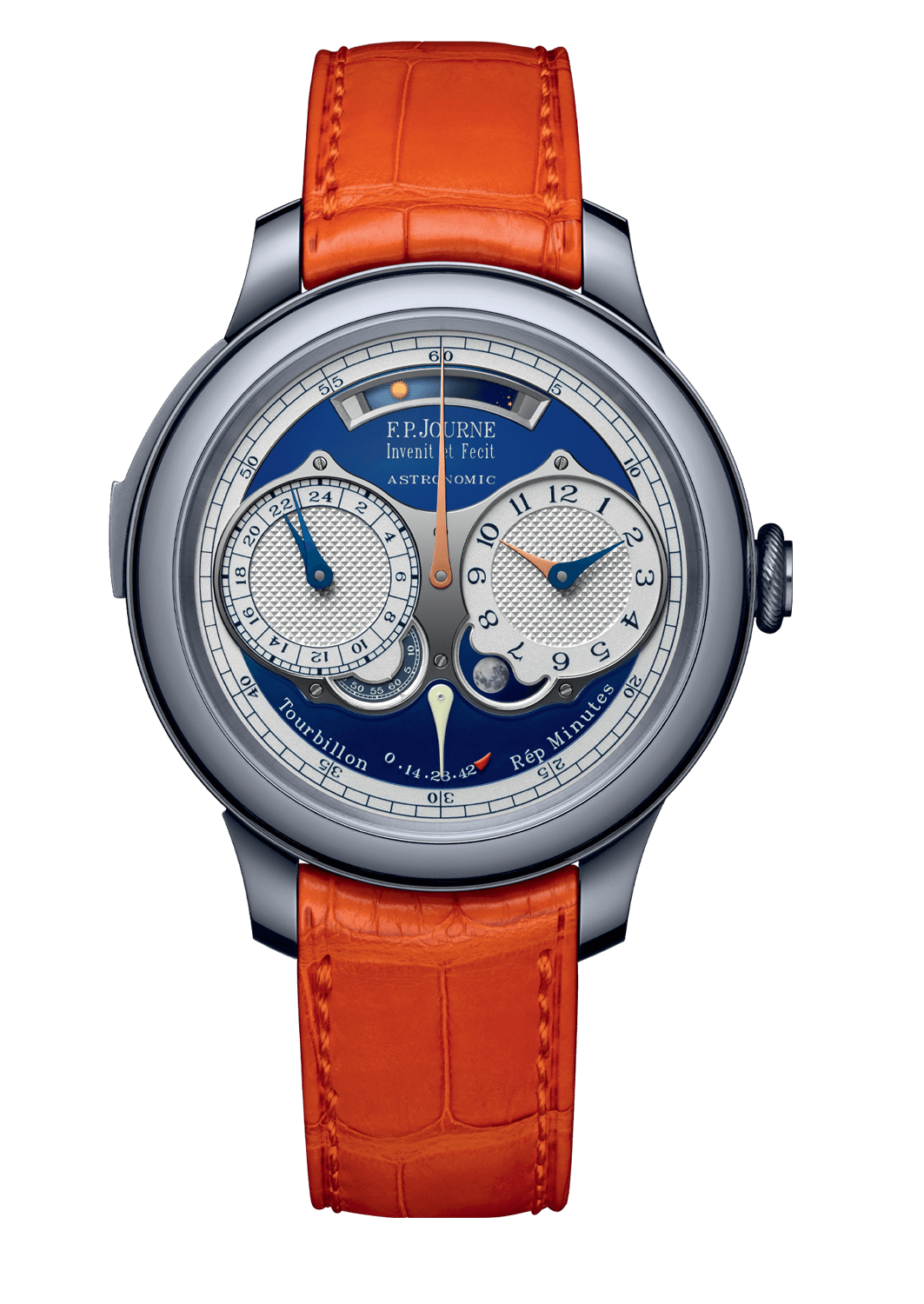
This release follows the lineage of the Chronomètre Bleu but elevates the concept through the use of Grand Feu enamel. Unlike the lacquered dial of the Bleu, the Furtif’s dial is a matte blue enamel. The numerals are not printed in the traditional sense; they are integrated into the enamel in such a way that they remain invisible at most angles. It is only when the sapphire crystal catches the light at a specific inclination that the numerals appear, shimmering like a ghost in the machine. This is horological poetry at its most technical.
Metallurgy: The Tantalum Challenge
The choice of Tantalum for the case material is a deliberate nod to the connoisseur. Tantalum, with the atomic number 73, is a rare transition metal known for its extreme resistance to corrosion and its high density. It is also notoriously difficult to work with. It is highly ductile yet possesses a melting point of over 3,000 degrees Celsius. In the workshop, Tantalum destroys tools; it requires specialized lubricants and a slower machining process than gold or steel.
The result is a case that possesses a unique, dark grey-blue luster. Unlike titanium, which can feel 'light' or 'cheap' to those accustomed to precious metals, Tantalum has a weight comparable to platinum. This gives the Furtif a gravity that matches its mechanical importance. The 42mm case is finished with a high polish that highlights the metal's natural blue undertones, creating a perfect aesthetic synergy with the blue enamel dial. At 9.5mm thick, it maintains the elegant, slim profile that has become a hallmark of the Journe manufacture.
The Calibre 1522: A Golden Architecture
While the dial of the Furtif plays a game of hide-and-seek, the movement is a transparent display of excellence. The Calibre 1522 is a manual-wind movement constructed entirely from 18k rose gold. This is a signature of F.P. Journe that remains unrivaled in the industry. Gold is a difficult material for movement plates; it is soft and requires immense skill to finish without marking the surface.
The architecture of the 1522 is centered around the pursuit of chronometric stability. It features a free-sprung balance with four timing weights, vibrating at 21,600 beats per hour. This frequency is a deliberate choice, echoing the slow, steady beat of classical pocket watches while providing the inertia necessary for daily wear. The finishing is exemplary: circular graining on the baseplate, circular Côtes de Genève on the bridges, and hand-polished chamfers on every edge. Each screw head is polished to a mirror finish, and the slots are chamfered with surgical precision.
Interestingly, Journe has moved the moon phase and the power reserve indicator to the back of the watch. By placing these complications on the movement side, he preserves the purity of the 'furtive' dial. The moon phase is particularly impressive, executed with a gold moon against a starry sky, and it remains accurate for 122 years. The power reserve indicator provides a 56-hour countdown, ensuring the wearer knows exactly when to engage the crown.
Chronometric Performance and Wrist Experience
On the timing machine, the Chronomètre Furtif demonstrates why Journe is a master of his craft. The movement is adjusted in six positions, a standard that exceeds the five positions required for COSC. The torque delivery from the mainspring is remarkably linear, ensuring that the amplitude of the balance remains stable throughout the majority of the 56-hour power reserve. This results in a watch that maintains its accuracy whether it is fully wound or nearing the end of its cycle.
Wearing the Furtif is a lesson in tactile luxury. The weight of the Tantalum provides a constant, comforting presence. The dial, which often looks like a solid, matte blue disc, invites the wearer to tilt their wrist, searching for the light. This interaction turns the simple act of checking the time into a ritual. It is not a watch for someone who wants to be asked 'What are you wearing?' across a dinner table. It is a watch for the individual who finds satisfaction in the hidden details—the way the gold bridges glow through the caseback, or the way the enamel depth changes in different environments.
Investment and the Secondary Market
From an investment perspective, the Ref. CF is currently one of the most 'bulletproof' assets in the horological world. F.P. Journe’s decision to limit production—not by a stated number, but by the sheer difficulty of manufacture—ensures that supply will never meet demand. The Chronomètre Bleu, its spiritual predecessor, saw its secondary market price soar from $20,000 to over $100,000 in less than a decade. The Furtif, with its more complex movement and enamel dial, is starting at a much higher baseline.
While we at Vivir advocate for wearing and enjoying timepieces, the financial reality of the Furtif cannot be ignored. It is a blue-chip asset. The use of Tantalum, combined with the 18k gold movement and the 'Boutique Edition' status, makes it a primary target for top-tier collectors. The Furtif represents a store of value that is as durable as the metal it is encased in.
Final Verdict
The F.P. Journe Chronomètre Furtif is a triumph of technical restraint. It takes the most difficult materials—Tantalum and 18k gold—and the most difficult techniques—Grand Feu enamel—and uses them to create something that is intentionally understated. It is a watch that rewards patience and observation. While its lack of legibility might frustrate the casual observer, it is precisely this quality that endears it to the sophisticated collector. It is not just a chronometer; it is a statement on the nature of time itself: precious, elusive, and ultimately, a private matter.