F.P. Journe FFC: The Unique Mechanical Hand
The F.P. Journe FFC is not a catalog watch in the usual sense. It is a unique piece created for Only Watch 2021, and its identity is built around a mechanical hand automaton that turns the display into a small mechanical theatre. That makes it a different kind of review subject: less a daily-wear comparison and more an examination of an independent house at its most conceptual.
What matters here is not volume or retail availability. The FFC is a one-off, and its significance lies in how F.P. Journe integrated an automaton into a finished wristwatch without losing the house's movement-first discipline. The result is a piece that collectors discuss in the same breath as the great unique lots: technically serious, visually unmistakable, and impossible to replicate through a standard reference.
A unique piece from F.P. Journe is not simply a standard watch with a different dial. It is a chance for the workshop to test an idea inside a complete, wearable object. The FFC's mechanical hand is exactly that kind of idea: a complication that is not about adding a function in the conventional sense, but about giving the display a physical, almost animate quality. That distinction is important because it changes the way the watch is judged. A conventional complication is measured by utility; the FFC is measured by character, integration, and the quality of the performance it delivers on the wrist.
Manufacture history
F.P. Journe was founded in Geneva in 1999 by François-Paul Journe, a watchmaker whose early reputation was built on restoration and unique pieces before the brand became known for in-house calibres and small-series production. The house has always been comfortable with scarcity: its catalog is deliberately limited, and its Only Watch contributions are treated as experimental one-offs rather than commercial exercises.
That context matters for the FFC. A unique piece from F.P. Journe is not simply a standard watch with a different dial. It is a chance for the workshop to test an idea inside a complete, wearable object. The FFC's mechanical hand is exactly that kind of idea: a complication that is not about adding a function in the conventional sense, but about giving the display a physical, almost animate quality.
F.P. Journe's broader history also explains why the FFC feels like a natural extension of the house rather than a marketing stunt. The brand built its reputation on movements that are beautiful from the back and dials that are legible and disciplined from the front. The FFC keeps the discipline but adds a layer of theatre. It is a rare example of an independent watchmaker using a unique piece to push a visual idea without abandoning the technical standards that made the brand collectible in the first place.
Movement and architecture
The FFC is powered by an in-house automatic calibre, Calibre 1414, with a 72-hour power reserve and a frequency of 21,600 vph. The automaton is the headline, but the movement is not a theatrical shell. F.P. Journe's architecture is visible in the finishing: circular-grained bridges, chamfered and polished steel components, and the kind of restrained Geneva-style execution that rewards close inspection rather than loud decoration.
What makes the FFC unusual is the way the automaton sits inside the watch's mechanical logic. The hand is not a disc or a printed motif; it is a mechanical actor with articulated movement. That integration is the technical story. A conventional calendar or chronograph adds information; the FFC adds behaviour. The movement has to deliver both timekeeping and a performance, and it has to do so in a watch that remains a watch rather than a tabletop automaton.
The calibre is not presented as a COSC-certified chronometer, and that is consistent with the FFC's purpose. This is a unique piece judged on mechanical ambition, finishing, and provenance. The 72-hour reserve gives it practical autonomy for a watch of this kind, while the 21,600 vph beat is a reminder that Journe's independent approach is not about chasing the highest frequency on paper.
From an architecture standpoint, the FFC is a reminder that F.P. Journe's movements are designed as complete systems rather than collections of features. The automatic winding, the power reserve, and the automaton all have to coexist without making the watch feel compromised. That is where the house's experience with small-series production matters. A unique piece can be ambitious, but it still has to function as a watch. The FFC's movement is the evidence that the ambition was not allowed to override the fundamentals.
Case, dial, and the automaton
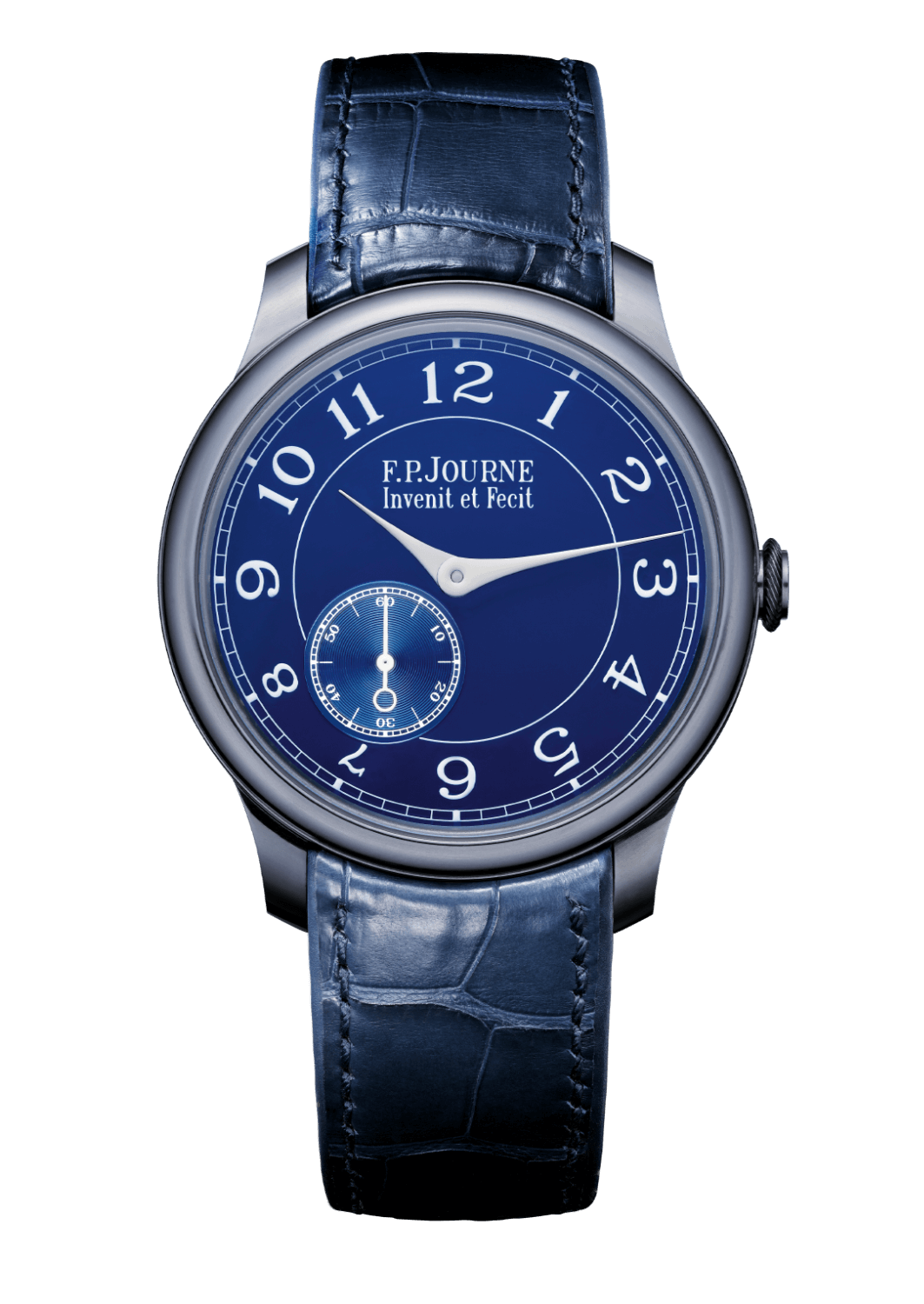
The FFC is housed in a tantalum case, a material F.P. Journe has used before for special pieces and one that gives the watch a cooler, more discreet presence than polished gold. The crystal is sapphire, the strap is leather, and the clasp is a pin buckle. Those choices keep the FFC in the language of a formal Journe rather than a sports watch.
The dial is the reason the FFC exists. The mechanical hand automaton is the central visual event, and it changes the way the watch is read. Instead of a conventional pair of hands, the display becomes a stage: the hand's movement is the attraction, and the time is communicated through a mechanical performance. That is a very different proposition from a tourbillon or a minute repeater. Those complications are admired for their mechanics; the FFC's automaton is admired for its character.
This is also where the FFC separates itself from the rest of the Journe catalog. The house is known for elegant, often symmetrical dials and movements that are beautiful from the back. The FFC is more extroverted on the front. It asks the wearer to accept a watch that is partly sculpture and partly instrument. For a collector who already knows the catalog, that is the appeal: it is a Journe that does something no standard Journe does.
The case material adds to that effect. Tantalum is not a flashy metal. It has a grey-blue depth that reads as technical rather than luxurious in the conventional sense. On a watch like the FFC, that is the right choice. The automaton is already the star; the case does not need to compete with it. The sapphire crystal and leather strap keep the focus on the dial, while the pin buckle reinforces the formal, old-school aspect of the object.
On the wrist
Because the FFC is a unique piece, first-hand wear reports are scarce. What can be said is that the automaton hand dominates the dial visually, while the tantalum case and leather strap keep the object in the familiar territory of a formal Journe. Expect a ceremonial presence rather than a daily-wear tool; the balance is shaped by the automaton and the collector's handling.
There is no broad owner consensus on long-term comfort, but the FFC is designed as a wearable piece rather than a desk object. The hand automaton adds visual weight to the dial, not necessarily physical weight on the wrist; the case remains the anchor. It is the kind of watch that is worn for an occasion and then studied at leisure, rather than forgotten on the wrist.
In practical terms, the FFC is best approached as a collector's watch. It is not the piece you wear to the gym, and it is not the watch you choose when you want to disappear into a crowd. It is a watch that invites conversation, and the automaton makes it impossible to ignore. That is not a drawback for the target owner. It is the point of owning a unique piece with this kind of mechanical theatre.
Accuracy and ownership
F.P. Journe does not publish a chronometer certification for the FFC, and the automaton is the point rather than daily rate. Expect Journe-level mechanical performance, but a one-off of this kind is judged by function and provenance more than by seconds per day. The owner is buying a piece of independent watchmaking history, not a regulated daily beater.
Ownership also means accepting that service is specialist work. The unique automaton and the in-house calibre make authorized service essential. F.P. Journe does not publish a fixed service interval for this one-off in the same way it does for series references, so the practical answer is to follow the manufacturer's guidance and avoid independent intervention.
That service reality is part of the ownership experience. A unique piece with an automaton is not a watch you treat casually. It requires a relationship with the brand and a willingness to accept that maintenance will be handled by the people who built it. For the collector who buys the FFC, that is not a burden; it is part of the package.
Occasions and presence
The FFC is a formal and dress watch in spirit. It is not a sports watch, and it is not a travel tool in the conventional sense. Its natural habitat is a collector's dinner, an auction preview, or a private viewing where the automaton can be appreciated. It has enormous wrist presence: the mechanical hand gives it a theatrical quality that standard haute horlogerie rarely attempts.
On a five-point scale, the FFC earns a 5/5 for presence. It is not subtle, but it is not loud in the way a gem-set or oversized watch can be. Its loudness is intellectual and mechanical: people notice that the watch is doing something unusual. That is exactly what a unique Only Watch piece should achieve.
The FFC also works as a dress watch because it does not rely on colour or decoration to make its point. The interest is in the mechanism, and that gives the watch a seriousness that matches formal clothing. It is a piece for someone who wants a watch that is conversation-starting without being ostentatious in the usual sense.
Variants and family context
There are no series variants of the FFC. It is a one-off, and its reference number is simply FFC. The closest family context is the broader F.P. Journe catalog: the Octa Automatique, Chronomètre Souverain, and Chronomètre Bleu share the house's movement-first philosophy and restrained case language, but none of them has the automaton hand.
Within the brand, other notable models include the Chronomètre à Résonance, Tourbillon Souverain, Centigraphe Souverain, Élégante, and Répétition Minutes. Each represents a different side of Journe: resonance, tourbillon, chronograph, electro-mechanical practicality, and sonnerie. The FFC sits apart as a unique conceptual piece rather than a catalog sibling.
That separation is important for collectors. The FFC is not a model you can buy into later through a different dial or case metal. It is a single object with a single history. The family references are useful for understanding the brand's language, but they do not dilute the FFC's uniqueness. If anything, they make it clearer how far the unique piece departs from the standard catalog while still remaining recognisably Journe.
Similar watches and homages
The FFC has no direct equivalent because it is a one-off. Collectors looking for mechanical theatre might consider Jaquet Droz automata, which share the idea of a watch as a moving tableau. MB&F's HM10 Bulldog offers a kinetic, character-driven display, while Ulysse Nardin's Freak treats unconventional time display as spectacle. None of them is a substitute for the FFC, but they occupy the same broad territory of mechanical watchmaking as performance.
There is no meaningful homage to the FFC. Its value is tied to the unique piece, the Only Watch provenance, and the F.P. Journe name. An affordable watch can imitate a hand-shaped dial, but it cannot reproduce the mechanical automaton, the in-house calibre, or the auction history. For that reason, the homage section is effectively empty: there is no direct tribute that matters.
That is not a criticism of the affordable market. It is simply a reflection of how far the FFC sits from series production. The watch is a piece of independent horological art, and the usual homage economy does not apply. Collectors who want the look can find playful automaton-inspired designs, but they are not buying the same idea.
Investment and service
The FFC has no retail MSRP and no current retail availability. It was sold at Only Watch 2021 for CHF 4.5 million, a landmark result for F.P. Journe and a clear signal that unique independent pieces with strong provenance can outperform conventional retail references. There is no pre-owned range in the usual sense because there is only one watch.
As an investment, the FFC is best understood as a museum-grade unique piece. Its trend is appreciating in the sense that exceptional one-off Journe pieces have strong collector demand, but the market is thin by definition. The hold recommendation is simple: if acquired, hold it. It is irreplaceable, and its value is anchored by the Only Watch result rather than by a production benchmark.
Service is authorized-only. F.P. Journe does not publish a fixed interval or approximate cost for this unique piece, and the automaton requires specialist attention. That is not a drawback for the target collector; it is part of owning a one-off.
The investment case is therefore less about liquidity and more about scarcity. A unique F.P. Journe with an automaton and Only Watch provenance occupies a different market from a standard Chronomètre Souverain. It is a trophy object, and trophy objects are valued by the depth of collector interest rather than by daily price discovery. The CHF 4.5 million result is the clearest public marker of that interest.
Final verdict
The F.P. Journe FFC is less a watch to compare than a mechanical portrait: a one-off Journe automaton with auction provenance. Its movement and finishing are deeply Journe, but the hand automaton is the reason it exists. For a collector, it is a grail by definition; for everyone else, it is a benchmark of what independent horology can attempt.