The Audible Soul of the Farer Alert
In the world of horology, complications are often categorized by their visual utility: the date window, the chronograph sub-dial, or the rotating GMT hand. However, the most intimate complication is the one you hear. The mechanical alarm is a relic of a pre-digital age, a time when waking up or remembering an appointment required a series of gears, springs, and a tiny hammer striking a metal pin. The Farer Alert brings this romantic functionality back to the forefront of modern watchmaking.
A Design Language of Distinction
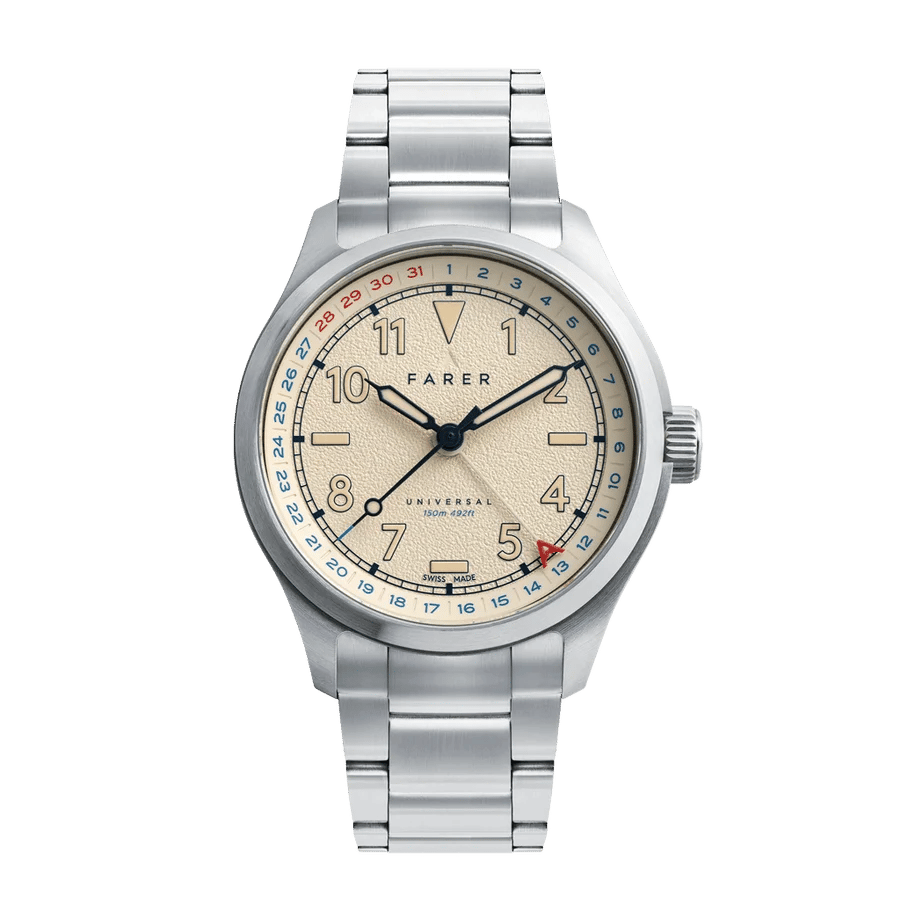
Farer has never been a brand to play it safe. While many heritage brands are busy reissuing the same black-dial divers from the 1960s, Farer has spent the last decade experimenting with a palette that feels more at home in a Paul Smith boutique than a traditional jewelry store. The Alert (ref. Alert) is a perfect example of this. The dial is a multi-layered affair, featuring a silver-white sunray center, a circular-brushed hour ring, and a silk-matte outer minute track. The depth is palpable.
But the star of the show is the 'Alert' hand itself. Tipped with a vibrant, signal-red arrow, it sits poised to strike. This isn't just a color choice; it’s a functional indicator. When the alarm is set, this hand points to the exact moment the internal hammer will begin its frantic dance. The use of Super-LumiNova X1 on the hands and indices ensures that even in the dead of night, the Alert remains legible—a critical feature for a watch designed to wake you up.
The Heartbeat: La Joux-Perret 8021
Under the hood, Farer has opted for a movement that commands respect: the La Joux-Perret 8021. This is a manual-wind caliber that operates at 28,800 vibrations per hour, offering a smoothness of sweep that matches its mechanical precision. What makes this movement special is its architecture. It features two separate barrels—one for the timekeeping and one for the alarm. This ensures that using the alarm doesn't drain the power reserve needed to keep the watch running through the night.
Winding the Alert is a two-part ritual. The crown at 4 o'clock winds the mainspring for the time, while the crown at 2 o'clock winds the alarm spring. There is a distinct difference in the tension and sound of these two winds, a detail that enthusiasts will find endlessly satisfying. When the alarm triggers, it doesn't beep; it vibrates. It’s a metallic, buzzing 'chirp' that is both charming and surprisingly effective. It’s the sound of history repeating itself on your wrist.
Wrist Presence and Versatility
With a 41mm diameter, the Alert sits in the contemporary sweet spot. It has enough heft to feel like a serious piece of engineering, but the 46.5mm lug-to-lug distance prevents it from feeling like a 'dinner plate.' The case finishing is exceptional for this price point, featuring high-polish chamfers that catch the light and brushed flanks that hide the inevitable scuffs of daily wear. The 50m water resistance is perhaps the only 'con' in an otherwise stellar spec sheet, meaning this is a watch for the boardroom and the bar, but perhaps not the beach.
The Cultural Context
Why buy a mechanical alarm in 2024? For the same reason one buys a vinyl record or a film camera. It is about the friction. In a world where everything is automated and optimized, the act of manually setting a mechanical alarm is an act of mindfulness. It forces the wearer to engage with time as a physical entity. At $2,100, the Farer Alert is positioned as an entry-point into high-complication horology. It competes with watches that cost three times as much, yet it carries a design language that is entirely its own.
Final Thoughts
The Farer Alert is more than a watch; it’s a companion. It’s for the traveler who wants to wake up in a hotel room without checking their phone. It’s for the professional who needs a tactile reminder of a meeting. And most of all, it’s for the collector who wants something that isn't just another 'me too' timepiece. Farer has captured lightning in a bottle here, proving that the most exciting things in watchmaking are often the ones you can hear coming from a mile away.