The Architectural Elegance of the Farer Cross II
In the hierarchy of horological complications, the world timer occupies a space of intellectual curiosity. It is a complication that demands a high degree of dial real estate and a precise synchronization of gears. With the Cross II Ref. W-CRO-SGS, Farer has not only met these technical requirements but has done so with a level of finishing that challenges the established giants of the industry. As we dissect this timepiece, we find a masterclass in how to manage visual information without succumbing to clutter.
Dial Architecture and the Piqué Texture
The centerpiece of the W-CRO-SGS is undoubtedly its silver piqué textured dial. To the uninitiated, it may appear as a simple pattern, but under a loupe, the precision of the micro-grid becomes apparent. This texture serves a dual purpose: it diffuses light to prevent glare and provides a high-contrast backdrop for the multi-colored elements of the world timer display. The dial is multi-layered, featuring a recessed central disc and a raised outer ring for the cities. This depth is critical for a world timer, as it allows the eye to naturally separate the local time from the global references.
The city ring itself is a marvel of typography. Farer has chosen a clean, sans-serif font that remains legible even at the small scale required to fit 24 cities onto a 39mm dial. The inclusion of London in red is a subtle nod to the brand’s British heritage, while the rest of the cities are rendered in a deep navy blue. The 24-hour disc, which rotates in synchronization with the movement, is split into day and night sections, providing an intuitive reference for time across the globe.
Case Engineering: Proportions and Finish
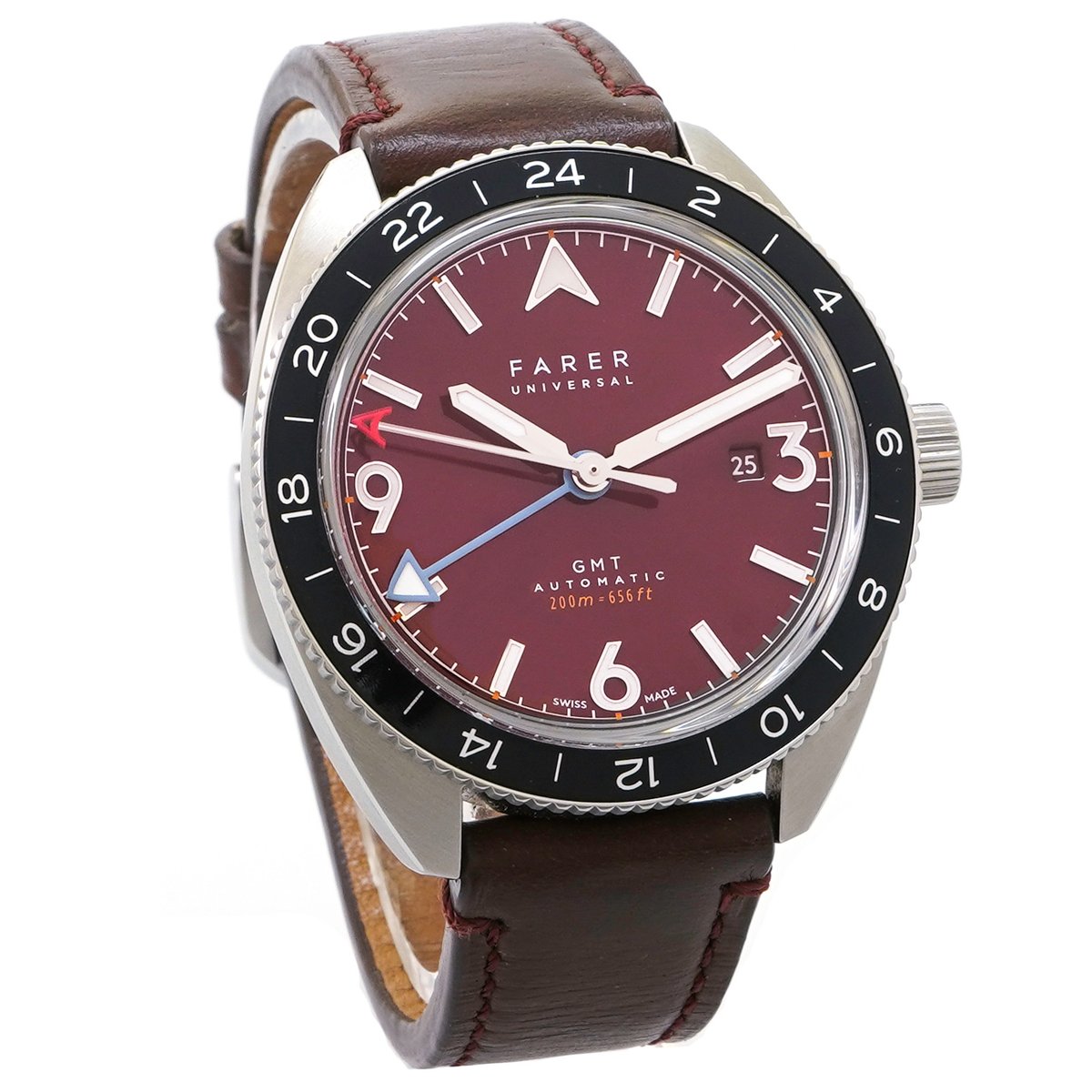
The case of the Cross II is a study in restraint. Measuring 39mm in diameter, it avoids the oversized trend that often plagues modern complications. The use of 316L stainless steel, finished with a combination of brushed surfaces and polished chamfers, gives the watch a refined, sculptural quality. The lugs are particularly noteworthy; they are short and aggressively curved, ensuring that the watch hugs the wrist. This ergonomic focus is a hallmark of Farer’s design philosophy, prioritizing the wearer's experience over sheer visual scale.
The dual-crown system is another technical highlight. The crown at 3 o'clock handles the winding and time-setting, while the crown at 10 o'clock operates the internal rotating city bezel. The tactile feedback of these crowns is crisp, with a satisfying mechanical resistance that speaks to the quality of the seals and the internal gearing. Despite the additional entry point for the second crown, Farer has maintained a water resistance of 100 meters, making this a truly versatile travel companion.
The Heart of the Watch: Sellita SW330-2 Top Grade
At the core of the Cross II lies the Sellita SW330-2 in its Top Grade execution. This is a significant upgrade from the standard GMT movements found in many watches at this price point. The 'Top Grade' designation means the movement is adjusted in five positions and features higher-quality components, such as a Glucydur balance wheel. For the collector, this translates to better long-term stability and chronometric accuracy.
Farer has not hidden this movement behind a solid case back. Instead, they have provided a sapphire exhibition window, revealing a bespoke rotor. The rotor is skeletonized and finished with a unique turbine pattern, a design choice that echoes the theme of global travel. The bridges beneath are decorated with perlage, a traditional Swiss finishing technique that involves creating overlapping circular patterns. While not 'haute horlogerie' in the hand-finished sense, the execution is exceptionally clean and demonstrates a reverence for mechanical aesthetics.
Functionality and the World Timer Complication
Operating the world timer on the Cross II is an exercise in mechanical logic. To set the watch, one first aligns the local city at the 12 o'clock position using the 10 o'clock crown. Then, the time is set using the main crown, ensuring the 24-hour disc matches the local time. Once synchronized, the wearer can read the time in any of the other 23 cities by simply looking at where the city name aligns on the 24-hour scale. It is a 'caller' style GMT implementation, meaning the 24-hour disc is adjusted independently, rather than the local hour hand. While some purists prefer a 'flyer' GMT for travel, the world timer configuration makes the caller style highly efficient for those who need to track multiple zones from a fixed location or during transit.
Comparative Analysis and Conclusion
When compared to its contemporaries, the Farer Cross II stands out for its chromatic bravery and its compact dimensions. Many world timers in the sub-$5,000 category are either overly traditional or excessively large. Farer has found the 'Goldilocks' zone, offering a watch that feels contemporary yet grounded in horological tradition. The Ref. W-CRO-SGS is more than just a tool for telling time; it is a piece of engineering that celebrates the complexity of our interconnected world. For the sophisticated young collector, it represents an entry point into high-complication watchmaking that does not require a compromise on style or technical specifications. It is, quite simply, one of the most compelling world timers available on the market today.