Fears, briefly
Fears is a Bristol name with a long memory. Edwin Fears opened his workshop in the city in 1846, and for the better part of a century the firm made watches that were sold across the West Country and well beyond it. The name went quiet, as so many did, and then in 2016 Nicholas Bowman-Scargill — the founder's great-great-great-grandson — brought it back. What he did not do was pretend the intervening decades had not happened. The revived Fears is a small, deliberately slow operation that makes a handful of references, most of them built around a cushion case and a dial that could plausibly have been drawn in the 1930s.
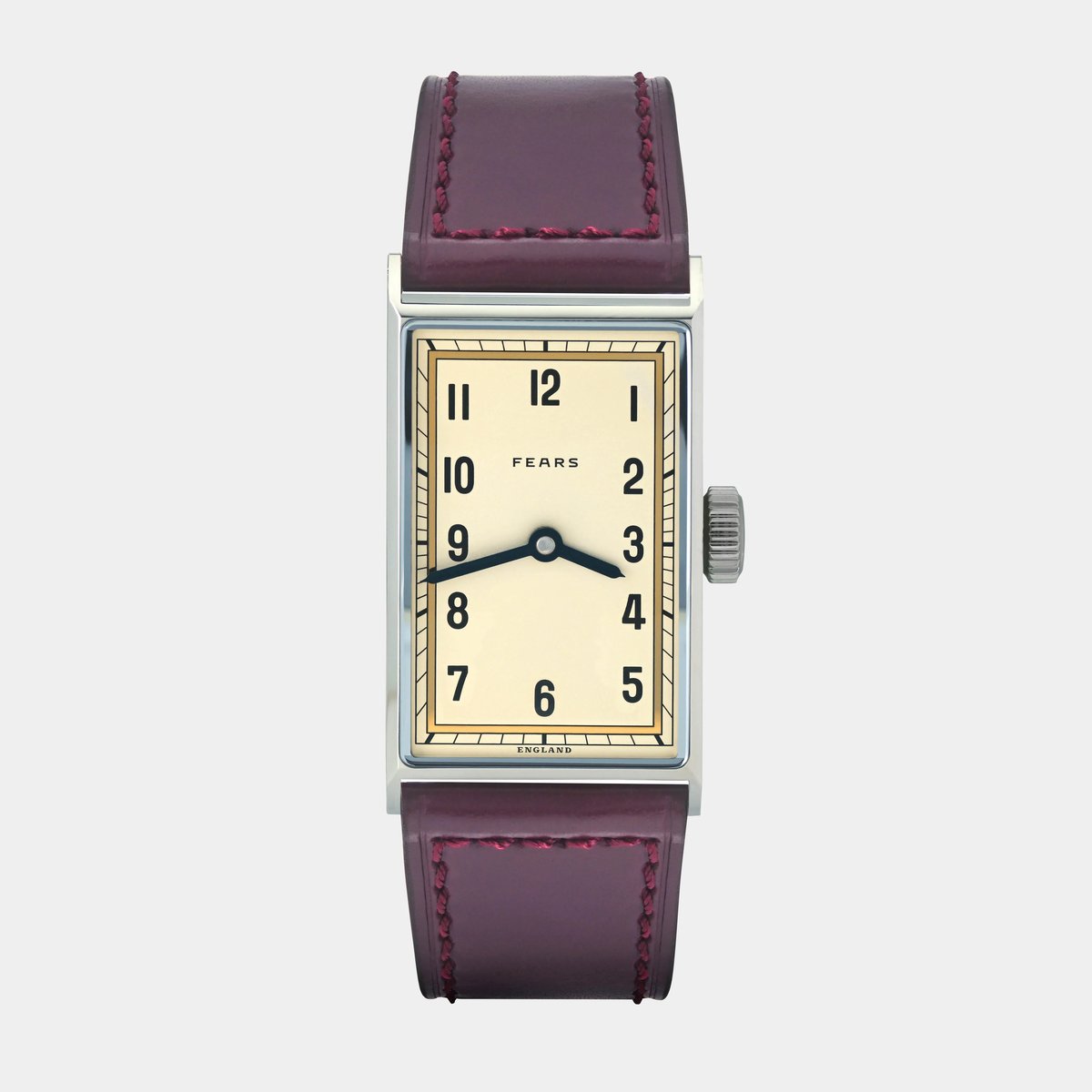
The Archival 1930 is the most literal expression of that idea. It takes its name, and its design cues, from a watch held in the brand's own archive and dated to 1930. It is offered in small batches rather than as a permanent catalogue line, and reference BS8-1930-0.012.057 is one of those batches. The BS8 prefix is the Bristol postcode where Fears works — a small detail, but a telling one. This is a watch that wants you to know where it came from.
What you actually get
A stainless steel cushion case, polished and brushed in the places that matter, with a sapphire crystal over the dial and a leather strap holding it on. That is the inventory. There is no bracelet option to agonise over, no ceramic bezel, no screw-down crown theatrics. Fears has stripped the decision-making down to the dial and the strap, which for a watch in this idiom is exactly right.
The cushion shape is the whole point. It is a form that reads softer than a round case and considerably warmer than a square one, and it does something specific on the wrist: it breaks up the silhouette so the watch never looks like a disc stuck to your arm. Fears has been refining this shape across its catalogue for years, and the Archival 1930 benefits from that accumulated muscle memory. The lugs curve away from the case cleanly, the caseband stays low enough that the watch does not sit proud of the wrist, and the whole thing tucks under a shirt cuff without a fight.
On the wrist, day one through day seven
Day one is about the strap. It arrives on leather, and leather is the variable that decides whether the first week is pleasant or annoying. A stiff, heavily finished strap will fight a cushion case, pushing the head of the watch off-centre and making you fiddle with it all day. A softer, properly tanned strap lets the case settle into the wrist within a few days and then stops being something you think about. Give it that week before you form an opinion. By day three or four, the watch should have found its position and stopped moving.
By midweek, what you notice is the absence of weight. There is no bracelet adding mass at the far end of the wrist, so the head of the watch stays where you put it and the strap does the work of holding it there. The cushion case distributes that weight across the flat of the wrist rather than concentrating it on a single contact point, which is why it wears more comfortably than a round case of comparable visual size. It is a watch you forget about, and in a dress watch that is the highest compliment available.
Legibility across the week is where the archival brief pays off. A dial drawn from a 1930 design is not a dial covered in text. There is no depth rating printed at six o'clock, no chronometer certification line, no paragraph of marketing copy. What is left is the time, laid out with the kind of spacing that was standard when people actually read watches rather than photographed them. In low light — a restaurant, a car at night, a dim office — you can read it at a glance without bringing your wrist up to your face, which is more than can be said for a lot of modern dress watches with high-polish hands on high-gloss dials.
Weekend wear is where the honesty of the design shows. This is not a watch that wants to go swimming, and it does not pretend to. Fears does not publish a water resistance figure for this reference, and the sensible assumption for a leather-strapped archival dress watch is that you take it off before you get wet. That is not a limitation so much as a category statement. If you need one watch that does everything, this is not it. If you have a daily driver and want something for the days that matter, the constraint costs you nothing.
The movement question
Fears builds its watches around Swiss ébauches rather than an in-house calibre, and the Archival 1930 follows that established pattern. The brand does not publish a calibre name, a beat rate, a jewel count or a power reserve for this reference, which is unusual in 2024 but consistent with the way Fears presents its watches: the specification sheet is short, and the emphasis is on the object rather than the parts list.
What that means in practice is that you should expect modern Swiss automatic behaviour and not much more. A handful of seconds a day either way once the movement has settled, with well-regulated examples doing better. Setting it once a week if you rotate it; not thinking about it if you do not. There is no chronometer certification here and no claim of one, and for a watch bought on aesthetics and provenance, that is a fair trade. If you are the sort of buyer who needs a published rate specification before you commit, this watch is not aimed at you, and Fears would probably agree.
Living with it
The Archival 1930 is a formal watch that does not insist on formality. On a leather strap it works with a suit, obviously, but it also works with a knit and chinos and it does not look absurd with a casual jacket. The cushion case gives it just enough visual interest to survive outside a dress context, and the restrained dial keeps it from tipping into costume. It is a travel watch in the sense that it is the one you pack when you do not know what you are walking into — a dinner, a meeting, a flight — and it will not be wrong in any of them.
What it will not do is survive a real week on the wrist in the way a sports watch does. It has no lume, so it is useless in the dark. It has no bracelet option, so you cannot swap it onto steel for the summer. It has no published water resistance, so you treat it as a dry-weather watch. Every one of those is a deliberate choice by Fears, and every one of them is defensible in a watch that is explicitly archival in intent. But you should know what you are buying. This is not a one-watch collection. It is the second or third watch, and it is very good at being that.
Ownership, servicing and value
Fears does not publish a service interval or a standard servicing tariff for this reference, and because the brand is small and production is batched, servicing should be arranged directly with Fears or an authorised partner rather than with a high-street watchmaker. That is a small friction, and it is the price of buying from an independent. In exchange you get a watch that a local jeweller will not have seen before and that a collector will recognise immediately.
On value: buy this because you want to wear it. Small-batch British independents can hold value reasonably well when the batch is genuinely small and the brand stays disciplined, but there is no established secondary market for this reference and no reason to treat it as an investment. There is no major auction history to point to. If you need liquidity, this is the wrong purchase — and if you do not, that is precisely the point.
Who it is for
The Fears Archival 1930 is not trying to win a specification contest, and it would lose one. What it does instead is offer a cushion-cased, archive-derived dress watch from a small British workshop that has spent years learning how to make that shape sit properly on a wrist. On the wrist is where it justifies itself: comfortable, quiet, legible, and uncommon enough that you will not see another one across a room.
Buy it if you want a quiet, characterful watch with real provenance and you already own the obvious things. Look elsewhere if you need published numbers, a bracelet, lume, or a resale story. The Archival 1930 is a considered purchase rather than an impulsive one, and it rewards the buyer who arrives at it deliberately.