The short version
Formex doesn't do hype cycles. The Biel-based house sells almost entirely direct, skips the boutique theatre, and puts its money into cases, movements and certification paperwork instead of airport billboards. That business model has made the Essence and the Reef darlings of the value-conscious collector set — the sort of people who read spec sheets the way other people read box scores.
The AirField is the line that gets talked about least and worn the most. It takes the field-watch formula — legible dial, steel case, sapphire, a workhorse automatic — and renders it with the clean, slightly architectural detailing that has become Formex's signature. Reference 0661.1.6546.822 is the version we spent time with, and it's a useful test case for the whole proposition: does a sub-luxury Swiss field watch still make sense in a market crowded with microbrands and neo-vintage bargains?
The answer, as with most Formex products, depends less on the spec sheet than on how you plan to live with it. This is a watch meant to be worn to a job site, a flight, a Friday dinner, and a weekend of errands without anyone asking what it is — and without you having to think about it either.
Brand context: Biel, direct, and the long game
Formex was founded in 1999 by Hans Peter Grädel in Biel/Bienne, the Swiss watchmaking town that produces more movements than any other place on earth. That location matters. Being in Biel gives a small brand access to the same supplier ecosystem the big houses use — cases, crystals, dials, movement ebauches — without needing a manufacture of its own. Formex's skill has been in choosing well from that ecosystem and then pricing the result as if the internet exists, which it does.
The brand's modern identity crystallised around two models. The Essence brought a suspension-style case and COSC-certified chronometry to a price bracket where neither was expected. The Reef brought genuine dive-watch credibility to the same direct-to-consumer formula. Both established Formex as a serious spec-for-money proposition rather than a fashion label with Swiss postcodes on the dial.
The AirField extends that philosophy into pilot and field-watch territory. It's a less glamorous category — nobody is queuing outside a boutique for a field watch — but it's arguably the one where the value equation matters most. Field watches are supposed to be bought once and worn hard, not rotated through a display case. That's a test of build quality rather than marketing.
Design and case
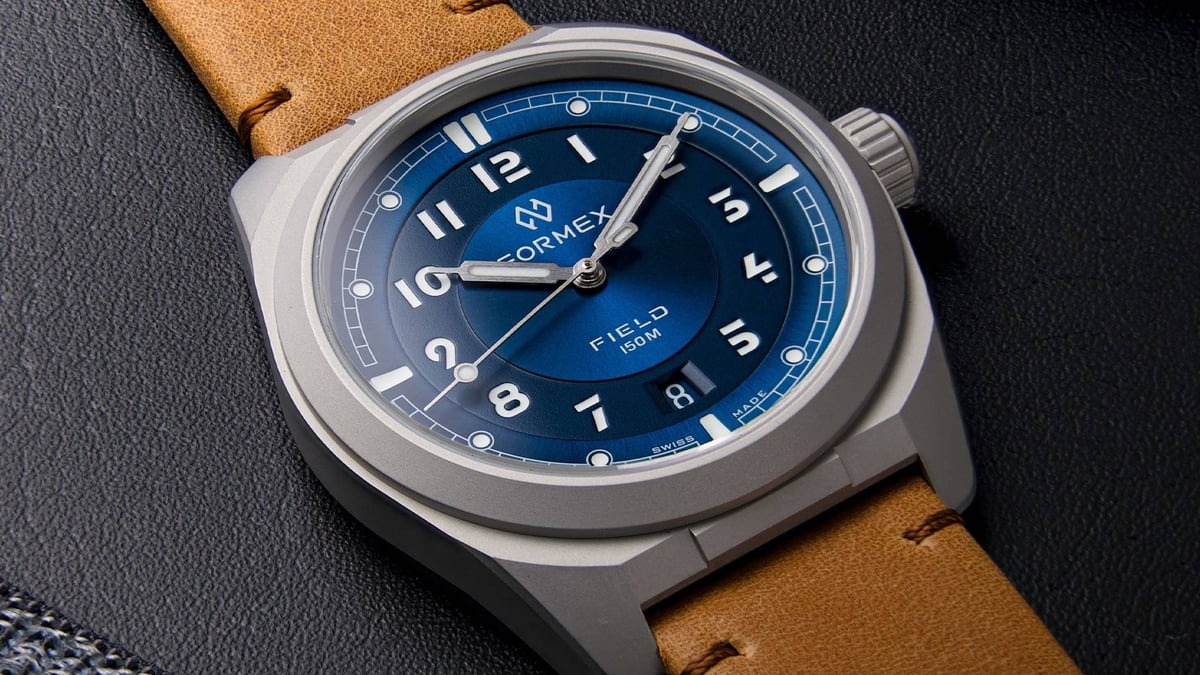
The AirField's design brief is legibility, and it honours that brief without turning into a wall clock. The dial is built around high-contrast markers and a clean, uncluttered field — no superfluous text, no decorative flourishes competing with the hands. It reads instantly in bad light, which is the entire point of the genre.
The case is stainless steel, brushed where it will take knocks and polished only where it will catch light. Formex has always understood that brushing is the more honest finish for a tool watch: it hides scuffs instead of advertising them. The crystal is sapphire, as you'd expect at this price, and the whole assembly is put together with the kind of tolerances that make you double-check the price tag.
The strap on this reference is leather, which softens the tool-watch image just enough to make it office-appropriate. It's a deliberate choice: a NATO would push the AirField fully into weekend territory, while leather lets it cross over into the parts of your life where you're expected to look like an adult. Formex also offers the AirField across alternate dial and strap configurations within the family, so buyers aren't locked into a single look.
The clasp deserves its own paragraph. Formex fits a deployant clasp that folds flat against the wrist and doesn't create the pressure ridge you get from cheaper folding mechanisms. It's the sort of detail that gets skipped at this price point and it's the sort of detail that determines whether you actually wear a watch or leave it in a drawer.
The movement
Inside is a Sellita SW200-1, the Swiss workhorse ebauche that powers a thousand tool watches across every price bracket. It's automatic, it beats at 28,800 vibrations per hour, and it delivers around 38 hours of power reserve — enough to take it off Friday night and pick it up Monday morning without resetting.
The SW200-1 is not a glamorous movement. It's not in-house, it's not COSC-certified in this application, and its finishing is honest rather than exhibition-grade. None of that matters. What matters is that it's proven, that spare parts are neither rare nor expensive, and that any competent watchmaker in any city on earth can service it without a factory laptop and a signed permission slip.
For a field watch, that's the correct engineering decision. The alternative — a proprietary movement with a proprietary service network — would be a liability the moment you take the watch somewhere interesting. Formex has consistently chosen serviceability over romance, and the AirField is no exception.
On the wrist
The AirField is one of those watches that disappears — and that's a compliment. The case wears close and balanced, without the top-heavy torque you get when a brand pairs a thick head with an over-stuffed strap. The leather on this reference breaks in quickly and conforms to the wrist rather than sitting on top of it.
Balance is the thing that separates a good field watch from a merely adequate one. The AirField doesn't slide or rotate; the head stays centred through a full day of typing, driving and hauling groceries. It's the kind of watch you forget you're wearing until someone asks about it — and then you spend five minutes explaining why you didn't just buy a Hamilton.
Under a cuff it behaves. The case profile is restrained enough to slip beneath a shirt without snagging, which is more than can be said for a lot of tool watches that claim to be daily-wearable. This is a watch that works with a jacket, a jumper, or a t-shirt, and doesn't look out of place in any of them.
The lume is Super-LumiNova, applied generously enough that the dial remains readable in a dark car park or a dim hotel room. It won't glow for a week, but it charges fast and fades evenly, which is what you actually want.
Accuracy and ownership
Because the movement isn't COSC-certified here, set expectations accordingly. Roughly ±10 seconds a day in real-world wear is a fair benchmark, with positional variation doing most of the work. Formex regulates before shipping, but this is a workhorse movement rather than a chronometer, and it will drift with temperature and activity like every other Sellita-based watch on the market.
For most wearers that's a non-issue. If you're the sort of person who syncs to a time server every morning, this isn't the watch for you — buy a quartz or pay for certification. If you're the sort of person who sets it once a week and gets on with life, the AirField will never give you a reason to complain.
Ownership costs are the quiet advantage of the whole proposition. The SW200-1 is one of the most widely serviced movements in the industry, so routine maintenance doesn't require a trip back to Switzerland or an anxious wait for a service centre to open a ticket. Any reputable independent watchmaker can handle it, and the parts availability means you're never held hostage by a single supplier.
Where it fits
The AirField is a daily driver first and foremost. It's at home on a commute, in a workshop, on a hiking trail, and at a casual dinner. It handles sport and travel without fuss — a leather strap is the weak link in a swimming pool, so plan accordingly, but for everything short of full immersion this is a watch that will keep up.
It is not a dress watch, and it shouldn't pretend to be. The AirField can pass under a blazer, but a formal occasion calls for something thinner and quieter. That's fine. Very few people own one watch, and the AirField makes a strong case for being the one you reach for on the other 340 days of the year.
On the wrist, its presence is restrained and confident — a 3 out of 5. It reads as a proper tool watch to anyone who knows what they're looking at, and as a nice, simple watch to everyone else. Neither reaction is a problem.
Alternatives worth considering
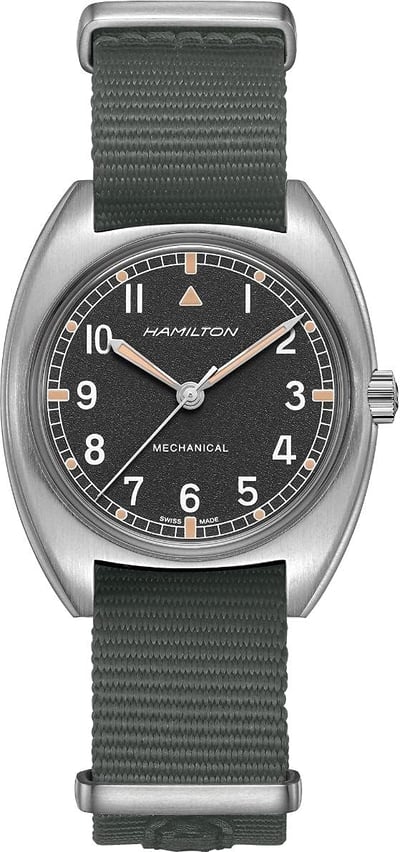
The obvious comparison is the Hamilton Khaki Field Automatic, which remains the default answer at this price. The Formex counters with a more refined case and a significantly better clasp, though Hamilton's heritage and ubiquity make it easier to find on a wrist near you.
The Sinn 556 offers German tool-watch purity with a comparable movement philosophy and a stronger resale story — if you can live with the more austere design language. The Longines Spirit brings heritage-brand legitimacy and COSC certification, but you pay a boutique premium for the name on the dial. The IWC Pilot's Watch Mark XVIII is the aspirational reference for legibility-first design, at roughly triple the money, and the Oris Big Crown ProPilot offers an independent Swiss alternative with a more overtly aviation-flavoured aesthetic.
If the budget is tighter, the Timex Expedition North Field Post gets you the silhouette and solar practicality for a fraction of the outlay, the Seiko 5 Sports Field delivers an in-house automatic and endless strap options, and the Hamilton Khaki Field Mechanical remains the hand-wound classic that most field-watch buyers end up comparing everything else against.
Value and verdict
Formex sells direct, which means the pricing reflects components rather than retail overhead. You're paying for a well-finished Swiss case, a proven Swiss movement, and a clasp that embarrasses watches costing twice as much. Against boutique rivals the value is obvious; against the used market it's more complicated, because direct-to-consumer brands depreciate before they flatten out.
Buy it to wear, not to flip. There's no auction history to speak of and there won't be — Formex isn't that kind of brand, and the AirField isn't that kind of watch. What it is, is a legible, well-built Swiss automatic that you can put on in the morning and forget about until the evening. In a market obsessed with drops, waitlists and provenance, that's a quietly radical thing to offer.
The Formex AirField doesn't chase trends, doesn't pretend to be a heritage piece, and doesn't ask you to pay for a boutique it will never let you visit. It just does the job — and does it with more composure than anything else in its bracket.