The Tactical Evolution of a Space Icon
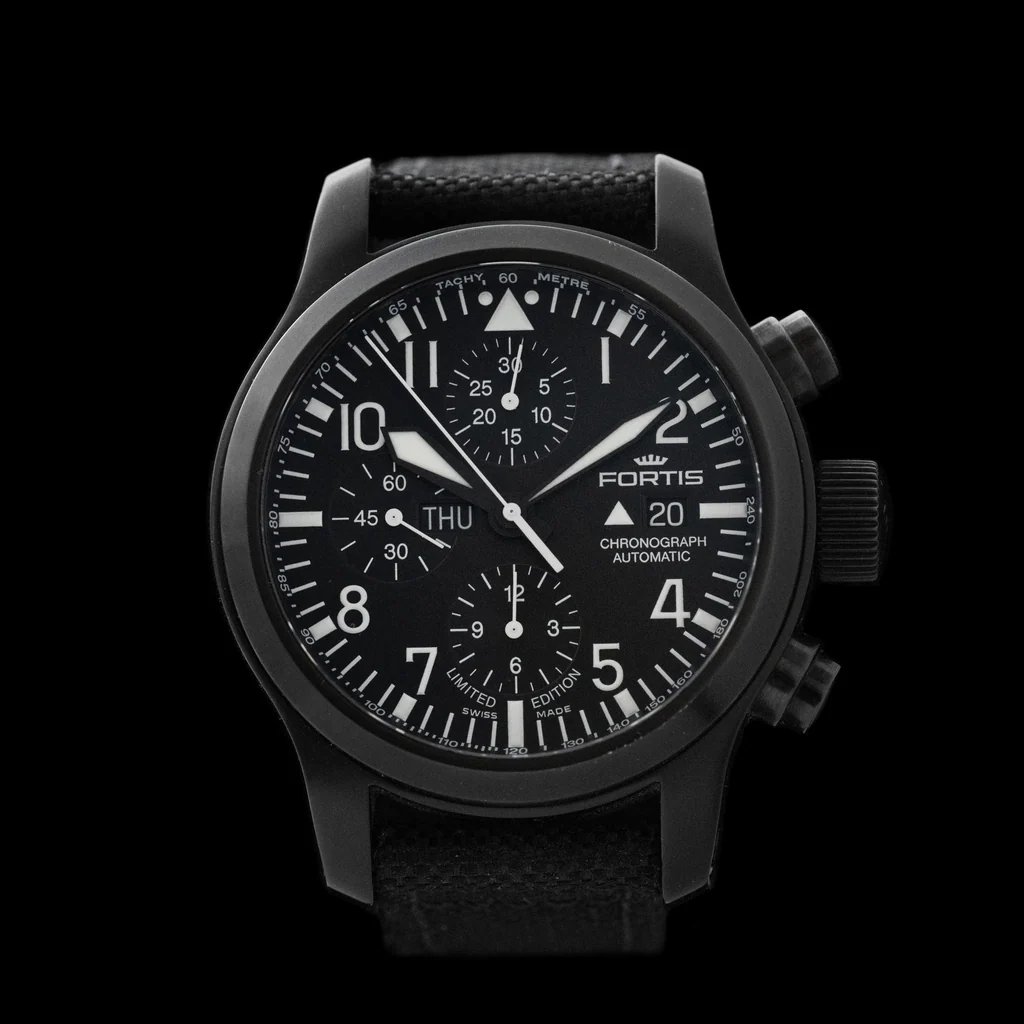
In the world of luxury horology, the term 'tool watch' is often used as a marketing buzzword rather than a technical specification. However, the Fortis B-42 Official Cosmonauts Chronograph (Ref. 638.28.13.L13) is one of the few timepieces that can legitimately claim the title. Since the mid-1990s, Fortis has been the standard-issue equipment for the Russian Federal Space Agency. While the Omega Speedmaster is the darling of the West, the B-42 is the workhorse of the East. The 'Black' variant we are analyzing today takes that utilitarian DNA and coats it in a layer of tactical PVD, creating a watch that feels as much at home in a cockpit as it does in a boardroom.
Design and Ergonomics: The 42mm Powerhouse
The first thing a collector notices about the B-42 Black is its presence. The 42mm case is crafted from high-grade stainless steel before being treated with a black Physical Vapor Deposition (PVD) coating. In an era where 'stealth' watches are increasingly popular, Fortis manages to maintain legibility—a feat many other brands fail to achieve when they go all-black. The dial features a matte finish that absorbs light, allowing the white and orange accents to pop with high-contrast clarity.
The ergonomics are a tale of two dimensions. While the 42mm diameter is the 'sweet spot' for many collectors, the 15mm thickness is a factor that cannot be ignored. This height is primarily due to the Valjoux 7750 movement inside, which requires a certain amount of vertical clearance for its chronograph modules. On the wrist, the B-42 feels substantial. It is balanced, but it is not a watch that disappears. For the young collector, this is often a benefit—it provides a tactile reminder of the engineering on the wrist. The integrated L13 leather strap is particularly noteworthy; it is thick and resilient, designed to handle the weight of the case without stretching over time.
The Movement: The F-2024 (Valjoux 7750) Workhorse
Under the hood of the 638.28.13.L13 lies the Fortis Calibre F-2024. For those initiated in the world of movements, this is a modified ETA/Valjoux 7750. From an investment and maintenance perspective, this is excellent news. The 7750 is perhaps the most reliable automatic chronograph movement ever produced. It is a cam-actuated system, which lacks the 'luxury' feel of a column-wheel chronograph but offers a level of robustness that is essential for a watch designed for space travel.
One characteristic of this movement is the famous '7750 wobble.' Because the rotor only winds in one direction, it can spin freely in the other, creating a distinct vibration on the wrist. To some, this is a quirk of character; to others, it is a reminder of the watch's mechanical nature. With a 48-hour power reserve and a frequency of 28,800 vph, it meets all the requirements for a modern daily wearer. More importantly, because it is based on a standard architecture, servicing costs are kept in check. Unlike in-house movements from brands like IWC or Breitling, which can cost upwards of $1,000 to service, the F-2024 can be maintained by any master watchmaker for a fraction of that price.
Market Analysis and Investment Potential
When we look at the Fortis B-42 Black through the lens of a market analyst, we see a 'value play.' The MSRP of this reference sat around $3,250 during its production run. On the secondary market today, you can find well-maintained examples between $1,400 and $1,900. This represents a significant depreciation from retail, which is common for brands outside the 'Big Four' (Rolex, Patek, AP, Omega).
However, the depreciation curve for Fortis has largely flattened. This means that if you buy a pre-owned B-42 today for $1,600, you are likely to be able to sell it for a similar amount in three to five years. It is a 'store of value' rather than an 'engine of growth.' The primary risk with the 638.28.13.L13 is the PVD coating. Unlike stainless steel, which can be polished to look like new, a scratched PVD coating is permanent. Collectors should look for examples with minimal wear on the 'high points' of the case—the lugs and the bezel edge. A pristine PVD Fortis will always command a 15-20% premium over one with visible steel showing through the black finish.
The 'Space' Factor: Why Pedigree Matters
Investment value in watches is often driven by story. The Fortis B-42 has one of the best stories in the industry. Since 1994, Fortis has been the official timekeeper for Roscosmos. The B-42 was specifically designed to meet the needs of cosmonauts, including large pushers that can be operated with gloves and a highly visible tachymeter scale. While the Black PVD version is more of a 'tactical' civilian variant, it shares the same flight-qualified internal components as the watches worn on the International Space Station.
For a collector, this pedigree provides a level of 'collector's insurance.' Watches with genuine military or space history tend to hold their value better than fashion-forward designs. The B-42 is a legitimate alternative to the Sinn 140 or the Omega Speedmaster, offering a more aggressive, modern look for those who find the Moonwatch a bit too 'vintage' in its aesthetic.
Final Judgment: Hold or Sell?
If you currently own a Fortis B-42 Black in excellent condition, my recommendation is to HOLD. The brand is currently undergoing a resurgence under new leadership, and as more collectors look for value outside of the mainstream, Fortis is perfectly positioned to capture that interest. If you are looking to buy, the current secondary market prices represent an excellent entry point. You are essentially getting a space-certified Swiss chronograph for the price of a entry-level Longines.
In summary, the Ref. 638.28.13.L13 is a watch for the collector who values substance over hype. It is a tactical instrument that carries the weight of history on its black PVD shoulders. While it may not be the centerpiece of a high-frequency flipping strategy, it is a rock-solid addition to any collection focused on tool watch excellence and functional design.