Fortis B-42 Marinemaster: Purpose Before Prestige
There is a particular kind of collector who arrives at the Fortis B-42 Marinemaster after exhausting the obvious names. This is not a watch that announces itself across a room, nor one that trades on heritage marketing. It is a Swiss dive watch built to a brief: legible, sealed, dependable, and honest about what it is. Reference 647.10.41 sits within Fortis's B-42 family, the collection that carried the brand's tool-watch ethos into the 2000s with a 42 mm case, a workhorse automatic movement, and the kind of no-nonsense finishing that rewards a close look rather than a passing glance.
Fortis has never been a fashion house. Founded in Grenchen in 1912, the company built its reputation on aviation instruments, military supply, and later on spaceflight. The B-42 Marinemaster is the dive-watch branch of that same philosophy — a marine tool designed for the wrist of someone who actually intends to get it wet. In an era when dive watches have become jewellery with timing bezels, the Marinemaster remains stubbornly functional, and that is precisely its appeal.
This review examines reference 647.10.41 in detail: its movement architecture, its case and dial execution, how it wears, what it costs to own, and where it sits against the alternatives. The verdict, stated plainly up front, is that the B-42 Marinemaster is one of the more underrated Swiss divers of its generation — a watch whose value proposition is engineering rather than image.
Brand History: Grenchen's Toolmaker
Fortis was founded in 1912 by Walter Vogt in Grenchen, a town in the Swiss Jura that became a centre of watchmaking. From its earliest years the company oriented itself toward precision instruments rather than decorative pieces, and by the mid-twentieth century it had established a reputation for robust, legible watches aimed at professionals. The brand's aviation connection deepened through the postwar decades, and in 1994 Fortis secured a place in horological history when its Official Cosmonauts Chronograph became the first automatic chronograph worn in space. That spaceflight association cemented the brand's identity as a maker of dependable tool watches for people who needed their instruments to work.
The B-42 collection, introduced in the early 2000s, took its name from its 42 mm case — a deliberate, functional dimension that sat at the sweet spot between presence and wearability. Within that family, the Marinemaster represented the dive-watch expression: a rotating bezel, high water resistance, and a dial engineered for underwater legibility. Reference 647.10.41 is one of the catalogued executions of that model, pairing the stainless-steel case with a matching bracelet and a dark, high-contrast dial.
Movement: The ETA 2836-2 Workhorse
The Marinemaster is powered by the ETA 2836-2, a Swiss automatic calibre that has underpinned countless tool watches since the 1980s. It is a 25-jewel movement beating at 28,800 vibrations per hour with an approximate 38-hour power reserve, and it carries both a date and a day display. The architecture is conventional and proven: a bidirectional winding rotor, a straightforward gear train, and a modular day-date mechanism that has been refined over decades of production. What it lacks in exotic finishing it makes up for in serviceability — any competent watchmaker can maintain an ETA 2836-2, and parts remain widely available.
Fortis did not dress the movement for display; the caseback is solid, which is the correct decision for a dive watch. The calibre is a means to an end, and that end is reliability. Fortis offered chronometer-certified movements in select parts of the B-42 range, but the 647.10.41 is generally catalogued without COSC certification. In practice, a well-regulated 2836-2 will hold time comfortably within the range a daily wearer expects, and the movement's ubiquity means long-term ownership is refreshingly free of drama.
It is worth being clear-eyed about what the 2836-2 is and is not. It is not a decorated in-house calibre, and there is no exhibition caseback to admire. What it offers instead is the quiet luxury of a movement that any watchmaker in the world can service, that parts are available for, and that has proven itself across millions of wrists. For a tool watch, that is the more valuable kind of engineering.
Case, Crystal and Dial
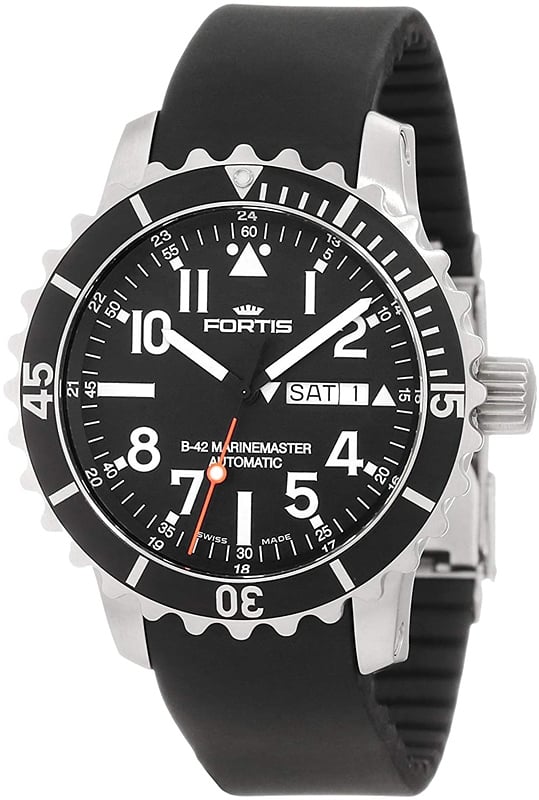
The case is stainless steel, 42 mm across, and finished with the mix of brushing and polishing that defines the era's Swiss tool watches. The upper surfaces are brushed to resist showing scratches, while the flanks carry a lighter polish that catches light without drawing attention. A unidirectional rotating bezel with a luminous pip frames the dial, its action crisp and free of the back-play that plagues cheaper divers. The crown is screw-down, and the case is rated to 200 metres — sufficient for recreational diving and more than enough for the desk-bound reality of most owners.
The bezel deserves particular mention. Its knurled edge is easy to grip even with wet or gloved fingers, and the 60-minute scale is clearly marked with a luminous pip at twelve. The screw-down crown is protected by modest crown guards and operates with a firm, precise thread. These are the details that separate a genuine dive watch from a desk diver, and the Marinemaster gets them right.
The crystal is sapphire, treated with an anti-reflective coating that keeps the dial readable in bright conditions. The dial itself is the heart of the watch's functionality: applied indices filled with Super-LumiNova, a clean minute track, and hands that are broad enough to read at a glance and at depth. The day-date window at three o'clock is the one concession to convenience, and it is executed without fuss. Legibility, not decoration, governs every choice, and the result is a dial that reads instantly in almost any light.
On the Wrist
At 42 mm, the B-42 Marinemaster wears as a proper tool watch — substantial without being cumbersome. The case sits with a reassuring heft on the wrist, and the bracelet, a brushed stainless-steel design with a deployant clasp, distributes that weight evenly. The proportions favour presence over delicacy; this is not a watch that disappears under a cuff, and it was never meant to. On a medium wrist it reads as confident rather than oversized, and the lugs curve downward to help the case hug the wrist rather than perch on top of it.
Comfort over a full day is good. The bracelet articulates smoothly, and the clasp, while not the most refined in the segment, is secure and simple to operate. The watch is at its best on the steel bracelet for daily wear, though a rubber strap transforms it into a more purpose-built diver. Either way, the balance is honest: the Marinemaster feels like a watch built to be used, not coddled, and it settles onto the wrist with the kind of reassuring weight that reminds you it is there without ever becoming a nuisance.
Accuracy and Daily Reliability
Real-world accuracy from the ETA 2836-2 depends largely on regulation and condition. A healthy example will typically run within roughly ten seconds per day in either direction, and many owners report considerably better. The movement is not COSC-certified in this reference, so buyers should expect workhorse precision rather than laboratory-grade timekeeping. The day-date mechanism is robust, though as with any ETA-based calendar, avoid changing the date near midnight when the mechanism is engaged. For a tool watch, this level of accuracy is entirely appropriate — the Marinemaster is built to tell you the time reliably, not to win a timing competition.
Occasions and Ownership
The Marinemaster is a sport watch first, and it wears best in that register: weekends, outdoor work, travel, and any situation where a legible, sealed, unpretentious watch is an asset. It transitions to daily wear without complaint, and its steel bracelet gives it enough polish to pass in casual office settings. It is not a dress watch, and it does not pretend to be; pairing it with formal attire would be a category error. Think of it as a daily driver with genuine capability — the kind of watch you put on and forget about until someone asks what it is.
Variants and Family
Reference 647.10.41 is one catalogued execution of the B-42 Marinemaster, pairing a dark dial with a stainless-steel bracelet. Fortis used suffix codes to denote dial colour and bracelet or strap configuration, so sibling references within the same family differ primarily in those respects rather than in architecture. The broader B-42 collection includes pilot-oriented Flieger models, the Official Cosmonauts line, and other diver and chronograph variants — all sharing the 42 mm case philosophy and the brand's tool-watch intent. Collectors chasing the Marinemaster specifically should verify the dial and bracelet combination against the reference, as the family's variations can be subtle.
Comparisons
Against the Rolex Submariner, the Marinemaster is a fraction of the price and a fraction of the prestige, but it delivers the core function — a sealed, legible automatic diver — without the waiting list. Against the Omega Seamaster 300M, it lacks the co-axial movement and the brand cachet, yet it offers comparable everyday capability for less money. The Sinn U1 is the closer spiritual rival: both are German-influenced Swiss tool watches built for function first, though Sinn's submarine-steel construction is the more exotic engineering story. The Oris Aquis and Tudor Pelagos round out the segment, each offering a different balance of finish, heritage, and price. The Marinemaster's argument is simple: it does the job, honestly, for less.
Investment and Service
The B-42 Marinemaster is not an investment piece, and it was never marketed as one. Fortis tool watches trade on the secondary market at a fraction of their original retail, which makes them excellent value for buyers and indifferent stores of wealth for speculators. Pre-owned examples typically change hands in the high hundreds to low four figures, depending on condition, completeness, and configuration. There is no meaningful auction history to speak of; this is a watch to wear, not to flip.
Servicing is straightforward. The ETA 2836-2 is one of the most serviceable movements in the industry, and Fortis recommends periodic maintenance through authorised channels. Because the calibre is so widely supported, independent watchmakers can also handle routine service, though authorised service is the safer route for preserving water resistance and originality. Budget for service as you would for any mechanical tool watch, and factor it into the purchase price.
Final Verdict
The Fortis B-42 Marinemaster ref. 647.10.41 is a watch that rewards the collector who values substance over signalling. Its ETA 2836-2 movement is proven and serviceable, its 42 mm steel case is built for real use, and its 200-metre rating and sapphire crystal make it a genuine dive watch rather than a stylistic nod. It will not appreciate, and it will not turn heads across a restaurant. What it will do is tell the time reliably, survive the water, and look honest doing it. For the discerning buyer who wants a Swiss automatic diver without the markup of mythology, that is a compelling proposition.