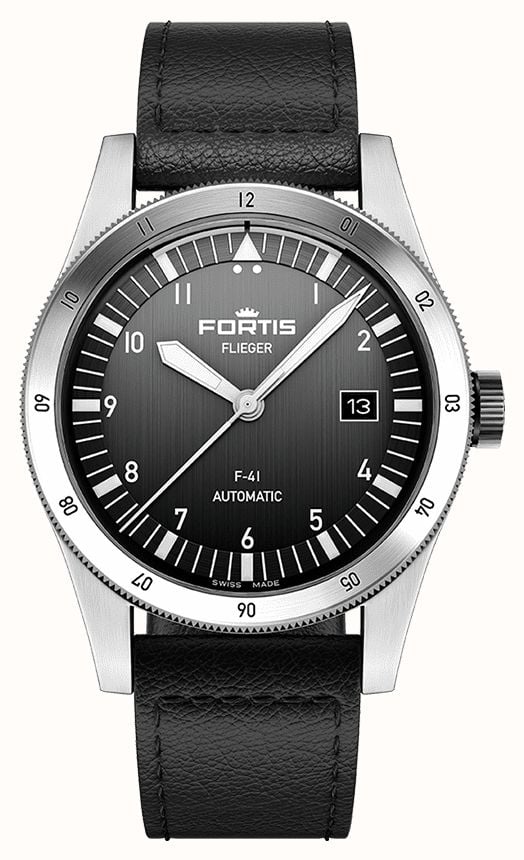
The Rebirth of an Icon: The New Fortis Philosophy
In the world of horology, 'heritage' is often used as a crutch. Brands lean on what they did in 1945 to justify what they are doing in 2024. But when Jupp Philipp took over Fortis in 2018, he did something radical: he stopped looking backward. The Fortis Flieger F-41 is the physical manifestation of this new direction. It is a watch that acknowledges its history as a pilot’s instrument but refuses to be a museum piece. Instead, it adopts a brutalist design language—raw, functional, and unapologetically steel—that resonates with a new generation of collectors who prefer industrial design over decorative flourishes.
Design Language: Brutalism on the Wrist
The first thing you notice about the F-41 is the finish. There are no polished surfaces here. The entire case is executed in a deep, vertical brushing that feels more like architectural steel than a luxury item. This is intentional. The F-41 is designed to take a beating and look better for it. The bezel is slightly concave, a clever engineering trick that protects the sapphire crystal from lateral impacts. It’s these small, thoughtful details that elevate the watch from a simple 'flieger' to a piece of modern industrial design.
The Dial: Brixtrack and Synchroline
Fortis has introduced two key features on the dial that set it apart from the sea of IWC clones. The first is the Brixtrack. Instead of just printing lume on a flat dial, Fortis uses circular-brushed metal tracks with applied Super-LumiNova 'bricks.' This adds a level of three-dimensionality and legibility that is staggering, especially in low-light conditions. The bricks catch the light at different angles, making the dial feel alive.
The second feature is the Synchroline. This is the orange line spanning from 11 to 1 o'clock. In the context of a pilot's watch, this is designed to help pilots synchronize within a squadron. In the context of the daily wearer, it provides a sharp, energetic pop of color—specifically 'Berlac Fluor Orange'—that breaks up the monochrome black and steel. It’s a nod to the watch’s functional roots that serves as a modern stylistic signature.
The Case and Engineering
At 41mm, the case is the 'Goldilocks' size for many, though it wears slightly larger due to the 51mm lug-to-lug distance. However, unlike traditional pilot watches which often suffer from poor water resistance, the F-41 is rated to 200 meters. This is achieved through a screw-down crown and a robust caseback, effectively turning the Flieger into a 'GADA' (Go Anywhere, Do Anything) watch. You can jump from a flight deck into the ocean without a second thought. This versatility is exactly what the modern collector is looking for—one watch that can handle every scenario.
The Block Bracelet: A New Standard
We cannot talk about the F-41 without mentioning the Block Bracelet. In an era where many brands are cutting corners on steel, Fortis has doubled down. The bracelet is heavy, precisely milled, and features a unique screw system that is significantly more secure than the standard pin-and-collar. The clasp is a work of art in itself, featuring a micro-adjustment system that allows you to dial in the fit as your wrist expands and contracts throughout the day. It provides a level of 'wrist-presence' that makes the watch feel like it should cost twice as much as its MSRP.
Movement and Performance
Inside the F-41 beats the Fortis UW-30. Purists might complain that it’s 'just' a Sellita SW200-1 base, but that misses the point of a tool watch. The SW200-1 is the AK-47 of Swiss movements: reliable, easily serviced by any watchmaker, and capable of high accuracy when regulated properly. Fortis takes these movements and regulates them in-house to ensure they perform under pressure. While a longer power reserve would be a welcome upgrade in future iterations, the 38-hour reserve is perfectly adequate for a daily wearer that rarely leaves the wrist.
The Vivir Verdict: Who is the F-41 For?
The Fortis Flieger F-41 is for the collector who is tired of the 'hype' cycle. It’s for the person who appreciates the aesthetic of a Leica camera or a Porsche 911—objects where form follows function so closely that they become beautiful in their own right. It’s a watch for the architect, the engineer, and the traveler. It’s a statement of competence. In a world of 'quiet luxury,' the F-41 is 'loud utility,' and we are here for it.
Comparison: Fortis vs. The Field
When stacked against the IWC Mark XX, the Fortis feels more rugged and modern. The IWC is a beautiful piece of jewelry with pilot DNA; the Fortis is a pilot's tool that happens to be beautiful. Compared to Sinn, the Fortis offers a more cohesive and contemporary design language. While Sinn is the king of 'tech,' Fortis is the king of 'design-led engineering.' For the price, you are getting a watch that feels significantly more substantial than almost anything else in the $2,000-$3,000 range.