Brand history: Fortis and the Flieger line
Fortis was founded in 1912 in Grenchen, Switzerland, by Walter Vogt, and spent much of the 20th century building a reputation for robust, legible instruments. The brand's aviation connection runs deep, and its watches have been worn by pilots and, famously, by Russian cosmonauts — a heritage Fortis still leans on in its marketing.
The Flieger line is Fortis's pilot-watch family, named for the German word for aviator. The modern Flieger collection was relaunched and rationalized in recent years around a simple naming convention: F-39, F-41, and F-43, each corresponding to case size. The F-43 Bicompax sits at the top of that range as the chronograph flagship, pairing the family's instrument-panel legibility with a two-counter chronograph layout.
The F-43 Bicompax is not a heritage reissue in the vein of a Navitimer or a Speedmaster. It is a contemporary tool watch, and that framing matters when you assess its value: you are buying capability and character, not a slice of auction history.
Design and case
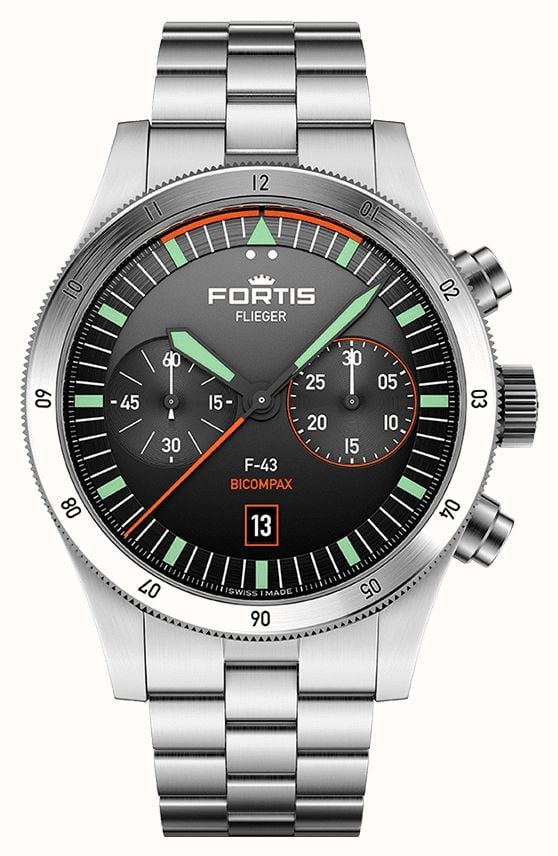
The F-43 Bicompax is built around a 43mm stainless-steel case, which places it firmly in the modern pilot-watch bracket. The design language is functional: a broad, uncluttered dial, a prominent crown flanked by chronograph pushers, and a sapphire crystal that resists the scratches a working watch will collect. Water resistance is rated to 100 meters, enough for daily life and the occasional swim but not a substitute for a dive watch.
The dial is where the F-43 earns its keep. The bicompax layout places a small-seconds register at 9 o'clock and a 30-minute chronograph counter at 3 o'clock, with a date aperture at 6. That symmetry gives the watch a balanced, instrument-like face, and the high-contrast printing keeps it readable at a glance. Super-LumiNova X1 on the hands and indices ensures legibility in low light, which is exactly what a pilot's watch should deliver.
The reference F4240007 is supplied on a leather strap with a pin buckle, a configuration that suits the watch's tool-watch character. A steel bracelet option exists within the line, and buyers who plan to wear the watch hard should consider it, but the leather strap keeps the package lighter and more versatile for daily wear.
Case finishing is straightforward brushed steel with polished accents where it counts. There is no jewelry-store sparkle here, and that is the point. The F-43 reads as an instrument first and an accessory second, which is exactly the brief Fortis set for itself.
Movement: Fortis Caliber 12
Inside the F-43 Bicompax beats the Fortis Caliber 12, an automatic chronograph movement built on a Sellita SW510 base. It runs at 28,800 vibrations per hour and delivers roughly 60 hours of power reserve, which is competitive for a chronograph at this price point and means the watch will still be running after a weekend on the nightstand.
The architecture is modular and well understood, which is good news for long-term ownership. The Sellita base means parts and service are widely available, and independent watchmakers can handle routine maintenance without the complications that come with a proprietary in-house caliber. Finishing is industrial rather than decorative — this is a movement designed to be reliable and serviceable, not to be admired through a display back.
The Caliber 12 is not COSC-certified, and Fortis does not market it as a chronometer. That is consistent with the watch's positioning: it is a tool, and the movement's job is to keep time reliably rather than to win precision contests. The chronograph function engages cleanly, the pushers have a positive feel, and the reset snaps back to zero without drama.
Collectors who fetishize movement finishing will find little to admire here. Collectors who value a movement that can be serviced by any competent watchmaker for a reasonable sum will find a lot to like.
On the wrist
At 43mm, the F-43 Bicompax has real presence on the wrist. It wears like a pilot's watch should — substantial, legible, and purposeful — and the case is balanced enough that it does not feel top-heavy. Collectors with smaller wrists should try before they buy, because 43mm is a meaningful commitment, but the watch does not wear as large as its dimensions might suggest thanks to a dial that keeps the eye centered.
The leather strap softens the package and makes the watch comfortable for all-day wear, though the case's mass is always apparent. This is not a watch you forget you are wearing; it is a watch you notice, in the way you notice a good tool. The crown and pushers are easy to operate, and the chronograph action is crisp enough for daily use.
The dial's legibility is the standout. In bright sun or dim cockpit lighting, the hands and indices remain readable, and the bicompax layout means the chronograph is genuinely usable rather than decorative. That is more than can be said for many pilot chronographs at twice the price.
Accuracy and ownership
In real-world use, expect the F-43 Bicompax to run within roughly minus five to plus ten seconds per day, which is typical for a well-regulated Sellita-based chronograph. Individual examples vary, and a watch that has been serviced and regulated by a competent watchmaker can do better. Do not expect chronometer-grade precision, and do not buy this watch if that is the priority.
Service intervals of around six years are reasonable, and a full service typically runs in the region of 500 dollars. Because the movement is Sellita-based, you are not locked into a single service provider, which is a genuine ownership advantage over more proprietary chronographs. Fortis's own service network is smaller than the Swatch Group's, so having independent options matters.
The watch is also easy to live with. The sapphire crystal shrugs off daily knocks, the 100-meter water resistance covers the occasional swim, and the leather strap is simple to swap. This is a watch that rewards use rather than coddling.
The market and investment case
The F-43 Bicompax carries a retail price of roughly 3,800 dollars, which places it below the IWC Pilot's Watch Chronograph and well below the Breitling Navitimer. On the secondary market, examples trade in the 2,200 to 3,000 dollar range, which is where the value case becomes interesting.
Fortis does not enjoy the resale gravity of IWC, Breitling, or Omega. The brand is respected among enthusiasts but lacks the mass-market recognition that drives strong residuals, and the F-43 Bicompax is on a depreciating trend. That is not a reason to avoid the watch; it is a reason to buy it pre-owned and to treat it as a tool rather than an asset.
There is no meaningful auction history for this reference, and it is unlikely to develop one. If you are looking for a pilot chronograph that will appreciate, this is not it. If you are looking for a well-built, legible, serviceable pilot chronograph that you can wear without anxiety, the secondary market is your friend.
The honest read is that the F-43 Bicompax is a buy-and-hold tool watch. Buy it at the right price, wear it, and accept that the depreciation curve is the cost of admission. The collector who understands that will get far more satisfaction from this watch than the one chasing residuals.
Alternatives
The obvious alternative is the IWC Pilot's Watch Chronograph 41, which offers stronger residuals, a more refined movement, and the cachet of a larger brand — at a higher price. The Sinn 103 St is the German tool-watch answer, with similar flieger DNA and a robust chronograph movement. The Oris Big Crown ProPilot Chronograph sits at a comparable price and mission, and the Hamilton Khaki Aviation X-Wind Chronograph undercuts the Fortis substantially for buyers who want the look without the outlay.
For buyers who want the flieger aesthetic at a fraction of the price, the Steinhart Nav B-Chrono II offers a similar bicompax look for around 850 dollars. It is not the same watch, but it scratches the same itch.
Within the Fortis family, the F-39 and F-41 offer the same design language in smaller cases, and the standard F-43 Automatic drops the chronograph for a cleaner three-hand dial. Buyers who do not need the chronograph function should look there.
Verdict
The Fortis Flieger F-43 Bicompax is a purpose-built pilot chronograph that asks to be worn rather than collected. It is legible, robust, serviceable, and honest about what it is. Buy it pre-owned, wear it hard, and ignore the depreciation curve — it is a tool, and a good one.
The collector who already owns the obvious pieces will find a lot to like here. The collector who is shopping for an investment should look elsewhere.