Eternity, Wound by Hand
Most watches tell time. A very small number of them tell you that time is a problem someone solved with 1,483 parts. The Franck Muller Aeternitas Mega 4, reference 8888 T GS CC R QPS E, belongs to the second group. It is the watch Franck Muller built to prove that a maison known for loud numerals and louder cuffs could also out-complicate the old guard — and it did, stacking 36 complications into a single tonneau case and holding the title of the world’s most complicated wristwatch for years.
This is not a watch you stumble into. It is a made-to-order statement piece, the kind of object that lives in a safe and comes out for the room that can read it. And yet the reference itself is a decoder ring: read it left to right and the entire architecture announces itself.
Decoding 8888 T GS CC R QPS E
Franck Muller’s reference codes are unusually honest. The 8888 denotes the Curvex tonneau case family. The T is the tourbillon. GS is the grande sonnerie — a Westminster chime that strikes the quarters on demand or automatically. CC is the chronographe compteur, a split-seconds chronograph. R is the power-reserve indication. QPS is the quantième perpétuel sautant, a jumping perpetual calendar. E is the equation of time. Six letters, six monumental systems, one case.
That is the appeal of the Aeternitas: it is not a watch with a complication; it is a watch with a curriculum. Every letter on the caseback is a semester of watchmaking.
Franck Muller, Briefly
Franck Muller founded his namesake house in 1991 in Genthod, Switzerland, alongside Vartan Sirmakes. The early identity was built on the Curvex — a case curved on two axes to hug the wrist — and on numerals so large and so stylized they became a signature. It was a brand that understood collectors wanted drama as much as finishing, and it leaned into that reputation hard.
The Aeternitas line was the counterargument to anyone who thought Franck Muller was only about aesthetics. Named for eternity and anchored by a perpetual calendar that would, in theory, run for generations without correction, the Aeternitas became the maison’s complication laboratory. The Mega 4 is its summit — the piece that put Franck Muller in the same sentence as Patek Philippe and Vacheron Constantin in the grand-complication conversation.
It also became a cultural object. Franck Muller had already been adopted by hip-hop and celebrity culture in the 2000s, name-checked in lyrics and worn on red carpets. The Aeternitas gave that audience a grail at the very top of the pyramid — a seven-figure flex that even the most jaded collector had to respect.
The Aeternitas Idea
The name is the thesis. A perpetual calendar is mechanical memory: it knows the length of every month and the leap-year cycle, and it will keep correct dates without adjustment until the next century rule bites. Wrap that calendar in a grande sonnerie, add a tourbillon and a split-seconds chronograph, and you have a watch that is less a timekeeper than a small, wearable institution.
Franck Muller did not invent the grand complication, but the Mega 4 pushed the category to a number — 36 — that became a marketing fact and a collector shorthand. In the years since, other houses have answered with their own ultra-complications, but the Mega 4 remains the reference point for sheer count and sheer audacity.
The Numbers Game
Thirty-six complications is a number that invites skepticism. What counts as a complication? Franck Muller’s count includes the grande sonnerie, the minute repeater, the tourbillon, the split-seconds chronograph, the perpetual calendar with its multiple indications, the equation of time, the power reserve, the moon phase, and a long tail of smaller functions. Some are major systems; some are sub-functions of those systems. The count is a marketing tool, but the underlying engineering is not: the Mega 4 is genuinely one of the most complex serially produced wristwatches ever made.
What matters for a buyer is not the number but the integration. A grande sonnerie, a split-seconds chronograph, and a perpetual calendar all want space, and making them coexist without compromising the chime or the chronograph is the real achievement. The Mega 4 does it in a case that, while large, is still a wristwatch.
The Movement: A Cathedral of Complications
Inside the 8888 T GS CC R QPS E is a manual-winding, in-house Franck Muller caliber built around roughly 1,483 components. The headline is the grande sonnerie: a Westminster quarter-hour chime with a minute repeater on demand, driven by hammers and gongs that you can watch move through the openworked dial. Add a one-minute tourbillon, a split-seconds chronograph, a jumping perpetual calendar with equation of time, and a power-reserve display, and you have a movement that is less a mechanism than a small city.
The architecture is deliberately visible. Franck Muller openworks the dial so the owner can see the hammers, the tourbillon cage, and the calendar works in motion. Finishing is haute horlogerie: hand-bevelled bridges, polished steel, and a level of handwork that justifies the authorized-only service channel. This is not a movement you service at the mall.
Because a grande sonnerie consumes enormous energy, the watch is a daily-wind ritual. The power reserve is displayed precisely because the owner needs to know when the chime is running out of breath. That ritual — winding, listening, setting — is part of the ownership experience. A watch like this is not passive.
The Chiming
The grande sonnerie is the heart of the piece. Unlike a minute repeater, which sounds only when asked, a grande sonnerie can strike the quarters automatically as time passes, and it can be switched to silence or to petite sonnerie. The Westminster chime is the most musically ambitious of the traditional chimes, and executing it in a wristwatch requires gongs, hammers, and a governor that fit into a wristwatch case.
The result is a watch that announces the hour in the most literal way. In a quiet room, it is theatre. In a loud one, it is a private pleasure — you feel the strike through the case before you hear it. That tactile dimension is why chiming-watch collectors are a breed apart.
The Case and the Dial
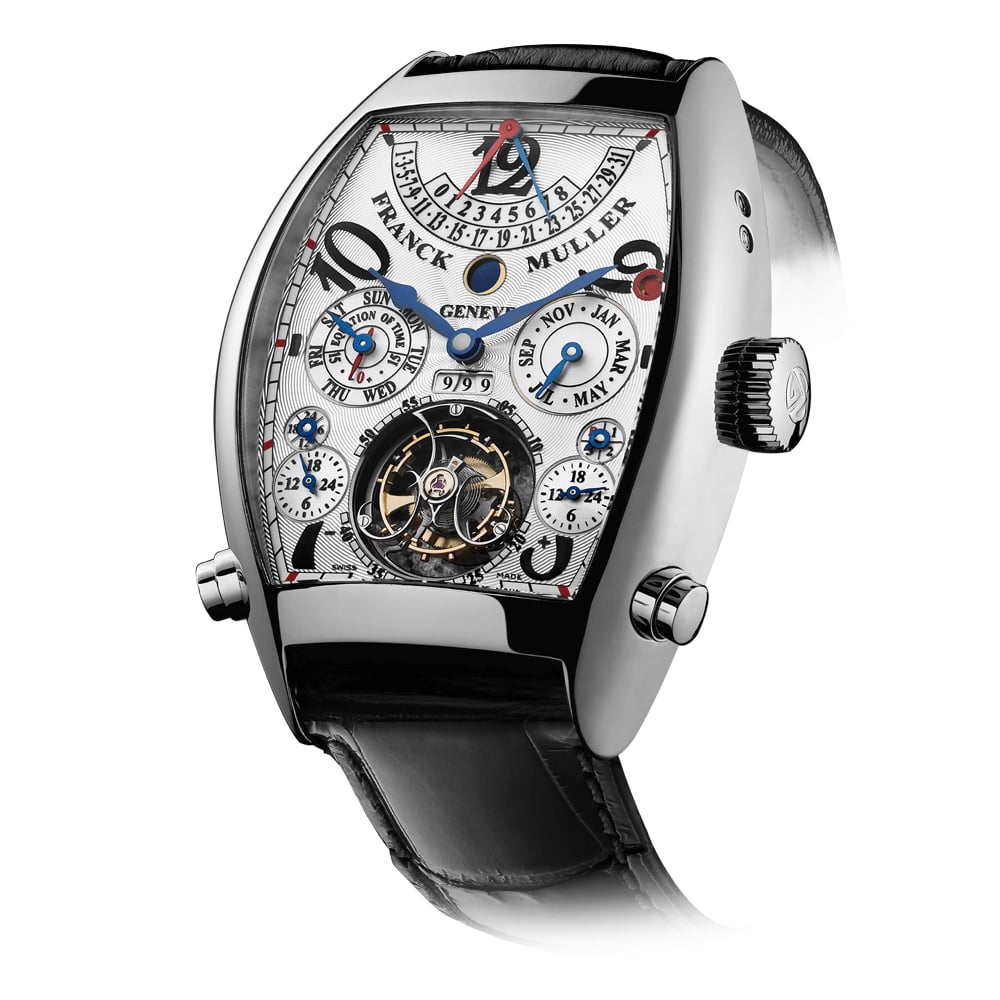
The case is the classic Franck Muller tonneau — broad, sculptural, and impossible to mistake for anything else. In precious metal, it carries real mass, and the curved profile is what keeps it wearable despite the scale. The dial is a layered, openworked composition: subdials for the perpetual calendar, an equation-of-time indication, the tourbillon aperture, and the chiming mechanism laid bare. It is busy in the way a cathedral façade is busy — every element is load-bearing.
There is no lume here, and no pretense of sport. This is a watch for rooms with good lighting and better company. The sapphire crystal is the only concession to modern robustness; everything else is ceremony.
The Dial, Up Close
The openworked dial rewards a loupe. The hammers and gongs of the sonnerie are visible, the tourbillon cage rotates once a minute, and the calendar subdials are arranged around the architecture rather than on top of it. The equation-of-time indication is a subtle, beautiful thing — a hand that tracks the gap between the sun and the clock across the year.
Legibility is not the priority. This is a dial you read in layers, over time, the way you learn a city. The first week you see the time; the first month you see the complications; the first year you see the system.
On the Wrist
The Mega 4 wears exactly as its reputation suggests: substantial, top-heavy, and unmistakably present. The tonneau shape distributes the mass across the wrist better than a round case of similar footprint, but there is no hiding the weight. On a leather strap it sits close and formal; the strap is alligator, and the clasp is a pin buckle, which is a surprisingly traditional choice for a watch at this altitude.
This is not a daily driver. It is a wrist event. You wear it to be seen wearing it, and the people who recognize it will recognize it instantly. For everyone else, it reads as a very large, very gold, very complicated object — which is also the point. The Aeternitas is a conversation piece that does not need to start the conversation.
Accuracy and Ownership Reality
High-complication watches are regulated, but chronometric precision is not the mission. Expect a rate within a few seconds a day in normal use, with variation driven by whether the sonnerie is engaged and how much the chronograph is run. The equation of time and the perpetual calendar are the real precision story here: the calendar is mechanical memory, and the equation of time tracks the difference between solar and mean time across the year.
Ownership is a relationship. The watch wants to be wound, the chime wants to be exercised, and the calendar wants to be set by someone who knows what they are doing. This is a piece for a collector with a watchmaker on speed dial, not a first luxury purchase.
Occasions
Formal, gala, collector dinners, auction previews, and the occasional very good party. Not sport, not travel in any practical sense, and not daily. The Mega 4 is a dress-complication watch in the truest sense: it belongs with a tuxedo or a very considered suit.
Who Wears It
Franck Muller’s cultural footprint is unusual for a high-horology house. The brand was a fixture in 2000s hip-hop and celebrity culture, and the Aeternitas sits at the top of that pyramid. The Mega 4 is the piece you buy when you have already bought everything else — the watch that signals you are not just wealthy but interested.
In the auction and collector world, it is a quiet flex rather than a loud one. It does not come up often, and when it does, it goes to someone who knows exactly what they are looking at. That is a different kind of status than a steel sports watch: it is status among people who know.
Collecting Context
The Mega 4 belongs to a very small club of seven-figure ultra-complications. Buying one is less about comparison shopping and more about joining a conversation. The relevant questions are provenance, service history, and whether the piece is complete and original. Because so few exist, the market is thin and private; you will not find one on every dealer’s shelf.
For a young collector, the Mega 4 is a destination rather than a starting point. It is the watch you work toward, the one that sits at the end of the road that starts with a first serious dress watch and passes through a chronograph and a perpetual calendar. It is, in that sense, a horizon.
Investment and the Auction Room
The Aeternitas Mega 4 was reported at roughly $2.7 million when new, and it trades in the seven figures on the secondary market when it trades at all. These pieces rarely surface at public auction; they move privately between collectors who already know each other. That scarcity is the investment case. The value is stable to appreciating, driven less by fashion than by the fact that very few examples exist and even fewer come to market.
If you are buying one, buy the example, not the brochure: provenance, service history, and completeness of the chiming function matter more than anything else. A Mega 4 that has been properly maintained is a different asset from one that has sat silent in a safe.
Service
Authorized service only. A grande sonnerie with a tourbillon and a split-seconds chronograph is not a watch any independent can safely touch without the correct parts and training. Budget for a factory service in Switzerland and for the watch to be away for a meaningful stretch of time. The upside is that Franck Muller knows this movement intimately, and a proper service preserves both function and value.
Family and Alternatives
Within the Aeternitas family, the Mega 4 is the flagship; siblings include the Aeternitas Tourbillon and perpetual-calendar configurations, plus the wider Franck Muller high-complication catalog such as the Giga Tourbillon. If you are shopping the same air, the Patek Philippe Grandmaster Chime, the Vacheron Constantin Les Cabinotiers grand complications, the Audemars Piguet Royal Oak Grande Complication, and the Jaeger-LeCoultre Hybris Mechanica line are the natural comparisons. Each is a different philosophy of excess.
The Patek is the most refined, the Vacheron the most bespoke, the AP the most sportif, and the Jaeger the most inventive. The Franck Muller is the loudest — and for a certain collector, that is exactly the point.
Verdict
The Franck Muller Aeternitas Mega 4 is not a rational purchase, and it is not trying to be. It is a proof of capability, a wearable argument that a house built on bold design can also build one of the most complicated movements ever cased. If you want the most complicated watch in the room and you want it to look like nothing else, this is the answer. If you want a daily wearer, keep walking.