A limited collaboration that turns Franck Muller's signature curve into a collector's flex.
Franck Muller has never been a brand that whispers. Since 1991 the maison has built its reputation on the opposite of restraint: oversized numerals, a barrel-shaped case that looks like it was drawn by a calligrapher with a grudge, and a marketing persona — the Master of Complications — that dares you to argue. So when Revolution, the collector publication and retailer with roots in Singapore and Hong Kong, partners with a house like this, the result is never a quiet insider piece. It is a statement drop, aimed squarely at the young collector who treats watches the way they treat sneaker collaborations and auction lots: as culture first, asset second.
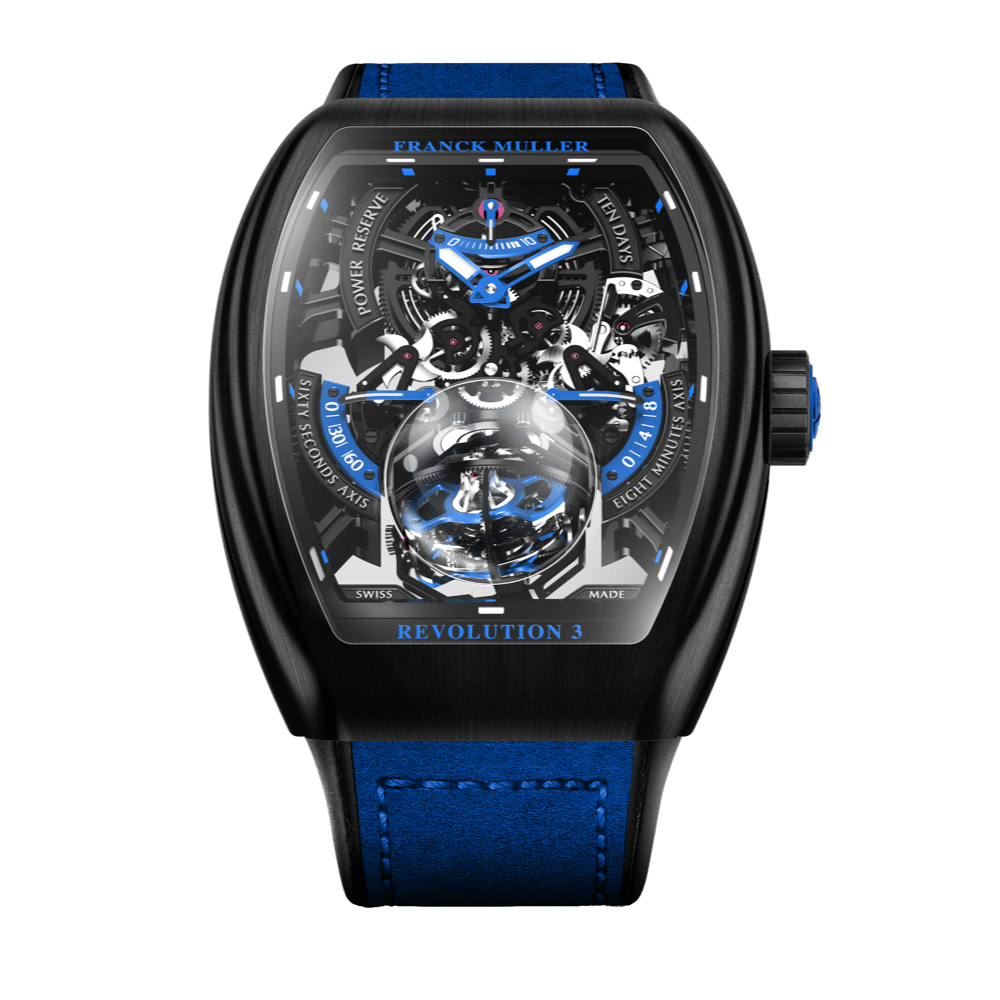
The Franck Muller Revolution 3, reference 9850TREV3, sits at the intersection of those two worlds. It is a limited-edition collaboration piece, which means the usual rules of catalogue-watch reviewing do not fully apply. There is no publicly published spec sheet with every dimension and tolerance laid out for the world to parse. What we have instead is a watch that has to be judged on design language, brand positioning, wearing experience, and the strength of the collaboration itself — the things that actually decide whether a limited edition matters five years after the drop.
This review is written with that honesty up front. Where a figure is publicly documented for this exact reference, we state it. Where it is not, we say so rather than invent a number. What follows is everything a discerning buyer needs to know about the Revolution 3: the brand history behind it, the design logic, how it wears, how it holds up, and whether it deserves a place in a serious young collection.
The House That Built the Curve
Franck Muller was founded in 1991 by the watchmaker of the same name and the entrepreneur Vartan Sirmakes. From the beginning, the brand's identity was built on two pillars. The first was the Cintrée Curvex, a tonneau-shaped case with a pronounced curve that wrapped around the wrist in a way that conventional round cases simply could not. The second was an almost theatrical commitment to complication — tourbillons, perpetual calendars, split-seconds chronographs — presented in a package that looked nothing like the sober Swiss classics coming out of the Vallée de Joux.
That combination worked. Franck Muller became the watch that people who did not want a Patek wore. It was loud, it was technically credible, and it was instantly recognisable across a dinner table. The Crazy Hours, launched in 2003, cemented the brand's reputation for playful irreverence: a dial where the numerals jump out of sequence, turning timekeeping into a parlor trick. The Vanguard, introduced in 2014, pushed the tonneau silhouette into sportier, more architectural territory and became the platform for a wave of collaborations with athletes, musicians, and cultural figures.
Understanding that lineage matters for the Revolution 3, because this watch is not an outlier. It is the logical product of a house that has always treated the case shape as a signature and collaboration as a natural extension of its personality. Franck Muller did not stumble into the collector-collaboration space. It was built for it.
The Revolution Collaboration Context
Revolution has spent the past decade building a reputation as one of the most credible collaboration partners in the watch world. Its editions tend to be small, tightly distributed, and designed with the collector rather than the casual buyer in mind. That matters, because a collaboration is only as good as the partner's taste. A bad collaboration produces a watch with a logo on the dial and nothing else. A good one produces a watch that could not have existed without both parties in the room.
The Revolution 3 belongs to the latter category by design. It takes Franck Muller's core visual vocabulary — the tonneau case, the oversized applied numerals, the layered dial architecture — and filters it through Revolution's collector-first sensibility. The result is a piece that reads as a Franck Muller first and a collaboration second, which is exactly the right hierarchy. You should never buy a collaboration watch because of the co-branding. You should buy it because the underlying watch is good, and the co-branding is the cherry on top.
What the collaboration does add is scarcity and story. Limited editions from credible partners tend to be traded within a community rather than dumped onto the open market, which means the ownership experience is different from a standard production piece. You will meet other owners. You will compare notes. In a hobby that increasingly runs on group chats and Instagram DMs, that social dimension is not a small thing.
Case and Design
The defining feature of the Revolution 3 is the tonneau case, and it is worth spending time on why that shape matters. A round watch is a circle on your wrist. A tonneau watch is an object. The curved flanks, the way the case tapers toward the lugs, the way light rolls across the polished surfaces — all of it creates a sense of sculpture that a round case simply cannot replicate. Franck Muller did not invent the tonneau, but the brand did more to popularise it in the modern era than almost anyone else.
On the Revolution 3, the case is finished in the brand's characteristic style: a mix of polished and brushed surfaces that catch light from multiple angles. The crystal is sapphire, as you would expect from any modern Franck Muller, and the dial sits beneath it with the layered depth that the brand's best work is known for. Exact case dimensions and case material for reference 9850TREV3 are not publicly documented, so this is a watch you should see in person before buying remotely. That is not a cop-out — it is the correct advice for any collaboration piece where the spec sheet is deliberately thin.
What is clear from the design language is intent. This is not a watch trying to be subtle. It is a watch trying to be remembered. The tonneau case, the applied numerals, the sense of theatricality — all of it is aimed at the collector who wants a piece that starts conversations. If you are looking for a discreet daily driver that disappears under a cuff, this is not it. If you are looking for a watch that makes an entrance, keep reading.
The Dial
Franck Muller dials are exercises in controlled excess. The numerals are large, stylised, and applied rather than printed, which gives them a physical presence that flat printing cannot match. The layout is typically layered, with a sense of depth created by multiple planes and finishes. The Revolution 3 follows that template, and the collaboration treatment — whatever specific dial variation it carries — is integrated into the design rather than slapped on top of it.
Legibility is generally good on Franck Muller pieces of this type, despite the visual busyness, because the contrast between the numerals and the dial surface is strong. The hands are typically broad enough to read at a glance, and the overall composition has a rhythm to it that rewards a second look. This is a dial designed to be photographed, and it shows.
The absence of lume is worth noting. Franck Muller dress and collaboration pieces typically prioritise aesthetics over night-time utility, and the Revolution 3 follows that convention. If you need a watch that glows in the dark, this is not the one. If you need a watch that looks extraordinary under restaurant lighting, it absolutely is.
The Movement
Franck Muller is a vertically integrated manufacture, and the vast majority of its movements are produced in-house. That is a genuine point of credibility in a market where many brands at similar price points rely on outsourced ébauches. The Revolution 3 is expected to run an in-house automatic, consistent with the brand's standard practice for pieces of this type.
Here is where honesty matters. The exact caliber, power reserve, frequency, and complication set for reference 9850TREV3 have not been published in a public spec sheet. This review will not invent those figures. What can be said is that Franck Muller's in-house automatics are well-regarded for their finishing and their robustness, and that the brand's complication credentials are not in question. The Master of Complications nickname was earned, not marketed into existence.
What that means for a buyer is straightforward. Ask the retailer for the caliber designation, the power reserve, and the service history if the watch is pre-owned. A serious seller will have those answers. A seller who does not is a seller you should walk away from. In the collaboration market, documentation is part of the value proposition.
On the Wrist
The Revolution 3 wears the way a Franck Muller tonneau is supposed to wear: the case reads as a sculpted object rather than a disc on the wrist, and the curved profile is designed to hug the arm rather than sit flat on top of it. That curvature is the whole point of the Cintrée Curvex lineage, and it is why these watches tend to feel more organic on the wrist than their visual bulk suggests. The tonneau silhouette distributes weight across the top of the wrist instead of concentrating it at the lugs, so the balance point sits closer to the centre of the arm.
Because the exact dimensions of this reference are not publicly documented, the honest advice is to try it on before you commit — particularly if your wrist is on the smaller side. Franck Muller cases are designed as presence pieces, and the brand has always leaned into that. What you get in return is a watch that photographs like a piece of jewellery and reads instantly across a room, which is precisely why the collaboration crowd gravitates toward it. Pair it with a tailored cuff and it disappears into the look; wear it with a tee and it becomes the loudest thing you own.
Accuracy and Everyday Ownership
Franck Muller does not publish a rate specification for reference 9850TREV3, and the piece is not presented as a chronometer-certified instrument. In practice, a modern in-house Swiss automatic from a manufacture at this level should deliver everyday performance in the range of a few seconds per day, and any serious buyer should ask for a timegrapher reading at the point of sale or on delivery. Treat accuracy as a background virtue here rather than the headline: this is a design-led, complication-adjacent collaboration piece, and the movement's job is to be dependable and serviceable, not to win a timing competition.
Water resistance for this reference is not publicly documented, so treat the watch accordingly. A leather strap and an unverified water resistance rating are not a invitation to swim. Wear it on land, wear it with care, and save the pool for something with a screw-down crown and a published rating.
Market Position and Value
Franck Muller's secondary market is a tale of two brands. The grail references — early tourbillons, rare Crazy Hours variants, certain Vanguard collaborations — can hold or appreciate. The broader catalogue, including many standard production pieces, has softened considerably from the brand's hype-era peak. The Revolution 3 sits somewhere in the middle: a limited collaboration from a credible partner, but still a Franck Muller, which means it carries the brand's market gravity.
Pricing for this exact reference is not publicly documented, so any figure quoted here would be invention. What can be said is that limited Revolution editions tend to trade within a community rather than on open platforms, which means the market is thinner and the pricing is less transparent than for a mainstream production watch. If you are buying, get the full set — box, papers, and any collaboration-specific documentation. If you are selling, expect to work harder than you would with a steel sports watch from a hotter brand.
The honest investment take is this: buy the Revolution 3 because you want to wear it, not because you expect it to appreciate. The collaboration premium is real but it is not a guarantee. Treat it as a bonus if it materialises, and a non-event if it does not.
Service and Long-Term Ownership
Franck Muller complications and collaboration pieces should be serviced through authorised channels. Independent servicing is possible for simpler movements, but parts access and resale value both favour going official. Service intervals and costs for this reference are not publicly documented, so budget conservatively and ask the retailer for guidance at the point of purchase. A watch like this deserves a proper service history, and a documented one protects your resale value.
The Verdict
The Franck Muller Revolution 3 is a collaboration piece for the collector who has already decided that watches are culture, not just engineering. It delivers the tonneau drama, the limited-edition scarcity, and the brand mythology that make Franck Muller interesting in the first place. It is not a safe buy, it is not a liquid asset, and it is not for everyone. But it is memorable, it is distinctive, and it is exactly the kind of watch that the current generation of young collectors is gravitating toward: something with a story, a shape, and a personality.
Buy it because it makes you feel something when you put it on — and because you have actually tried it on. Not because you are betting on the secondary market. That is the only honest advice anyone can give you about a watch like this, and it is the advice that will keep you happy long after the drop has ended.