Why the Vanguard Altea matters more than it should
Franck Muller has spent three decades selling one thing above all else: shape. Long before every brand discovered the value of a signature silhouette, this house was building cases that curved, flared and refused to be round. The Vanguard Altea is the latest expression of that instinct, and it arrives at a moment when the market for shape-driven watches is unusually receptive and unusually unforgiving at the same time.
Receptive, because a generation of collectors who cut their teeth on steel sports watches is now looking for something with a personality that does not require a five-year waiting list. Unforgiving, because those same collectors have learned to check the secondary market before they check their emotions. Franck Muller has never been a safe haven for capital, and the Altea does not change that.
So let us deal with the uncomfortable part first, then spend the rest of this review on why the watch is still worth your attention.
The Altea inside the Vanguard lineage
Franck Muller founded the company that bears his name in 1991, operating from the Watchland campus in Genthod on the outskirts of Geneva. The brand's early reputation was built on complications and on the Cintrée Curvex, a case shape so distinctive that it became a de facto trademark. For years, Franck Muller was the watch you bought when you wanted to signal that you knew watches but did not want to wear what everyone else was wearing.
The Vanguard arrived in 2014 and changed the commercial calculus. Wider, sportier, more overtly contemporary than the Cintrée Curvex, it became the brand's volume platform and its most photographed silhouette. It also became the model around which Franck Muller's modern dealer network was rebuilt — the reference that greets you in every boutique window from Dubai to Singapore.
The Altea sits inside that family but pushes it in a quieter direction. Where the Vanguard Skeleton and the Yachting variants lean into mechanical theatre and nautical bravado, the Altea leans into dial finishing and case proportion. It is the version of the Vanguard you could wear to a client meeting without the client wondering whether you are about to describe your crypto portfolio. That positioning matters, because it targets exactly the buyer Franck Muller has historically struggled to hold: the young collector who wants design credibility and everyday usability in the same object.
Case, dial and the architecture of the thing
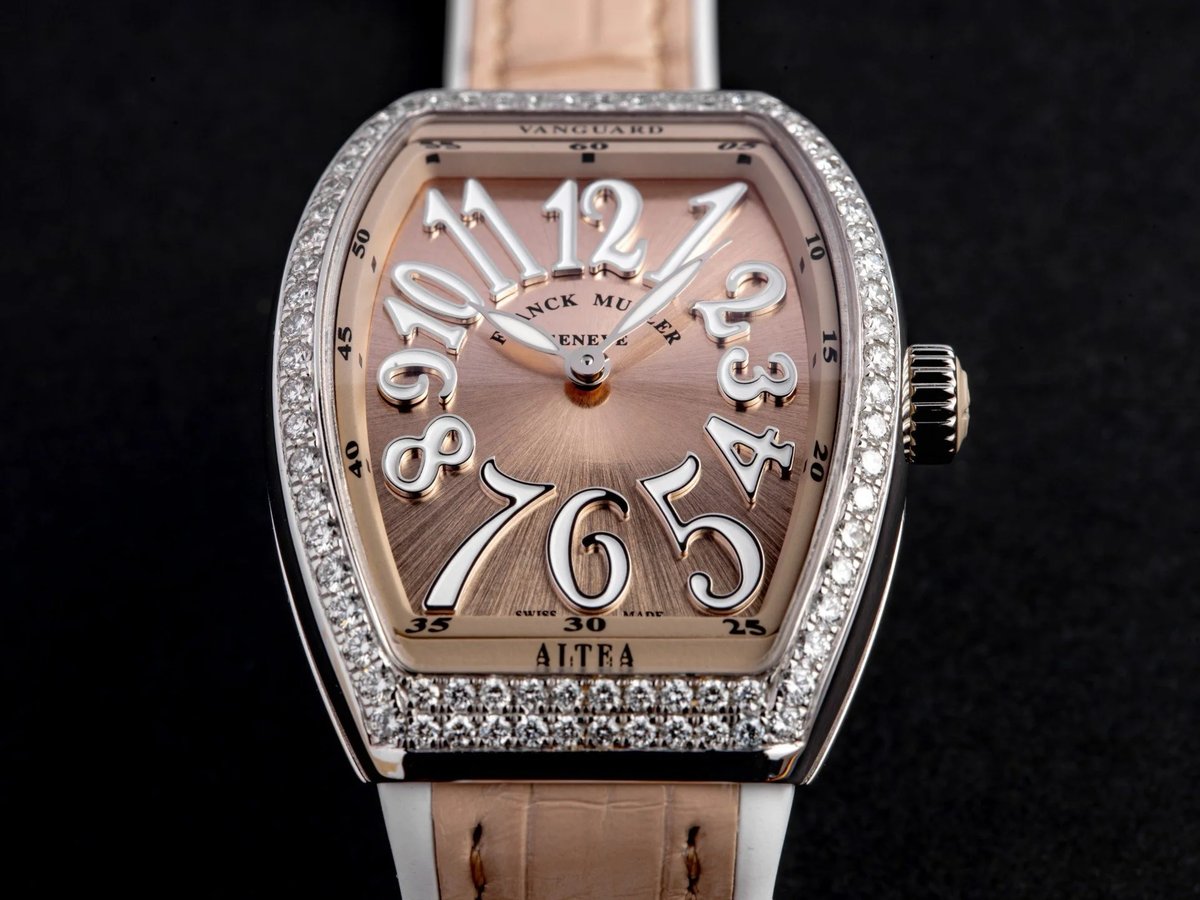
The Altea's case is the argument. Franck Muller's tonneau geometry curves in two directions, so the caseback follows the wrist instead of sitting on it like a coin. The bezel is broad enough to frame the dial properly, and the transition from bezel to caseband to strap is handled as a single continuous gesture rather than three separate decisions. That is harder to execute than it sounds, and it is the reason the Altea reads as designed rather than assembled.
Franck Muller does not publish an exhaustive dimensional spec sheet for this reference, so I will not invent one. What I can tell you is what the proportions do on the wrist: the dial opening is generous relative to the case footprint, which gives the Altea an unusually open, legible face for a tonneau design. The hour markers are applied and faceted, catching light along their edges, and the hands are broad enough to read at a glance without swallowing the dial. There is a date display, positioned to preserve the symmetry of the layout rather than to dominate it.
The dial itself is where the Altea differentiates from its siblings. The sunray-brushed, gradient finishes give the surface real depth as the light moves, and the effect is far more sophisticated in person than on a screen. Franck Muller has always been good at dial colour — the Color Dreams line proved that decades ago — and here the palette choices are tasteful rather than theatrical. If you are choosing between variants, choose on the dial first and the case metal second; the dial is what you will look at every day.
Crystal is sapphire, as you would expect at this level. Lume is not part of the design brief — this is not a watch built around darkness — and legibility in low light comes from contrast rather than luminescent paint. Water resistance is modest by sports-watch standards, so treat the Altea as a city watch: rain, handwashing and the occasional splash are fine, but verify the specific rating on your reference before you take it anywhere near open water.
The movement
Powering the Altea is a Franck Muller automatic from the brand's FM 800-series base, an in-house caliber family that has underpinned a large share of the modern Vanguard range. Franck Muller does not chase chronometer certification across this line, and the Altea's appeal is not built around movement specifications — it is built around the object as a whole.
What you get is a workmanlike automatic with roughly a 42-hour power reserve and a 4 Hz beat rate, dimensions that reflect a movement designed for reliability and serviceability rather than showcase finishing. The rotor and bridges carry decoration appropriate to the price, but this is not a watch you buy to stare at through a display back. The winding is smooth, the crown action is positive, and the date changes without drama. For a daily wearer, that is exactly the brief.
It is worth saying plainly: the movement is not the reason to buy the Altea, and it is not the reason to avoid it. It is competent, it is in-house, and it will do its job. If movement architecture is what gets you out of bed in the morning, there are better uses of this budget — but those watches will not look like this one.
On the wrist
Here is where the Altea wins people over. The curved caseback distributes the watch's mass across the wrist rather than concentrating it on a single contact point, and the integrated-look rubber strap continues that curve outward so there is no visual or physical break between case and band. The result is a large-looking watch that wears far more comfortably than its footprint implies. On a medium wrist it sits flat, stable and quiet, with almost no rotational play during a full day of typing, driving and gesturing.
Weight in steel is substantial without being tiresome — enough to remind you that you are wearing something expensive, not so much that you want it off by four in the afternoon. The rubber strap deserves particular praise: no break-in period, no sweat management issues, no bracelet scratches to obsess over, and a taper that keeps the whole assembly looking deliberate rather than chunky. The trade-off is that the strap is the wear item. Treat it as a consumable and budget accordingly, because aftermarket options for an integrated-look tonneau are limited and the OEM route is not cheap.
Small-wristed buyers should try before they commit. Tonneau cases forgive a lot thanks to their curvature, but they do not forgive everything, and the Altea has more presence than a round watch of equivalent footprint. If it fits, it fits beautifully. If it does not, no amount of dial finishing will fix it.
Accuracy and daily life
There is no chronometer certification to lean on, so set expectations at the modern-automatic baseline: roughly -5 to +15 seconds per day out of the box, with most examples settling toward the tighter half of that range after a few weeks of regular wear. Positional variation is normal. Consistency matters more than raw rate — if the numbers swing week to week, that is a service conversation rather than a regulation quirk.
In practice, the Altea is a low-drama daily wearer. Set it once a month if you rotate through a collection, or barely at all if it is your primary watch. The lack of lume is a non-issue for office and evening use, and the sapphire crystal shrugs off the kind of incidental contact that would mark an acrylic or mineral cover. This is a watch designed to be worn, not stored.
The market: resale, demand cycles and the hold-versus-sell call
Now the part that matters to anyone reading this publication. Franck Muller's secondary market is soft, and it has been soft for years. The Vanguard family, for all its commercial success at retail, does not hold value the way the integrated-bracelet steel sports watches from the major groups do. Expect pre-owned Altea examples to trade in the roughly $6,800 to $9,800 band depending on metal, dial, condition and completeness, against a retail figure in the low-to-mid five figures depending on configuration and market. That is a meaningful haircut, and it is the single most important number in this review.
The demand cycle here is brand-led rather than collector-led. Franck Muller sells through boutiques, through a wide authorized dealer network and through a strong travel-retail presence. That distribution model moves units but dilutes scarcity, and scarcity is what underpins resale. When a watch is available in every airport in the Gulf, the secondary market prices it accordingly. Add a steady flow of new Vanguard variants into the market and you get a recipe for depreciation rather than appreciation.
There is no meaningful auction history to point to. The Vanguard line rarely appears in volume at international salerooms, and when it does, the results are not the kind that get written up as market news. For a collector building a portfolio, that absence of an auction record is itself information: it tells you there is no established price-discovery mechanism beyond dealer and peer-to-peer listings, which means wider spreads and slower exits.
So what is the call? If you own an Altea and are thinking about selling, do not wait for a recovery that has not arrived in a decade. Move it during a period of brand momentum — a new model launch, a sponsorship cycle, a strong holiday quarter — and price it to the market rather than to your feelings. If you are buying, buy pre-owned. At roughly half of retail, the depreciation has already been absorbed by someone else, and the watch becomes a genuinely compelling proposition: a distinctive tonneau case, an in-house automatic, and a strap setup that makes it a real daily wearer, all for less than a mid-range steel chronograph from a mainstream brand.
The Altea is not an appreciating asset. It is a very good object available at a price that finally reflects that reality.
Service and ownership
Franck Muller does not publish a rigid service interval, preferring a condition-based approach, and that is broadly sensible for a modern automatic. In practice, most owners will be looking at a service somewhere in the five-to-eight-year window depending on wear. Costs vary by market and by what the watch needs, so get a written quote before anything is opened. For watches under warranty, stay with an authorized service center; afterward, a Franck Muller-trained independent can be a perfectly sound route, provided they can source parts. The brand's service network is thinner than the major Swiss groups, so build a relationship with a specific service point rather than assuming any competent watchmaker can handle it.
Alternatives worth considering
If you want a tonneau with more secondary-market depth, the Hublot Spirit of Big Bang delivers a similar brief with considerably better liquidity. If you want architectural design with a stronger collector narrative, the Bvlgari Octo Finissimo is the obvious port of call, though it costs more. If you want the connoisseur's answer to the same question, the Girard-Perregaux Vintage 1945 is genuinely undervalued and closer to traditional watchmaking in spirit. And if you simply want to test whether the shape works for you before committing, a sub-$200 homage will tell you more in a week of wear than any amount of reading.
None of those watches look like the Altea. That is the point. The case shape is the product, and if the case shape speaks to you, the alternatives will not.
Verdict
The Franck Muller Vanguard Altea is the rare watch from this house that makes sense on the merits rather than on the marketing. The case is sculptural, the strap integration is properly engineered, and the movement is honest, if unspectacular, work. It is comfortable in a way that tonneau cases often are not, and it carries enough design distinction to justify the wrist space it occupies.
It is also not an investment, and pretending otherwise does the watch a disservice. Buy it pre-owned, wear it hard, replace the strap when it wears out, and judge the purchase by how often it ends up on your wrist. That is the only return that has ever mattered with a watch like this.