The Tonneau, Reconsidered
There is a particular kind of watch collector who will tell you, with genuine conviction, that Franck Muller is a marketing house with a complication problem. They are not entirely wrong, and they are not entirely right. What they usually mean is that the maison sells spectacle — enormous curvilinear cases, numerals stretched like taffy, a portfolio of tourbillons and multi-axis mechanisms that read as engineering theatre. What that critique misses is that spectacle, done with conviction, is itself a design discipline.
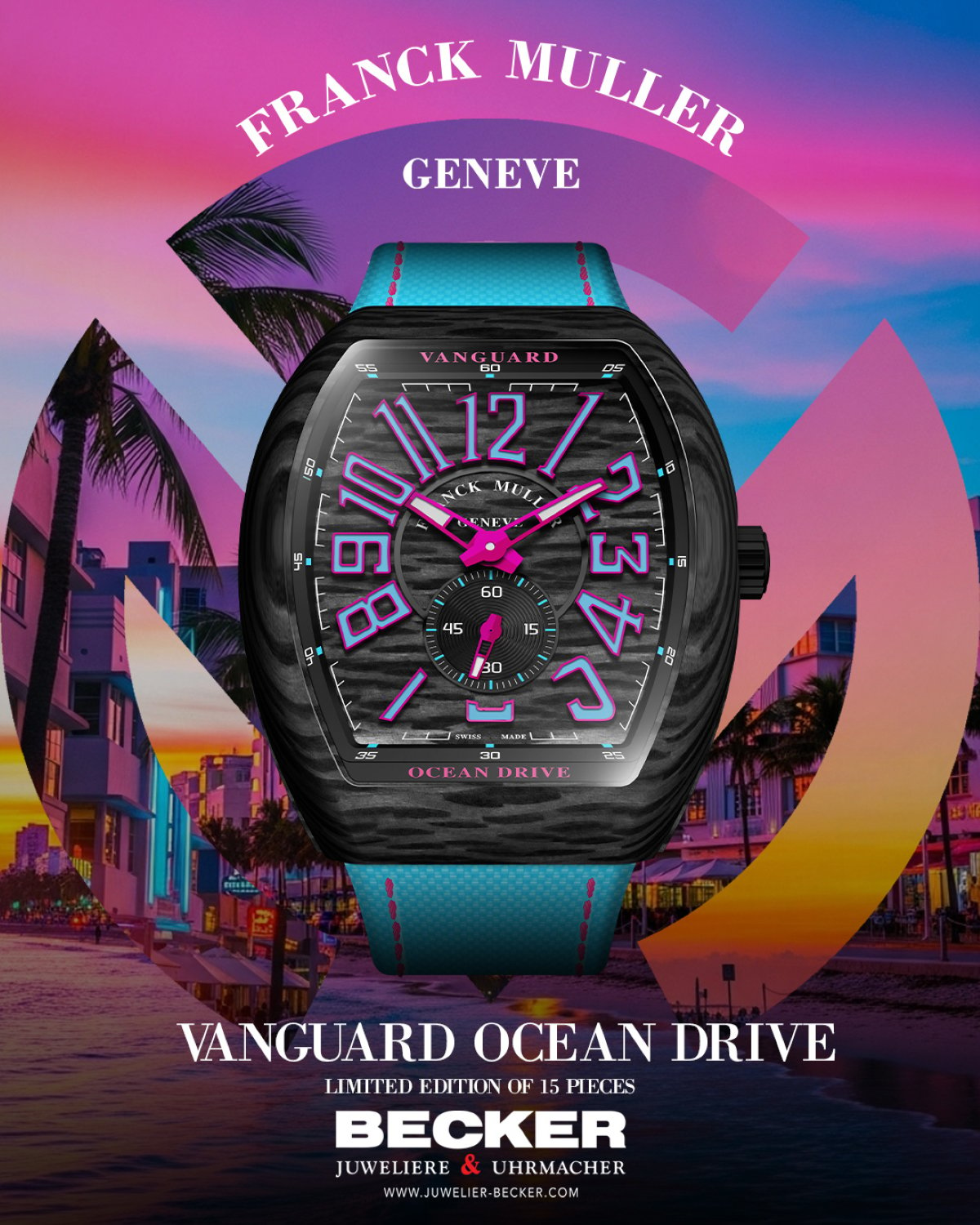
The Vanguard Ocean Drive is where that discipline becomes practical. It is a tonneau-cased automatic with a central-seconds hand, a date at six, a textured blue dial, and an integrated rubber strap that flows into the case flanks. It is not a complication watch. It is not trying to be. What it is trying to do is put the Franck Muller silhouette on the wrist of someone who wants one watch to do most things — and, crucially, to do them on a Saturday afternoon as comfortably as on a Monday morning.
The question worth answering is not whether the Ocean Drive is as serious as a Calatrava, because it plainly is not. The question is whether it earns its place as a sport-luxury daily against a market that has never been more crowded with integrated-bracelet alternatives. That requires looking at the case, the movement, the wrist, and the balance sheet — in that order.
A House Built on Silhouette
Franck Muller founded the company that bears his name in 1991, alongside Vartan Sirmakes, establishing operations in Genthod on the outskirts of Geneva. The timing was propitious. The early '90s were a period when the mechanical watch was being re-established as an object of desire rather than a tool, and Franck Muller's contribution to that revival was architectural rather than technical. The Curvex case — a tonneau that curves in both plan and profile, so that its crystal and dial follow the arc of a wrist — became the signature. The house trademarked the phrase 'Master of Complications' and spent the following decade earning it with an increasingly baroque catalogue.
The Vanguard arrived as a deliberate reinterpretation of that language for a younger buyer. Where the Curvex was Art Deco and slightly nostalgic, the Vanguard was sharper: a more aggressive tonneau, larger applied numerals with a distinct 'exploding' treatment, a case that reads as machined rather than sculpted, and — critically — an integrated strap. The Ocean Drive variant leans the collection toward the nautical and the casual, with a dial finish that suggests moving water and a rubber strap that is meant to be worn, not preserved.
Understanding that lineage matters for evaluating the watch. You are not purchasing a distillation of Swiss watchmaking's finest finishing. You are purchasing a coherent piece of industrial design from a house that has spent three decades refining exactly one idea. On that narrower, more honest brief, the Ocean Drive delivers.
Case and Dial: The Argument in Steel
The Vanguard case is stainless steel, and Franck Muller handles its surfaces with more restraint than the shape suggests. The flanks are brushed with a fine, even grain; the bezel and the case edges between the lugs receive a polished treatment that catches light along the curve. The transition between the two finishes follows the geometry of the tonneau rather than cutting across it, which is a detail most manufacturers at this price get wrong. Look closely at the point where the polished bevel meets the brushed flank near the strap attachment — it is clean, consistent, and free of the waviness that betrays rushed polishing.
The sapphire crystal sits close to the case, with only a modest dome, and the anti-reflective treatment on the underside keeps the dial readable in flat light without turning it into a mirror outdoors. There is no lume anywhere on this reference: no luminous compound on the applied numerals or the hands, which tells you what Franck Muller thinks this watch is for. It is not a diver, not a pilot's watch, not a field watch. It is an object designed for daylight.
The dial is where the Ocean Drive makes its strongest case. The base carries a textured finish — a relief pattern that reads as water or wave depending on how the light hits it — under a saturated blue that shifts from near-navy at the edges to a brighter mid-blue across the centre. Applied over that are the Vanguard's signature stretched Arabic numerals, in polished metal, with a width that deliberately overwhelms the indices they replace. It is a bold choice and it does not suit everyone; the numerals occupy visual territory that a more conventional dial would give to negative space. But the effect is deliberate and coherent, and the hands — sword-shaped, polished, with a fine bevel — are legible against the textured background because the finish scatters light away from them rather than directly back at the eye.
The date window at six o'clock is small, framed, and unobtrusive, which is the correct decision for a dial this busy. The printing is crisp. There is no cyclops, no magnifier, and no attempt to make the aperture a design feature. It simply does its job and steps aside.
The FM 800: An Honest Engine
Inside is the calibre Franck Muller designates FM 800, an automatic with central seconds and a date function. It runs at 28,800 vibrations per hour and provides approximately 42 hours of power reserve. The architecture is built on an outsourced ébauche, subsequently finished within Franck Muller's own workshops, and the house does not submit it for COSC certification.
That set of facts will end the conversation for some collectors, and it is worth being clear-eyed about why. At this price point, Zenith will sell you an in-house El Primero derivative, Girard-Perregaux will sell you manufacture calibre credentials, and Grand Seiko will sell you finishing that embarrasses watches at twice the money. Franck Muller's answer is that the movement is not the point of this watch. The case is the point, and the movement is required to be reliable rather than remarkable.
Judged on that basis, the FM 800 is competent and, importantly, honest about itself. The finishing is visible through the sapphire caseback: Côtes de Genève striping across the oscillating weight, perlage on the bridges, blued screws, and a signed rotor that turns with an audible but not obnoxious whir. The thinness of the base calibre is what allows the tonneau case to avoid the slab-sided look that afflicts so many shaped watches. There is a functional elegance to that choice.
The practical advantage of an outsourced base is serviceability. The FM 800's architecture is well understood by the independent repair trade, which means you are not held captive to a single service centre or a five-figure overhaul invoice. For a watch intended to be worn, that is not a compromise. It is a feature.
On the Wrist
The Vanguard's great achievement is that a case this distinctive manages to disappear into the wrist. The mechanism is the curvature of the lugs: rather than projecting laterally and forcing the watch to sit on top of the wrist bone, they arc downward and inward, so the caseback settles close to the skin. Combined with a rubber strap that integrates into the case flanks with minimal visible gap, the result is a watch that feels anchored rather than balanced on a fulcrum.
The strap deserves its own paragraph. It is a purpose-moulded rubber, not a generic cut length, with a taper that reduces bulk near the buckle and a subtle texture that matches the dial's relief. The deployant clasp is well executed — positive engagement, no sharp edges against the underside of the wrist, and no rattle. It does mean the strap must be cut to size rather than adjusted through holes, so resizing is a workshop job, and second-hand buyers should always confirm the strap has not already been trimmed to a small wrist.
Two caveats. First, this is a tall case through its centreline, and the tonneau profile means that height sits proud of the wrist rather than being disguised by a domed caseback. Under a fitted dress shirt cuff, it will catch and drag. Second, the case is substantial in width as well, so smaller wrists should look seriously at the V41 configuration before committing. The watch wears like a sport watch, not a dress watch, and it should be bought as one.
There is no luminous material on this reference, which is consistent with the design brief but worth noting for anyone who wants a watch they can read at 2 a.m. in a hotel room. This is a daylight instrument.
Accuracy and Daily Ownership
Factory regulation on the FM 800 is adequate rather than exceptional. In practice, examples that have been worn regularly for a few months tend to settle into a range of roughly plus four to plus ten seconds per day, with the usual positional variation you would expect from the architecture — dial up versus crown down versus worn on the wrist. The date mechanism changes cleanly. There is nothing here that requires an obsessive temperament.
It is a watch that benefits from being worn. Like most automatics with a modest power reserve, it holds rate best when it is on the wrist regularly and kept within a reasonable state of wind. If you rotate through several watches, a winder is a sensible accessory rather than a luxury; if it is your daily, you will never think about it.
Living With It
The Ocean Drive is at its best in the situations its name suggests: a weekend in the Mediterranean, a lunch that runs into the evening, a Tuesday at a desk where nobody else is wearing a tonneau. It pairs happily with a linen shirt, a cashmere polo, or a well-cut blazer over an open collar. It looks out of place with a tuxedo and slightly self-conscious with a formal suit and French cuffs — not because it is casual, but because the case height and the strap's profile demand room.
Travel is a genuine strength. The rubber strap shrugs off heat, water and humidity; the date is useful across time zones even without a GMT function; and the design does not invite the kind of attention that makes a luxury watch awkward in unfamiliar places. The lack of a screw-down crown is a reminder that this is a lifestyle object rather than a diving instrument, and it should be treated accordingly.
The Money Question
Franck Muller's retail pricing has long been ambitious relative to the secondary market, and the Vanguard line is no exception. New, the Ocean Drive sits in the low five figures — a number that places it directly against watches with in-house movements, chronometer certification, and stronger brand equity in the collector community.
Pre-owned, the arithmetic changes completely. Vanguard automatics trade in the high single-digit thousands to low four figures depending on configuration, condition, and whether the original strap and box are present. At that level, the watch becomes a genuinely interesting proposition: you are paying for a distinctive case architecture, credible finishing, and a rubber-strap daily wearer that nobody else at the table owns. What you are not paying for is investment potential. Prices have drifted downward since launch and show no sign of reversing meaningfully.
The auction record offers no relief. The Vanguard Ocean Drive has no meaningful auction history; Franck Muller's saleroom activity clusters around early Curvex complications and the Aeternitas series, neither of which lifts the broader catalogue. Buy this watch because you want to wear it, and buy it at the level where somebody else has already absorbed the depreciation.
Servicing
Franck Muller's recommended service interval is roughly five years under normal wear, and an authorised service will typically run in the high hundreds of dollars assuming no component replacement is required. The good news, as noted, is that the FM 800's outsourced architecture means a competent independent watchmaker with access to parts can handle routine servicing at a lower cost. Authorised-only servicing is not a practical necessity here, which is unusual and welcome at this price point. Always ask for documentation of prior service on a pre-owned example, and confirm the rubber strap has not been cut to a small size.
Alternatives Worth Considering
If you want the same integrated-strap, shape-forward brief with more horological substance, the Zenith Defy Skyline is the obvious rival — angular, in-house, and considerably more legible in low light. The Hublot Classic Fusion is the closest philosophical peer, and it is arguably the Ocean Drive's most direct competitor: both are case-first watches, both rely on an outsourced base movement, and both ask you to buy a silhouette rather than a résumé. Girard-Perregaux's Laureato offers manufacture credentials and a flatter profile for buyers who want the integrated look without the tonneau drama. Corum's Heritage Artisan Tonneau makes a similar shape argument at a comparable secondary-market entry point.
What none of them replicate is the specific Franck Muller gesture: the stretched numerals, the textured dial, the way the case seems to have been machined from a single confident idea. If that gesture appeals to you, the alternatives will feel like compromises. If it does not, no specification sheet will change your mind.
Verdict
The Vanguard Ocean Drive is a better watch than its reputation suggests and a less important watch than its retail price implies. On the wrist it is comfortable, distinctive and genuinely usable; in the hand it is finely enough finished to reward a close look without pretending to haute horlogerie standards it was never built to meet. The FM 800 is an honest, serviceable engine, and the absence of COSC certification is a fact to accept rather than a flaw to forgive at this price.
Buy it pre-owned, buy the configuration that suits your wrist, and wear it without ceremony. It will not appreciate, and it does not need to. What it offers instead is a silhouette that no round steel sports watch can match and a daily-wear proposition that is far more sensible than the maison's more theatrical output. In a market saturated with integrated-bracelet sameness, that is a real argument.