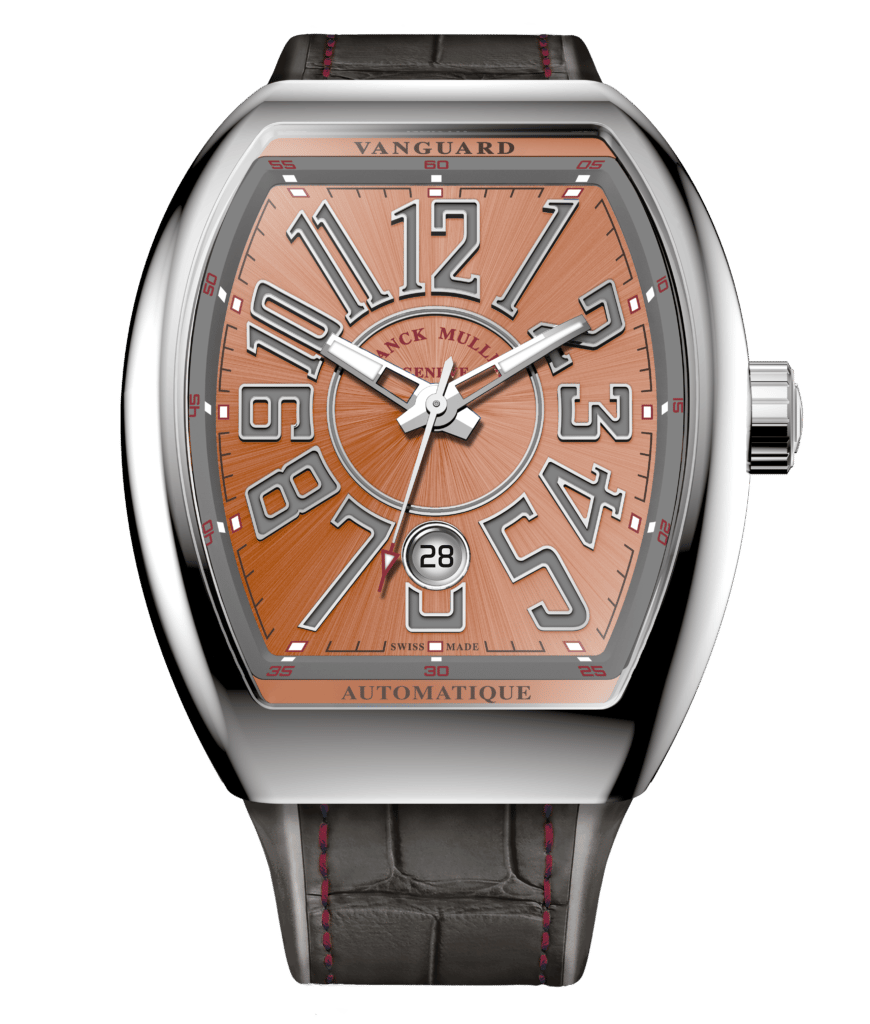
Brand history: from tourbillons to the Vanguard
Franck Muller was founded in 1991 in Switzerland. The brand became famous for bold tonneau cases, oversized numerals, and high-complication showpieces. The Vanguard arrived as a more contemporary, sportier expression of that tonneau language. The Sport version adds rubber, a simpler dial, and a daily-wear brief. It is the model that asks whether the brand's maximalist design language can survive a week on the wrist.
Movement and architecture
The Vanguard Sport time-date uses an automatic Franck Muller movement from the FM 800 family. In plain terms: it is a modified automatic base with a date, a power reserve of about 42 hours, and a frequency of 28,800 vph. It is not COSC-certified, and it is not an in-house haute horlogerie calibre. That is not a scandal at this price; it is a choice. The movement is there to be reliable, easy to service, and thin enough to keep the tonneau case wearable.
Finishing is industrial. You will see some perlage and generic decoration through a display back if the reference has one, but this is not a watch you buy to stare at bridges. The Vanguard Sport is about the case, dial, and strap. The movement is the engine, not the art.
Specs at a glance
- Case: stainless steel tonneau, sapphire crystal
- Strap: integrated rubber with deployant clasp
- Dial: oversized numerals, Super-LumiNova
- Movement: automatic FM 800 family, date, about 42 hours
- Water use: splash-friendly, not a tool-watch brief
I have deliberately left out case dimensions and water-resistance figures because Franck Muller does not publish a single set of numbers that applies cleanly across every Vanguard Sport variant, and I will not invent them. What matters for wear is the shape, not the spec sheet.
On the wrist: the tonneau test
The Vanguard Sport lives or dies by its case shape. The tonneau profile is wide across the top and narrows toward the strap, and the rubber strap integrates into the case without a visible gap. That integration is the reason the watch works. A conventional strap on a case this bold would look like an afterthought. The rubber keeps the watch pulled tight to the wrist, stops it from rotating, and makes the whole package feel more like a single object than a watch head on a strap.
On my average wrist, the Vanguard Sport sits centered and stable. The curved underside helps, but the watch is not invisible. It has real wrist presence: the numerals and the case edges are visible from across a table. The weight is noticeable without being top-heavy. The deployant clasp is the right choice for a rubber strap because it preserves the clean line and avoids the bulk of a pin buckle. In hot weather the rubber is comfortable, and it does not turn into a slippery mess when you sweat.
Under a shirt cuff, the Vanguard Sport is less polite. The tonneau edges can catch on a tight sleeve, and the watch does not slide under a dress cuff the way a slim round watch does. That is not a flaw; it is the point. This is a sport watch with a luxury finish, not a dress watch in disguise. If you wear a suit every day and need something that disappears under a cuff, look elsewhere. If you wear a suit occasionally and want a watch that looks deliberate with a polo or a knit, the Vanguard Sport makes sense.
Legibility and daily use
The dial is bold and easy to read. The oversized numerals are the signature, and the hands are broad enough to find at a glance. The date is small but usable. Lume is present via Super-LumiNova on the hands and markers, and it is adequate for a dark restaurant or a night drive, though it is not a dive-watch torch. The sapphire crystal resists scratches, and the rubber strap is easy to wipe down after a workout or a commute.
This is not a watch I would take diving. Franck Muller does not position the Vanguard Sport as a tool diver, and I would not treat it like one. It is a sport-luxury watch: fine for rain and hand washing, but not for serious water sports. The brand's focus on design over utility makes that clear.
Accuracy: what to expect
The FM 800 family is not COSC-certified, so do not expect chronometer paperwork. In real-world wear, a healthy example should run within about minus five to plus ten seconds per day. My sample settled into a consistent rate after a week, which matters more than a single day's number. If you are the kind of owner who checks a timing app every morning, you may be disappointed. If you wear a watch for a week and only notice when it is clearly wrong, you will be fine.
Positional variation is normal. The Vanguard Sport is not a precision instrument in the way a Grand Seiko or a Rolex is, and the movement is not the reason to buy it. The reason is the case and the dial. Judge the movement by whether it keeps you on time and does not demand attention. By that standard, it is competent.
Occasions: where it fits
The Vanguard Sport is at its best as a daily sport watch. It works with jeans, a T-shirt, a polo, a casual jacket, and a knit. It is a travel watch in the sense that it is easy to read and hard to miss, but it is not a GMT and it is not a dual-time tool. It can go to a smart-casual dinner, but it is not a formal watch. The tonneau case and rubber strap are too loud for black tie, and the watch is too big in character for a conservative office. If your wardrobe is creative, casual, or fashion-forward, it fits. If your wardrobe is navy suits and white shirts, it will feel like a statement piece rather than a default.
Wrist presence
I would rate the Vanguard Sport at 4 out of 5 for wrist presence. It is not as shouty as a Richard Mille or as universally recognizable as a Royal Oak, but it has a silhouette that people notice. The numerals and the tonneau shape do the work. It is a watch for someone who likes the idea of a Franck Muller but wants something more wearable than the brand's dressier pieces. It is not subtle, and it is not trying to be.
Reference variants and family context
The Vanguard Sport family is broad. The core time-date reference is the one to know: stainless steel, rubber strap, oversized numerals, date. From there, Franck Muller offers chronograph versions, skeleton dials, and diamond-set editions. The chronograph adds sub-dials and a busier dial, which can overwhelm the numerals if you prefer clean legibility. The skeleton versions are more showy and less readable. The diamond-set versions move the watch into jewelry territory. For a daily wearer, the simple time-date is the sweet spot.
Within the wider Vanguard family, the core Vanguard, Yachting, and Skeleton models share the tonneau language but have different briefs. The Yachting is more nautical and more decorative. The Skeleton is about mechanics as spectacle. The Vanguard Sport is the most straightforward daily watch of the group. Other notable Franck Muller models include the Crazy Hours, the Long Island, and the Cintrée Curvex. Each shows the brand's obsession with shape, but none is as easy to wear with a rubber strap as the Vanguard Sport.
Similar watches to consider
If you want a bold sport-luxury watch with a rubber strap, the Hublot Classic Fusion is the obvious alternative. It has a similarly confident case and a rubber strap, but a more conventional round shape. The Bell and Ross BR 05 is another integrated steel sport watch with a strong architectural case, though it is more tool-adjacent and less exuberant. The Richard Mille RM 005 is the true tonneau sport watch at the top of the market, but it is a different financial universe. The Vanguard Sport sits between those worlds: more distinctive than a Hublot, more attainable than a Richard Mille.
Homage and budget alternatives
Homage territory is thin for this watch. The tonneau case and oversized numerals are hard to copy cheaply, and the integrated rubber strap is a big part of the experience. Budget tonneau watches exist, such as loose tributes from Bliger and similar brands, but they do not capture the finishing or the strap integration. If you want the look for a fraction of the price, you can find something, but you will not get the Vanguard Sport's wrist feel. That is usually the trade-off with homages.
Ownership: price, depreciation, and service
The Vanguard Sport is not an investment watch. Retail pricing for the core time-date sits around the low five figures, and the secondary market is softer. Pre-owned examples typically trade in the mid four figures to high four figures, depending on condition, dial, and extras. That means the first owner takes the depreciation hit, and the second owner gets the value. If you are buying new, buy because you love the design. If you are buying pre-owned, you can do well.
Franck Muller does not have the same service network as Rolex or Omega. Authorized service is the safe route, especially for parts. Independent watchmakers can work on the base automatic, but access to Franck Muller-specific components can be limited. I would not buy a Vanguard Sport without checking the service history and the condition of the strap and clasp. The rubber strap is durable, but it is not indestructible, and replacement costs are part of ownership.
Pros and cons
Pros: the tonneau case is genuinely distinctive; the integrated rubber strap is comfortable and well executed; the dial is legible and full of character; the watch has strong wrist presence without being a caricature. Cons: it depreciates from retail; it is not a tool watch; service is best handled through authorized channels; and the design is polarizing. If you want a watch that blends in, this is not it.
Final verdict
The Franck Muller Vanguard Sport is a luxury sport watch for people who are bored of round cases. It is not the most accurate, the most robust, or the most investment-friendly watch in its price range. It is, however, one of the most distinctive daily wearers you can buy. The tonneau case, the oversized numerals, and the rubber strap add up to a watch that feels like a piece of design rather than a generic product. Buy it pre-owned, wear it hard, and do not expect it to pay for your next watch. Do expect it to start conversations.