Frederique Constant in thirty seconds
Frederique Constant was founded in Geneva in 1988 by Peter and Aletta Stas, which makes it younger than most of the collectors who now buy it. That youth is not a footnote — it is the whole business model. The brand built its reputation on classical Swiss design and increasingly sophisticated movements at prices that undercut the established houses by a wide margin, and it did so as an independent for nearly three decades before Citizen Watch Group acquired a majority stake in 2016.
Citizen's backing changed the scale of the operation without changing the pitch. Frederique Constant still sells value-density rather than heritage. You are not buying a maison with a 150-year archive; you are buying access to Swiss watchmaking at a rational premium over Japanese and micro-brand alternatives. For a young collector, that is arguably a more honest transaction than paying five figures for a name and a service bill.
The flip side is that Frederique Constant has never been able to shake its position as the smart-but-unfashionable choice. It is the brand a knowledgeable buyer recommends to a friend who is not a watch person. That is a compliment, and it is also a resale problem, and we will get to both.
Where the Classics Premiere sits in the catalogue
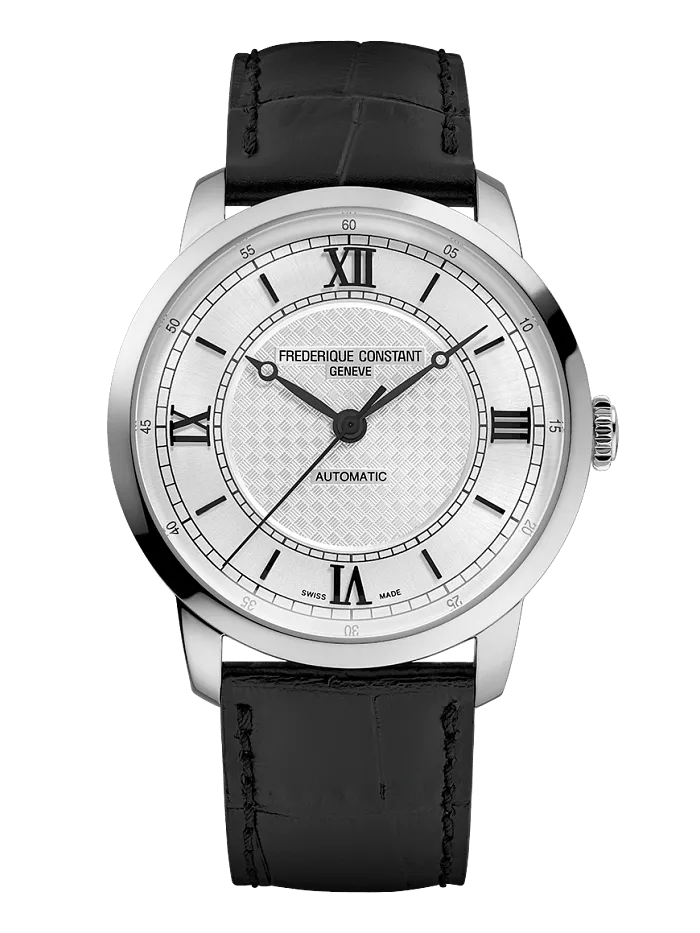
Frederique Constant's catalogue is unusually dense for a brand of its size, and the Classics family is the spine of it. Within that family, the Premiere occupies the purest dress-watch territory: stainless steel case, clean dial, leather strap, no lume, no rotating bezel, no pretence at sporting capability. It is not trying to be a one-watch collection, and it is not trying to be a GADA piece. It is a formal watch, marketed as a formal watch, priced as a formal watch.
That clarity of purpose is rarer than it sounds. Most sub-two-thousand-dollar watches try to cover too much ground — a little sportiness here, a little water resistance there — and end up looking like they were designed by committee. The Premiere does not. Its design language is deliberately conservative: applied indices, a restrained handset, a dial that reads as silver-white rather than stark white, and a case that is polished where it should be and flat where it needs to be.
If you want the broader context, the Classics Index and the Slimline are the stablemates worth understanding. The Index is the slightly more everyday-oriented automatic; the Slimline strips the concept down further; the Classics Moonphase carries the FC-705 caliber and doubles the price. The Premiere sits between the Index and the Moonphase, and for a lot of buyers it is the right resting point.
The movement: Caliber FC-301
The reference number tells you the caliber before you even open the spec sheet. FC-301 is the automatic workhorse that anchors Frederique Constant's mechanical range — a Swiss ébauche-based movement, widely understood to be Sellita-derived, finished and assembled under the brand's own roof. It beats at 4 Hz, it carries a date function, and it is about as exotic as a Toyota powertrain.
That is not an insult. It is the single most important thing to understand about this watch.
Let me be blunt about what the FC-301 is not. It is not a manufacture caliber in the sense that phrase is used in auction catalogues. It does not have hand-bevelled bridges or a free-sprung balance. It does not carry a chronometer certificate, and Frederique Constant does not pretend otherwise. If you are the kind of collector who reads movement finishing under a loupe, this is not your watch and no amount of rationalisation will change that.
What the FC-301 is, however, is robust, well-understood, and universally serviceable. Its architecture is shared with a huge proportion of the Swiss mid-market, which means any competent independent watchmaker can strip, clean and regulate it without needing parts flown in from Geneva. For a first or second mechanical watch, that matters far more than a decorated bridge nobody will ever see. The day your watch stops and the nearest authorised service centre is a four-hour round trip, you will understand exactly what you paid for.
The date function is worth a note. Frederique Constant keeps the calendar display unobtrusive, which is the correct decision — a dress watch should not be interrupted by a chunk of white real estate at three o'clock. It is there because buyers expect it, not because the design demands it.
The case and dial: restraint as a design decision
The case is stainless steel, polished on the flanks, with sapphire crystal over the dial. There is no luminous treatment anywhere on the watch, which is exactly right — a dress watch that glows in the dark is a dress watch that has misunderstood its own brief. The absence of lume also means the hands and indices can be finished properly rather than painted, and the overall effect is cleaner and more expensive-looking than the price suggests.
The dial is the part that earns the watch its keep. Silver-white with a soft sheen rather than a flat matte, applied indices rather than printed ones, and a handset that is slim enough to feel formal without becoming hard to read. Nothing on this dial is shouting. There is no open heart, no visible date wheel architecture, no gratuitous texture. Frederique Constant has, at least here, resisted the temptation to add features that would photograph well on a product page and look cheap in person.
The strap is the weak link. Frederique Constant fits a leather strap with a pin buckle that is perfectly adequate and entirely forgettable. It will crease, it will darken at the buckle, and within a year it will be the oldest-looking part of an otherwise clean object. This is not a criticism unique to Frederique Constant — most watches at this price ship with a compromise strap — but it is the first thing a new owner should change. A deep brown or oxblood leather on this case transforms the watch for well under a hundred dollars.
On the wrist
The Premiere wears the way a dress watch should: it gets out of the way. Because the design is built around a formal brief rather than a compromise sports brief, the case sits close to the wrist rather than riding above it. There is no bezel bulk, no crown guards, and no visual noise competing with the dial. It disappears under a shirt cuff, which is the entire point, and it does so without the slightly-too-small hesitancy that afflicts some entry-level dress watches trying to look understated.
Comfort is a non-issue. The leather strap softens quickly, the case is light enough to forget about by mid-morning, and the balance on the wrist is neutral — no top-heaviness, no tendency to rotate. This is a watch you put on at seven in the morning and do not think about again until you take it off. For a formal watch, that is the highest compliment available.
The one caveat is presence, and I want to be honest about it. This watch does not project. If you are used to a diver or a chronograph, the Premiere will feel almost apologetic on the wrist for the first week. That is a feature, not a bug — but it is worth being clear-eyed about, because a lot of buyers purchase an understated watch and then quietly resell it three months later because they miss the weight.
Accuracy and daily life
The FC-301 is not a chronometer and Frederique Constant does not market it as one, so set expectations accordingly. A healthy example should hold within roughly ten to fifteen seconds a day in normal wear, with positional variation doing most of the work. That is entirely normal for a Swiss ébauche-based automatic at this price, and it is not a reason to avoid the watch.
It is, however, a reason to buy carefully. On the secondary market, a Premiere with no service history and a vague description is a gamble — not because the movement is fragile, but because regulation and a basic service are costs you should price in before you commit. A seller who will show you a timegrapher reading is worth a premium of fifty dollars over one who will not. Regulation is cheap; discovering the problem after the return window has closed is not.
Day to day, the ownership experience is frictionless. Sapphire means you do not think about scratches. The absence of lume means you do not think about charging it. The date means you set it once a month. There is no screw-down crown ritual, no bezel alignment anxiety, no lume anxiety. It is a watch that asks nothing of you, which after a few years of collecting is a surprisingly rare quality.
One practical note: this is a dress watch, and it should be treated as one. Frederique Constant does not position the Premiere as a sports piece and the specification reflects that. Do not plan on pool duty, and do not assume it will shrug off a weekend of manual labour. Buy a beater for that and keep this one for the occasions it was designed for.
The resale maths, which is where this gets honest
Frederique Constant does not hold value, and anyone who tells you otherwise is selling you something. The Premiere lists in the low four figures depending on market and configuration, and the pre-owned market settles comfortably below that for examples in good condition with box and papers. The depreciation is steep, it happens immediately, and it is not recoverable.
This is not a scandal. It is the structural reality of entry luxury. Brands without auction presence, without waitinglists and without a collector base do not hold value, because the secondary market prices watches on desirability rather than quality — and desirability is manufactured over decades, not engineered in a catalogue. Longines has the same problem at a similar price point. Baume & Mercier has it worse. Frederique Constant is in respectable company.
The practical consequence is straightforward: buying this watch new is a poor decision and buying it pre-owned is a very good one. At the bottom of the pre-owned range you are paying roughly what a mid-tier Seiko Presage costs, for a Swiss automatic dress watch with sapphire crystal and a case that photographs like something twice the price. That is genuine value, and it is the only version of this transaction that makes sense for a discerning buyer.
Liquidity is the other consideration. If you need to sell a Premiere quickly, you will take a haircut and you will wait. The buyer pool is smaller than it is for a Tudor or an entry-level Omega, and it is considerably less motivated. Treat this as a watch you buy to wear, not a watch you buy to trade. There is no auction history to speak of and there is unlikely to be one.
What it competes with
At retail, the obvious alternatives are the Longines Master Collection, the Baume & Mercier Classima and, if you stretch, the Tudor 1926. The Longines has better brand recognition and a marginally stronger finishing package; the Classima is the closest direct competitor on design intent; the Tudor is a step up in every measurable respect and priced accordingly. None of them is a dramatic upgrade, and all of them depreciate similarly.
The more interesting comparison is the Nomos Tangente. It costs roughly twice as much, but it offers an in-house Glashütte movement and a design pedigree that Frederique Constant simply cannot manufacture. If you are buying one dress watch and you intend to keep it for fifteen years, the Nomos is the better long-term purchase. If you are buying your first formal watch and you want to preserve capital for a diver or a chronograph later, the Premiere pre-owned is the more sensible allocation.
And then there is the budget end, which deserves respect. An Orient Bambino or a Timex Marlin Automatic will give you eighty per cent of the visual effect for a fifth of the price. The Frederique Constant wins on case finishing, crystal quality, movement serviceability and the simple satisfaction of owning something Swiss and properly made — but anyone pretending the gap is enormous is flattering the more expensive watch.
Service and ownership cost
Because the FC-301 is ébauche-based, you are not locked into an authorised service centre. Any competent independent watchmaker can service it, and the cost should land in the few-hundred-dollar range for a full strip and clean, less for a simple regulation. That flexibility is worth real money over a decade of ownership, and it is the strongest practical argument for buying a watch with a movement like this rather than something more exotic at the same price.
Frederique Constant does not publish an aggressive service schedule, and the pragmatic approach is to service when the watch tells you it needs it — declining amplitude, worsening accuracy, or a rotor that sounds like it is complaining. For a dress watch worn a few days a week, that could be a long time.
The verdict
The Classics Premiere is one of the more honest watches in entry luxury. It does not pretend to be an heirloom, it does not pretend to be a sports watch, and it does not pretend that a Citizen-owned Geneva brand carries the same weight as a maison on the Rue du Rhône. What it does is deliver a well-proportioned, well-finished, mechanically sound formal watch that looks considerably more expensive than it is and asks nothing of its owner beyond a strap change.
Buy it pre-owned. Buy it at the bottom of the range. Buy it from a seller who will show you a timegrapher. Then put the savings into a good leather strap and stop thinking about it — because thinking about it is how collectors talk themselves into spending four times as much on a watch that does the same job. The Premiere is not an investment and it is not a statement. It is a tool for a specific social situation, and it performs that function with more grace than its price tag has any right to expect.
Hold or sell?
Neither, honestly. This is a wear-it watch. If you already own one, there is no scenario in which selling makes financial sense — you have already absorbed the depreciation and the proceeds will not buy you anything meaningfully better without adding substantial money. If you are considering buying, the only defensible entry point is the pre-owned market, and the only defensible reason to buy is that you need a dress watch and you like how this one looks. That is a low bar, but it is the correct one.