Astronomy at a Human Scale
The moonphase is watchmaking's most romantic complication and, for most of its history, one of its most expensive. For decades a working moon disc meant a manufacture movement, a module stacked on a base caliber, or both — and the invoice that came with either. Frederique Constant's contribution to that conversation has always been democratic: put the sky on the dial, keep the case honest, and price it where a first serious watch buyer can reach it. The Classics Quartz Moonphase, reference FC-206RN3S6, is that argument in its purest form.
It is a dress watch before it is anything else. A round, restrained case, a sapphire crystal, a moon aperture with a date, and a leather strap. Nothing here is designed to shout across a dinner table. What it asks of you is not a winding ritual but a battery every few years — and in exchange it hands back a complication most Swiss houses still charge four figures for.
This is not a watch for someone counting balance-wheel oscillations. It is for the collector building slowly, who wants one genuinely poetic dial among the divers and chronographs, and who would rather spend the difference on a second watch than on a rotor. Judged on those terms, the case is considerably stronger than the price suggests.
The House Behind the Dial
Frederique Constant was founded in Geneva in 1988 by Peter Stas and Aletta Stas-Bax, a Dutch couple who built the company around a simple proposition: classical Swiss watchmaking, executed with discipline, sold at prices that did not require a family office. For its first fifteen years the brand was a canny assembler — good cases, good dials, Swiss movements sourced from established suppliers, and a marketing instinct for the traditional vocabulary of horology.
Then it changed. By the mid-2000s Frederique Constant had begun developing its own movements at its Geneva facility, a path that eventually produced in-house automatics and, crucially for this review, Manufacture moonphase calibers. That matters. A brand that only ever made quartz moonphases would be selling costume jewellery; a brand that builds mechanical moonphases for four figures and quartz ones for one figure is offering a deliberate ladder, and the cheaper rung is legitimate precisely because the expensive one exists.
In 2016 the company joined Citizen Watch Co.'s watch group, alongside Alpina and Ateliers deMonaco. The industrial backing has not diluted the classical brief: the Classics collection remains the brand's centre of gravity, and the quartz moonphase sits near its accessible floor.
The Case and the Crystal
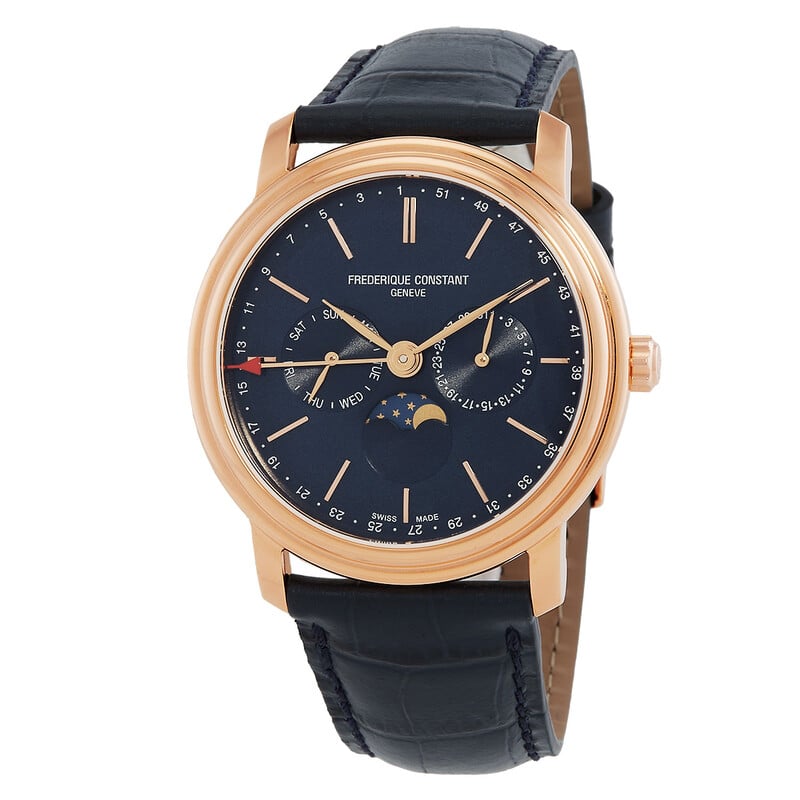
The case is a straightforward round shape with a slim bezel, which is exactly the right decision on a watch whose entire appeal is a picture at six o'clock. Every millimetre the bezel surrenders goes to the dial, and the dial is the reason you are here. Surfaces carry a high polish — the sort of clean, unobtrusive finishing Frederique Constant has always managed well at this price — and the warm gold-tone finish of this reference reads richer in person than the specification suggests, particularly in low evening light.
The crystal is sapphire, which is not a given at this end of the market and is one of the quiet reasons the watch holds up to daily wear. There is no anti-reflective fussiness to discuss and none needed; the dial stays readable from most angles, with the usual brief flare when a light source lines up directly.
The caseback is closed, which will disappoint exactly nobody. On a quartz caliber of this sort there is nothing to see, and Frederique Constant has resisted the temptation to fit a sapphire window onto an unfinished plate. Water resistance is modest, as it is on virtually every leather-strapped dress watch — treat it as splash-resistant and take it off before you swim.
The Dial: A Sky at Six
Here is the reason to buy it. At six o'clock a circular aperture opens onto a moon disc: a deep blue sky scattered with stars, with a golden moon that rotates through the aperture as the lunar month advances. It is a small piece of theatre, and it works because everything around it is quiet. The hour markers are restrained, the minute track is finely printed, and the hands are shaped for a dress watch rather than a sports one — slim enough to look correct over a cuff, long enough to reach the track.
Alongside the moon sits a date, which is the practical correction to an otherwise purely decorative dial. A moonphase-only watch is beautiful and slightly useless; adding the date makes the FC-206RN3S6 a watch you can actually run a week on. Legibility is good. The aperture does not crowd the markers, and the dial avoids the trap of many affordable moonphases, which is to fill every remaining square millimetre with guilloché, printing, or applied hardware until the moon has nowhere to breathe.
The design is classical without being a pastiche. It will look correct with a suit today and in fifteen years, which is more than can be said for most watches at this price that try harder.
The FC-206 Caliber
Inside is a Swiss quartz caliber that Frederique Constant catalogues as the FC-206 — the same designation embedded in the reference number, since the brand's nomenclature leads with the movement. It runs at the standard 32,768 Hz quartz oscillator frequency. The moon disc is driven from the going train through the conventional two-moon reduction used across the industry: a disc printed with two lunar faces, advanced one step per day, so that roughly every twenty-nine and a half days a new moon slides into the aperture.
There is no finishing to discuss, because there is no way to see it, and that is the honest arrangement. What matters in a quartz caliber is the quality of the module stacked on top of it — the smoothness of the moon disc's advance, the precision of the aperture cut, the security of the date mechanism. On this evidence the module is well executed: the disc steps cleanly, the date changes without hesitation, and nothing about the operation feels improvised.
The practical consequence of quartz is worth stating plainly, because it is the whole ownership proposition. The watch does not need winding, does not drift meaningfully between services, and does not require you to develop a relationship with a mainspring. You set it, you wear it, and every two or three years you have the cell replaced. For a collector with three or four mechanical watches already, that is a virtue rather than a compromise: the moonphase is always running, always correct, always ready.
On the Wrist
The watch wears as a dress watch should: light, balanced, and easy to forget. The case sits low and slips beneath a shirt cuff without negotiation, which is the entire point of a piece like this. There is no heft to manage and no crown pressing into the back of the hand; the whole object stays out of the way until you turn it over and look at six o'clock.
The leather strap and pin buckle are the correct pairing. A bracelet would introduce visual noise the dial does not need, and a deployant at this price tends to feel like an afterthought. The low mass means the watch never lists to one side, and the rounded case profile keeps the edges from catching on a jacket sleeve. Set it, wear it, forget it, and look down occasionally for the reason you bought it.
Timekeeping and the Moon
Quartz calibers in this class are typically specified to within about a quarter of a minute per month, and in practice you should expect to correct the time four or five times a year — or, more realistically, once at each daylight-saving change. That is the trade: a watch that is more accurate than almost any mechanical piece you own, and correspondingly less interesting to talk about.
The moon disc is a separate matter. A conventional two-moon reduction drifts about one day against the true synodic month every two and a half years or so. Reset the moonphase whenever the battery is changed — which is also the moment to reset the date — and it will stay credible for the life of the cell. The procedure is simple: consult a reference for the current phase, advance with the corrector, and stop when the disc matches. It takes a minute and it is, quietly, one of the more satisfying interactions you will have with any watch.
What Ownership Looks Like
Servicing is the least dramatic part of the proposition. Battery replacement is work for any competent jeweller or watchmaker, ideally with a gasket check at the same time. A full overhaul is rarely economic on a quartz caliber at this price, and most owners will simply run the watch until a movement replacement becomes the sensible option. Frederique Constant's service network handles the model, and so do most independents.
On value, be clear-eyed. Retail sits around the thousand-dollar mark; pre-owned examples trade meaningfully below that, typically in the mid-hundreds depending on condition and whether the original strap and box survive. This is a depreciating asset in the financial sense and an appreciating one in the practical sense: a moonphase that costs less to own than a mid-range smartphone contract, and will outlast several of them. Buy it to wear.
The Alternatives
The obvious step up is Longines' Master Collection Moonphase, an automatic with genuine horological credibility and roughly twice the outlay. Raymond Weil's Maestro Moonphase occupies similar territory with a busier dial. Baume & Mercier's Classima offers the dress-watch brief without always offering the moon. Montblanc's Star Legacy Moonphase is the more ornate, more expensive answer to the same question.
Below the Frederique Constant, the honest alternatives are not moonphases at all. Orient's Sun & Moon offers a day/night disc rather than a true lunar display, and various high-street moonphase homages put a rotating disc on the wrist for under two hundred and fifty dollars — with finishing to match. The FC-206RN3S6 occupies the narrow band in between: a real moonphase, properly built, without the compromises of the very cheap or the price of the very good.
Verdict
The FC-206RN3S6 is the most persuasive argument for Frederique Constant's entire philosophy: a real complication, properly executed, at a price that does not require a justification to a spouse. It is not a collector's object in the auction sense, and it makes no apology for being a quartz watch. What it does is put a rotating moon and a legible classical dial on the wrist of someone who might otherwise own neither — and for a young collection, that is a genuinely useful thing.
Wear it with tailoring, wear it on a Friday, wear it to the sort of dinner where nobody asks about your watch and the one person who does will nod. That is the whole brief, and Frederique Constant has met it.