The collaboration nobody gate-keeps
Car watches have become a genre of their own, and like most genres they've drifted toward the expensive end. Chopard's Mille Miglia, TAG Heuer's Carrera, Richard Mille's everything — the message is consistent: if you want motor racing on your wrist, you'll pay for the privilege. Frederique Constant has spent two decades quietly ignoring that message.
Since the early 2000s, the Geneva-based house has been the naming partner of the Vintage Rally Healey, a regularity rally for Austin-Healey owners that runs through the Alps and beyond. The watches built to commemorate it have always been the honest end of the collaboration spectrum: steel cases, leather straps, sensible automatics, prices that a Healey owner might actually spend on something other than parts.
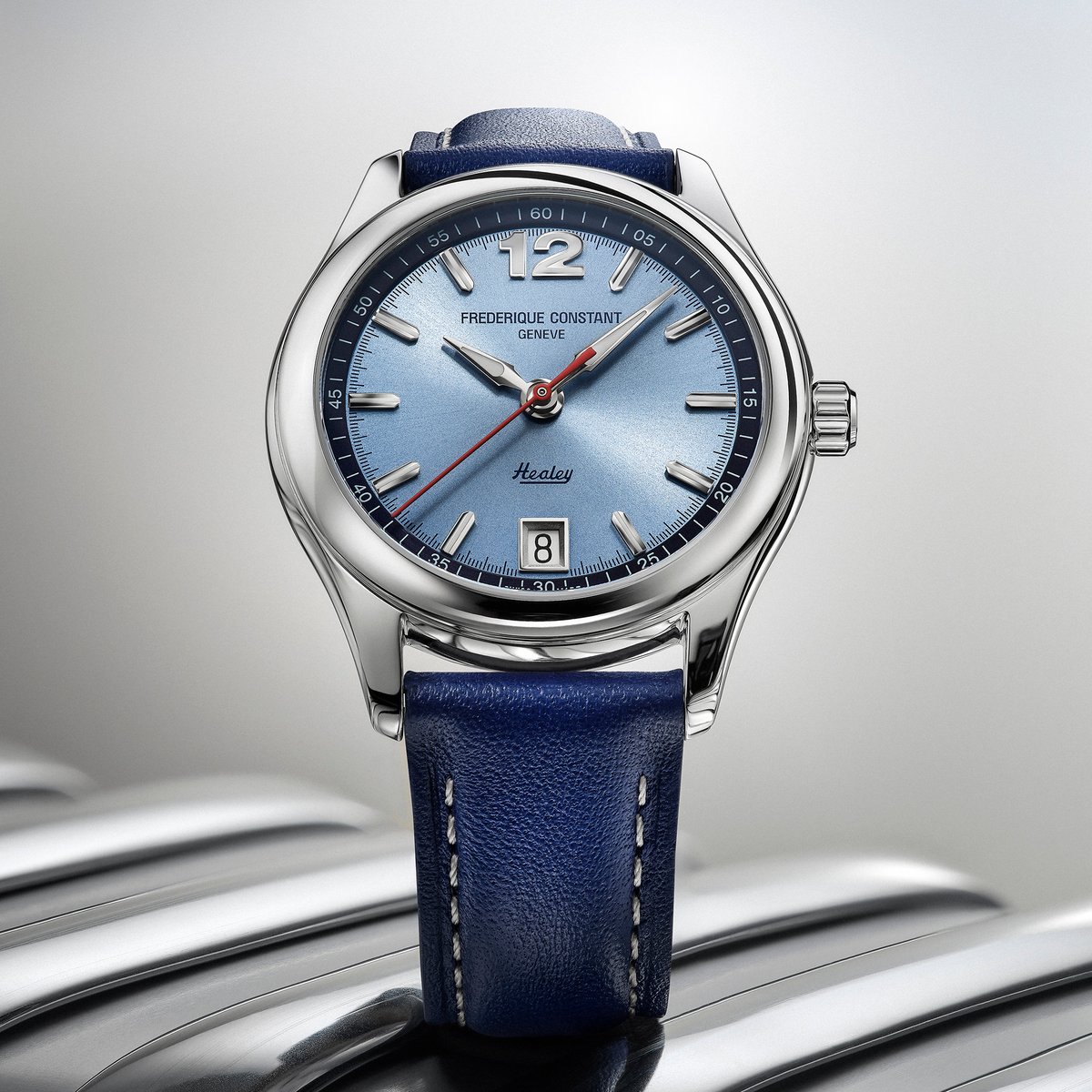
The Classics Vintage Rally Healey Automatic, reference FC-301HGRS5B26, is the current expression of that philosophy. Green dial — British racing green, the shade the works cars wore — a date, a Sellita-based automatic, and a price that lands comfortably under two thousand dollars. There is no carbon, no skeletonised wheel, no numbered plaque. There is just a very well-judged dress watch with a story attached, and that turns out to be enough.
Frederique Constant in thirty seconds
Peter Stas and Aletta Stas-Bax founded Frederique Constant in Geneva in 1988 with a thesis that the Swiss industry had stopped believing: that you could build a proper Swiss watch and sell it to people who weren't yet collectors. The company has since moved into in-house calibres, silicon escapements and the Highlife sports line, and it sits alongside Alpina under a group now owned by Citizen.
But the Classics collection is where the brand made its name, and the Vintage Rally Healey sits inside it as the most personality-forward sub-line. These are annual editions, usually limited, often refreshed with a new dial colour or a different Healey motif. That cadence matters for buyers: it means the specific reference you're looking at has a finite production run, but it also means the market is never short of a Healey automatic in some form.
The dial is the whole argument
Let's be direct — you don't buy this watch for the movement, the case architecture or the finishing. You buy it for a green dial that Frederique Constant got right when a lot of more expensive brands get it wrong.
British racing green is a difficult colour. Push it too dark and it reads as black in anything but direct sun; push it too light and it becomes a fashion watch. The Healey edition lands in the middle, with a sunray finish that shifts from near-forest in low light to something distinctly emerald under a window. It's the kind of dial that makes people lean in at a table without quite being able to say why.
Around it, the design language is deliberately conservative. Applied baton indices, a slim bezel, vintage-adjacent typography, a discreet date at three, and Healey branding that stays on the right side of subtle. The hands are simple and legible. There is no lume to speak of, which is the correct decision for a watch like this — luminous plots would have broken the spell.
The case is polished stainless steel with the soft, rounded lugs Frederique Constant uses throughout the Classics line, and it's capped with sapphire. The overall effect is less 'racing chronograph' and more 'the watch a Healey owner wears to dinner after a day in the car', which is precisely the brief.
The movement: honest, not heroic
Inside is the FC-301, an automatic with roughly 38 hours of power reserve running at 28,800 vibrations per hour. It's Sellita-based rather than one of Frederique Constant's in-house Manufacture calibres, and that single fact will decide the purchase for a lot of people.
If you came to the brand because of its in-house work — the silicon escapements, the Slimline Moonphase Manufacture, the Worldtimer — the FC-301 will feel like a step down. If you came because you want a mechanical watch you can actually live with, it's the opposite. Sellita-based movements are the reason a watchmaker in most cities can service this thing without shipping it back to Switzerland, and the reason parts are available and reasonably priced.
Finishing is industrial but tidy: light Geneva striping on the rotor, perlage across the bridges, nothing you'd photograph through an exhibition caseback. That's fine. This is a movement designed to do a job quietly and for a long time, and it will.
How it wears
The Healey is a watch that disappears under a cuff. The case is balanced toward the slim side, and the rounded lugs mean it sits down close to the wrist rather than perching on top of it. The leather strap is supple out of the box and the pin buckle is simple enough that you stop noticing it within an hour.
That restraint is the point. If you're used to divers or integrated-bracelet sports watches, the Healey will feel almost apologetic on first wear. Give it a week and the appeal becomes obvious: it slides under a shirt cuff, doesn't snag on a jacket lining, and never announces itself across a dinner table. It is a watch for people who like watches, not for people who like being noticed wearing one.
It is not, however, a watch you'd take into water or wear to the gym. Between the leather strap, the absent lume and the dress-watch brief, it's a fair-weather companion. Treat it accordingly and it will age gracefully; treat it like a tool watch and the strap will tell on you first.
Accuracy and daily life
The FC-301 is not a chronometer and Frederique Constant doesn't pretend otherwise. In real-world use, Sellita-based automatics at this frequency typically settle into a window of roughly minus ten to plus fifteen seconds a day, and individual examples often do better once they've run in. Expect ordinary positional variation: crown-up overnight nudges the rate one way, dial-up the other. None of this requires a timing machine. It requires you to stop checking your phone for the time.
Power reserve is around 38 hours, which means the watch will survive a day off the wrist but not a weekend in a drawer. If you rotate your collection, a winder is worth considering; if you don't, this is a watch that wants to be worn every day anyway.
The collector's arithmetic
Let's be honest about the money. The Healey Automatic sits in the same bracket as a mid-range Longines or a well-specced Oris, and it depreciates in the same way. Buy new and you'll take the usual hit; buy pre-owned from someone who bought it for the rally and wore it a handful of times, and you'll be into a Swiss automatic with a genuinely distinctive dial for less than the cost of a decent quartz dress watch from a fashion house.
There's no auction market to speak of. Healey editions occasionally turn up at small themed sales or charity auctions connected to the rally itself, but nobody is building a position in Frederique Constant Classics. The people who pay a premium for these are the people who own the car.
Which is the right frame entirely. This is a watch bought with affection, not thesis. If it appreciates, that's a bonus; if it doesn't — and it won't — you still got a decade of pleasure out of something that cost less than a service on a German sedan.
What else to look at
If you want the racing connection with more brand heat, the Chopard Mille Miglia Classic is the reference point, at several times the money. TAG Heuer's Carrera Date occupies similar conceptual ground at a higher price and with a stronger resale story. Longines' Heritage Classic gets you comparable vintage-inflected design and better brand recognition for roughly the same outlay, and Oris's Big Crown Pointer Date offers more wrist presence and a similar independent-Swiss sensibility.
At the homage end, Orient's Bambino and Timex's Marlin Automatic will get you the mid-century look for a fraction of the price — but neither carries the rally provenance, and provenance is the entire reason to choose the Healey.
The verdict
The Vintage Rally Healey Automatic is the rare collaboration watch that doesn't overplay its hand. It doesn't pretend the FC-301 is a Manufacture calibre, doesn't pretend the case is titanium, and doesn't pretend the pin buckle is a deployant. What it does is give you a beautifully chosen dial colour, a reliable Swiss automatic and a case that behaves itself under a cuff — for less than a set of tyres on the car that inspired it.
Buy it because the idea of a Healey on your wrist makes you smile. That's the only investment case this watch has ever needed.