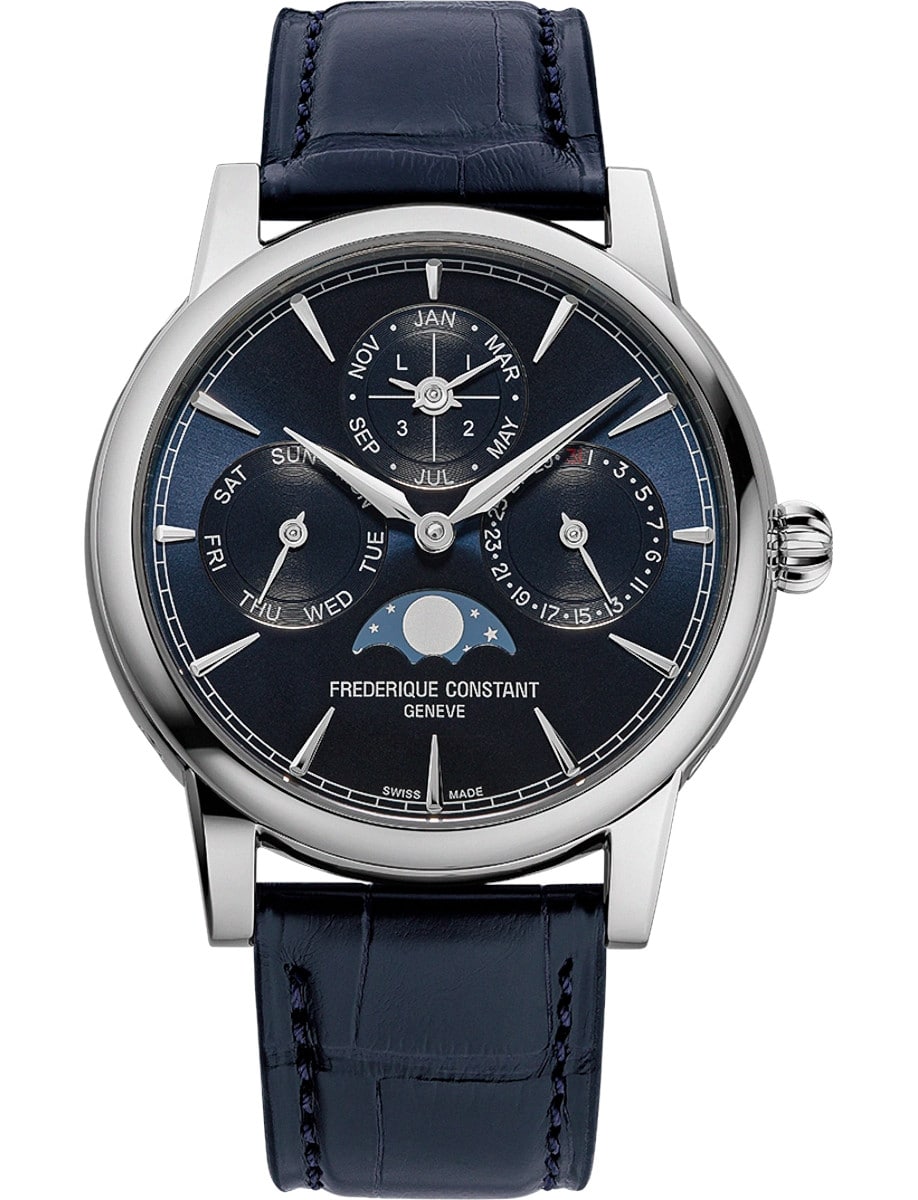
Reference FC-776S3H6 sits at the intersection of two very different collector instincts: the hunger for actual complication, and the allergy to paying for a logo. The perpetual calendar has always been the patrician complication, the one that lives in safes and gets mentioned in auction catalogues. Frederique Constant did not invent the affordable perpetual calendar, but it came closer than anyone to making one that does not feel like a compromise.
This review breaks down what the FC-776 actually is, how it wears on the wrist, what it costs to keep running, and whether, in a market where steel sports watches have become a form of currency, a perpetual calendar at this price is a smart buy or a beautiful dead end.
The perpetual calendar's awkward class problem
Watch complications have a hierarchy, and the perpetual calendar sits near the top of it for a reason. A chronograph counts seconds. A GMT tracks a second time zone. A perpetual calendar tracks the actual structure of the Gregorian calendar, accounting for 28-day Februaries and the leap-year cycle that recurs every four years and skips three times a century. Program a mechanical watch to do that and you have essentially built a small, lubricated computer that runs for decades without correction.
Which is why the complication has historically been reserved for the very top of the market. A perpetual calendar from Patek Philippe, Audemars Piguet, or Vacheron Constantin has traditionally started in the high five figures and climbed from there. That pricing is not arbitrary: the mechanism is complex to design, complex to assemble, and complex to service, and the brands that make them have spent a century building the mythology that justifies the number.
Frederique Constant's argument, made quietly and repeatedly over the past decade, is that the mythology is the expensive part, not the mechanism. That argument is either thrilling or heretical depending on which side of the boutique you stand on. Either way, it produced a watch that makes the perpetual calendar accessible to a collector who has a mortgage.
Frederique Constant: the Geneva outsider that went in-house
The brand was founded in 1988 by Peter and Aletta Stas, a Dutch couple who started with a simple proposition: well-made Swiss watches at prices that did not require a second mortgage. For its first fifteen years Frederique Constant was a competent, value-oriented label with a slightly anonymous reputation. Then, in 2004, it did something that changed the trajectory of the company: it developed and manufactured its own movement, the Heart Beat calibre, with the balance wheel exposed on the dial as a visible declaration of intent.
Going in-house is expensive and slow, and most brands at this price point never attempt it. Frederique Constant did, and the decision compounded. The company now produces a broad range of manufacture calibres from its facility in Plan-les-Ouates, including tourbillons, worldtimers, flyback chronographs, and the perpetual calendar that sits inside this reference. Citizen Watch Group acquired the company in 2016, which gave it supply-chain stability and global distribution without dismantling the value proposition.
The relevant point for this review is that the perpetual calendar is not a bought-in module dropped into a generic case. It is a movement the brand developed and builds itself, which is why the price is what it is.
The FC-776: a mechanical calendar that thinks for itself
The calibre that gives this reference its number is an in-house automatic carrying a perpetual calendar mechanism, driving day, date, month, leap-year indication, and a moonphase. It runs at 28,800 vibrations per hour with a power reserve in the region of 38 hours, which is modest by modern standards and worth flagging: this is not a watch you can leave in a drawer for a week and pick up again without a resetting ritual.
The architecture follows a familiar pattern for value-driven complicated watches. The base automatic provides the timekeeping and the winding, and the calendar works are stacked on top. That approach keeps development costs down compared with an integrated perpetual calendar calibre, and the practical trade-off is a movement that is taller and slightly less elegant than the integrated designs found at ten times the price. What you get in exchange is decoration: Geneva stripes, blued screws, and a movement that is finished well enough to be worth looking at through the caseback.
Operating the calendar is done through recessed pushers, and there are the usual rules of engagement. Do not adjust the calendar while the mechanism is engaged in its changeover window, typically in the evening hours, and do not expect a quickset date. This is a watch that wants to be kept running. Put it on a winder, or wear it in rotation with discipline, and the ritual disappears. Let it stop for a month and you will be reaching for a pin and a printed instruction card.
On the wrist
This is a dress watch first and a complication showcase second, and it wears accordingly. The stainless steel case is polished on the flanks with brushing where it matters, and the caseband sits low enough that a shirt cuff slides over it without a fight. The leather strap is supple out of the box rather than the cardboard that some value-priced Swiss straps arrive as, and the whole package reads light on the wrist in the way a calendar watch should. You forget you are wearing it, which is the highest compliment a dress piece can receive.
The caveat is balance. Four registers plus a moonphase is a lot of information on one dial, and on a smaller wrist the layout can feel busier than a two-hand dress watch. The reward is that the dial rewards close inspection: the subdials are legible at a glance once you learn the geography, and the leap-year indication is the sort of detail that turns a watch into a conversation piece at dinner. The light silver-toned dial in this reference keeps things formal without tipping into fussiness.
It is not a wrist presence piece in the loud sense. Nobody at the next table will clock it. But among people who read dials, it registers immediately, and that is a different and arguably better kind of attention.
Living with it: accuracy, service, and ownership
There is no chronometer certification here, and Frederique Constant does not market this calibre as a precision instrument. In practice, expect real-world performance in the neighbourhood of a few seconds a day in either direction once the watch has settled into a routine, with variation driven more by wearing habits than by the movement itself. If you demand certified accuracy, this is not the watch for you, and you already knew that.
Servicing a perpetual calendar is not the same as servicing a three-hand automatic. The mechanism has to be correctly synchronised when it is reassembled, and a generalist watchmaker who has never handled a modular calendar will either refuse the job or make a mess of it. Budget for an authorised service centre rather than your local independent, and expect a routine overhaul to land in the several-hundred-dollar range rather than the flat fee a simple automatic commands. That is the cost of entry for a mechanical calendar, and it applies whether the watch cost five thousand dollars or fifty thousand.
Water resistance is modest on a watch of this type, which is worth saying plainly: this is not a watch to swim in. Sapphire crystal protects the dial, and the case is stainless steel, but the leather strap and the dress-watch brief tell you everything you need to know about its natural habitat. It lives under a cuff, in an office, at dinner, and occasionally at a wedding.
The alternatives matrix
The obvious rival is Montblanc's Heritage Perpetual Calendar, which occupies similar territory and offers a comparable proposition, though it is typically a limited-run proposition and far harder to find at retail. Baume & Mercier's Clifton Perpetual Calendar is the more conservative option, with a rounder case and a quieter dial, for collectors who want the complication to blend in rather than announce itself.
Astep up in money brings IWC's Portugieser Perpetual Calendar, which is roughly double the price and delivers considerably more wrist presence and brand recognition. Further up again is Jaeger-LeCoultre's Master Ultra Thin Perpetual Calendar, which is the connoisseur's pick and a different category of watchmaking altogether: thinner, more finely finished, and priced accordingly.
What none of them do is undercut the Frederique Constant on raw complication-per-dollar. That is the entire thesis of this watch, and it holds up under scrutiny.
Money talk
Let us be honest about the financial picture, because pretending otherwise does a disservice to anyone considering a purchase. Frederique Constant does not carry the secondary-market gravity of the big houses. Retail for this reference sits in the region of nine thousand dollars, and pre-owned examples trade meaningfully below that, typically in the mid four figures to around seven thousand depending on condition, box, and papers. That is a depreciating asset, not an appreciating one.
There is no meaningful auction history to speak of. These watches trade on the secondary market rather than at hammer, and the results cluster well below retail. If you are buying this as an investment, you have misunderstood the brief. If you are buying it because the alternative is a five-figure perpetual calendar you cannot justify, the maths works out very differently: the depreciation you take on this watch is smaller in absolute terms than the premium you would pay for a comparable complication from an established maison.
Verdict
The FC-776S3H6 is the smartest way into a perpetual calendar that does not involve a home equity loan. It is not the most finely finished watch in its class and it will not make you money, but it delivers a genuinely complicated, genuinely in-house mechanical brain for the price of a mid-tier chronograph. Buy it because you love the idea of a watch that knows more about the calendar than you do, and wear it until 2100 proves it right.