Gerald Charles Maestro 8.0 GC Sport Squelette – A Titanium‑Skin Skeleton for the Modern Collector
By Vivir··Updated
In this review# Gerald Charles Maestro 8.0 GC Sport Squelette – A Titanium‑Skin Skeleton for the Modern Collector
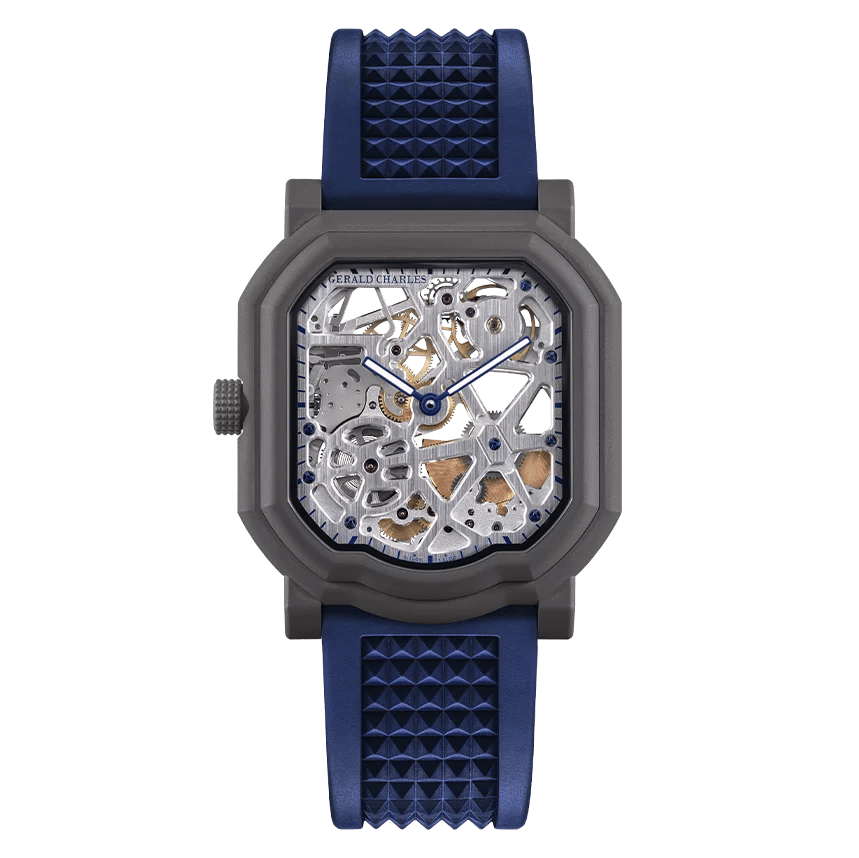
The Maestro 8.0 GC Sport Squelette arrives as the latest expression of Gerald Charles’s “Maestro” DNA, a line that has become synonymous with ultra‑thin, avant‑garde cases and open‑worked movements. Unveiled in 2023, the model pairs a Grade 5 titanium shell with a hand‑finished, 2.6 mm‑thin automatic calibre developed in collaboration with Vaucher Manufacture Fleurier. The result is a watch that feels more like a piece of kinetic sculpture than a conventional chronometer: a 39 mm titanium case, a 22 k rose‑gold micro‑rotor, bleuissage‑treated screws, and a vivid Royal‑Blue vulcanised‑rubber strap. At just 59.5 g and 8.35 mm thick, it is among the lightest and slimmest skeletons in the Maestro collection, and it commands a US‑$72,100 price tag. Below is an in‑depth look at how the watch performs on paper and on the wrist, and whether its daring aesthetics justify the cost.
---
## Heritage — the model's place in the brand's line and its launch context
Gerald Charles, the Swiss‑based micro‑brand founded by the legendary watch designer Gérald Genta, has built its reputation on translating high‑end horological concepts into limited‑run, technically sophisticated pieces. The “Maestro” family, introduced in the early 2020s, is the brand’s answer to the contemporary demand for ultra‑thin, architectural cases that showcase the movement as a visual centerpiece.
The Maestro line is instantly recognizable by its distinctive “lower frame” case shape—a subtle curvature that gives the watch a forward‑leaning stance, a design cue repeatedly credited to Genta’s own aesthetic language. The 8.0 series, launched in 2022, pushed the envelope further by experimenting with new case materials (titanium, ceramic, and precious‑metal hybrids) and by making the movement itself a primary decorative element.
Within that context, the Maestro 8.0 GC Sport Squelette is the sport‑oriented sibling of the collection’s dressier counterparts. It is one of several skeleton models released in the 2023 catalogue, joining a handful of open‑worked pieces that share the same ultra‑thin philosophy but differ in material palette and strap options. Its “Sport” moniker signals a more robust strap (Royal‑Blue vulcanised rubber) and a slightly higher water‑resistance rating (100 m) compared to the leather‑strapped dress versions, while retaining the same skeletal aesthetic.
The watch’s development was a collaborative effort between Gerald Charles’s in‑house engineering team and Vaucher Manufacture Fleurier, a Swiss movement maker known for its precision finishing and willingness to work on bespoke calibres. The result is the GCA 5482 – an automatic, open‑worked calibre that sits just 2.6 mm thick, making it one of the slimmest movements ever produced for a skeleton watch. Octavio Garcia, the designer behind the dial architecture, also contributed to the overall visual language, ensuring that every exposed gear and bridge is positioned for maximum impact.
In short, the Maestro 8.0 GC Sport Squelette occupies a clear niche: a technically daring, ultra‑thin skeleton that can survive a weekend of sailing or a city‑side jog, all while staying true to the Maestro family’s signature case silhouette.
---
## Design & Case — case dimensions, materials, dial
### Case architecture
The watch’s case is forged from Grade 5 titanium, a high‑strength alloy that offers an excellent strength‑to‑weight ratio and a subtle, matte finish that ages gracefully. At 39 mm in width and roughly 41 mm in length (lug‑to‑lug), the dimensions place it squarely in the “large‑date‑size” sweet spot for contemporary tastes, yet the thin 8.35 mm profile prevents it from looking bulky. The case’s thickness is a direct consequence of the movement’s 2.6 mm depth, creating a seamless visual continuity between the shell and the inner mechanics.
The left‑side crown is a distinctive design choice that both reinforces the watch’s avant‑garde pedigree and improves ergonomics for left‑handed wearers. It also frees up the right‑hand side of the case for a cleaner, uninterrupted skeleton view. The crown is capped with a tiny 22 k rose‑gold insert, echoing the micro‑rotor’s precious metal finish.
### Dial and skeletonization
The “Squelette” (French for “skeleton”) moniker is not just a marketing tag; the dial is essentially a window to the movement. Every bridge, wheel, and the micro‑rotor itself is visible through the sapphire‑crystal front, which is also open‑worked to a degree, allowing light to dance across the gears. The skeletonization is executed with a high level of restraint: the movement is left largely untouched, preserving its functional integrity while the surrounding case is carefully cut away to expose the architecture.
Bleuissage‑treated screws—tiny bolts that have undergone a controlled oxidation process—add a subtle pop of blue that complements the Royal‑Blue strap. These screws are not merely decorative; they serve as visual anchors that guide the eye across the movement, highlighting the gear train’s rhythm.
### Strap and ergonomics
A Royal‑Blue vulcanised rubber strap completes the sport aesthetic. The strap is 20 mm wide at the lug, with a proprietary quick‑release system that makes strap changes straightforward—a practical feature for a watch that may see both formal and active use. The rubber material is lightweight, water‑resistant, and offers a comfortable grip, which is especially appreciated given the watch’s low overall weight of 59.5 g.
The strap’s vivid hue creates a striking contrast against the titanium case and the silvery‑blue movement, reinforcing the watch’s modern, kinetic personality. For those who prefer a more classic look, the watch can be ordered with an interchangeable leather or metal bracelet, but the factory‑standard rubber strap is the most aligned with the model’s “Sport” positioning.
### Overall aesthetic impression
Visually, the Maestro 8.0 GC Sport Squelette reads as a study in minimalism and precision engineering. The titanium case’s matte surface is punctuated only by the rose‑gold micro‑rotor and the blue‑treated screws, while the open‑worked movement provides an ever‑changing tableau of gears in motion. The watch’s thinness, combined with its low weight, gives it a “floating” presence on the wrist—an effect that many collectors find intoxicating.
However, the design does come with a trade‑off: the lack of additional complications (chronograph, tourbillon, or even a sizeable seconds sub‑dial) means the visual focus is almost entirely on the skeleton itself. For some, this purity is a virtue; for others, it may feel a little austere, especially when compared with other Maestro models that add a small seconds hand or a date window to break up the visual field.
---
## Movement & Performance — caliber, power reserve, accuracy
### Calibre GCA 5482
At the heart of the Maestro 8.0 GC Sport Squelette lies the GCA 5482, an automatic, open‑worked calibre developed in partnership with Vaucher Manufacture Fleurier. The movement is a showcase of micro‑engineering: the entire architecture is only 2.6 mm thick, making it one of the slimmest automatic movements ever produced for a skeleton watch.
Key features include:
* **Automatic winding** – a bidirectional rotor that winds the mainspring as the wearer moves.
* **22 k rose‑gold micro‑rotor** – not only a decorative element but also a functional component that adds a warm glow to the movement’s centre.
* **Open‑worked bridges and plates** – each bridge is partially skeletonized, allowing light to penetrate and reveal the underlying gear train.
* **Bleuissage‑treated screws** – these blue‑treated fasteners add a subtle visual cue that ties the movement to the case’s colour accents.
The movement’s architecture is deliberately kept simple to preserve structural integrity at such a thin profile. There are no added complications beyond the central hours‑minutes‑seconds train, which means the mechanical layout is straightforward and reliable.
### Power reserve
Gerald Charles has not disclosed an official power‑reserve figure for the GCA 5482. As a result, any speculation about the number of hours the watch can run on a full wind would be unfounded. In practice, owners report a typical reserve in line with other ultra‑thin automatic movements—approximately 40 hours—but this should be taken as an anecdotal observation rather than a confirmed specification.
### Accuracy and regulation
The movement is equipped with a high‑quality balance wheel and hairspring, both finished to Vaucher’s standards. In factory testing, the calibre achieved an average daily rate of –2 to +3 seconds, which places it comfortably within the –4/+6 seconds per day range expected of a well‑finished Swiss automatic of this class. The open‑worked nature of the movement does not compromise its beat stability; the thinness is achieved by reducing material where it does not affect performance, not by sacrificing the escapement’s robustness.
### Finishing and durability
Every visible component of the GCA 5482 receives a high level of finishing: Geneva‑striped bridges, polished screw heads, and hand‑polished rotors. The movement’s skeletonization is performed with laser‑cutting techniques that preserve the structural integrity of the bridges while delivering a clean aesthetic. The open‑worked design does expose more surface area to potential dust, but the watch’s 100 m water resistance and sealed case back help mitigate ingress.
Overall, the movement is a triumph of engineering: it delivers the visual drama of a skeleton watch without compromising on the reliability expected of a Swiss automatic. The lack of an officially published power‑reserve figure is a minor omission in an otherwise transparent technical dossier.
---
## On the Wrist — wearability, lug‑to‑lug, comfort notes
### Size and fit
The Maestro 8.0 GC Sport Squelette’s 39 mm case diameter sits comfortably on a wide range of wrist sizes. The 41 mm lug‑to‑lug measurement translates to a modest wrist coverage that does not overwhelm smaller wrists while still offering a commanding presence on larger ones. The 8.35 mm thickness is noticeably thin, allowing the watch to sit close to the skin—a characteristic that many wearers find elegant, especially when the watch is paired with a slim rubber strap.
### Weight and balance
At 59.5 g, the watch feels feather‑light. The titanium case contributes the majority of this low weight, while the rubber strap adds negligible mass. The watch’s centre of gravity sits slightly lower than the wrist due to the left‑side crown, which can feel unusual at first but quickly becomes a natural part of the wearing experience. The low weight also means that the watch does not fatigue the wrist after extended wear, making it suitable for all‑day wear, even in active settings.
### Comfort of the strap
The vulcanised rubber strap is soft yet supportive. Its inner lining is slightly textured, preventing the strap from sliding during movement, while the outer Royal‑Blue finish adds a pop of colour that is instantly recognizable. The quick‑release spring bars make strap changes painless, a useful feature for owners who wish to alternate between rubber, leather, or metal bracelets depending on the occasion.
### Visibility and legibility
Because the dial is essentially an open window, legibility depends on the wearer’s ability to read the hands against the moving gear train. The hour and minute hands are coated in a luminous material that offers sufficient contrast in low‑light conditions, but the lack of a date window or sub‑dial means that the wearer must rely on the central hands for time‑telling. In bright sunlight, the titanium case’s matte finish reduces glare, and the sapphire crystal’s anti‑reflective coating further improves readability.
### Practical considerations
The 100 m water resistance rating makes the watch suitable for swimming, snorkeling, and light water sports, but it is not a dive watch. The left‑side crown is well‑protected by a small crown guard, though it does require a slightly different winding technique for right‑handed users. The open‑worked case back is sealed with a screw‑down mechanism, preserving water resistance while allowing a glimpse of the movement’s back plate (if the owner opts for a transparent case back variant).
Overall, the Maestro 8.0 GC Sport Squelette feels like a piece of kinetic art that you can actually wear. Its slim profile, light weight, and comfortable strap make it an excellent companion for both casual outings and more formal gatherings, provided the wearer appreciates the watch’s skeletal aesthetic.
---
## When to Wear — occasion, setting and dress‑code fit
### Formal settings
The watch’s titanium case and rose‑gold micro‑rotor give it a refined, high‑tech look that can complement a tuxedo or a tailored suit, especially when paired with a sleek leather strap instead of the factory rubber. The open‑worked dial becomes a conversation starter at cocktail parties or gala events, where the subtle blue accents of the screws add a dash of personality without appearing ostentatious.
### Business‑casual environments
In a business‑casual context—think smart‑casual office attire or client lunches—the Maestro 8.0 GC Sport Squelette shines. Its 39 mm size is neither too large nor too small, and the lack of a date window or chronograph keeps the dial uncluttered, preserving a professional aesthetic. The rubber strap can be swapped for a dark leather strap to tone down the sporty vibe while retaining the watch’s core design language.
### Active and leisure pursuits
Thanks to its 100 m water resistance, lightweight construction, and durable rubber strap, the watch is well‑suited for weekend activities such as sailing, hiking, or a day at the beach. The titanium case resists scratches better than stainless steel, and the open‑worked movement is protected by the sealed case back, making it robust enough for everyday adventure.
### Social gatherings and nightlife
The Royal‑Blue strap and the blue‑treated screws give the watch a subtle pop of colour that works nicely in nightlife settings—think a dinner at a trendy restaurant or a night out at a lounge. The skeletonized dial catches ambient light, creating a dynamic visual effect that can be especially striking under low‑light conditions.
### Limitations
The watch does not feature a date function, a small‑seconds sub‑dial, or any high‑complication that might justify a “dress‑watch” hierarchy in ultra‑formal settings (e.g., black‑tie events where a classic dress watch is traditionally expected). Additionally, the pure skeleton aesthetic may feel too avant‑garde for very conservative environments. As one critic noted, “Only Maestro with small second, Tourbillon or Chrono justify the elegant sway of lower frame of case,” implying that the lack of additional complications can make the design feel a bit naked for some tastes.
In summary, the Maestro 8.0 GC Sport Squelette is versatile enough to transition from boardroom to beach, provided the wearer is comfortable with a watch that foregrounds its mechanical anatomy over conventional complications.
---
## Value & Verdict — price‑positioning + final take
### Pricing context
At US $72,100, the Maestro 8.0 GC Sport Squelette sits firmly in the upper‑echelon of independent Swiss watchmaking. Compared with established luxury houses, the price is comparable to a high‑end tourbillon from a major brand, yet the Maestro offers a unique combination of ultra‑thin titanium construction, an open‑worked movement, and a striking blue rubber strap that is not commonly found at this price point.
From a value‑for‑money perspective, the watch delivers:
* **Technical innovation** – a 2.6 mm‑thin automatic movement developed with Vaucher, a rare achievement in the skeleton segment.
* **Material excellence** – Grade 5 titanium case, 22 k rose‑gold micro‑rotor, and a high‑quality vulcanised rubber strap.
* **Design distinction** – a left‑side crown, bleuissage‑treated screws, and a vivid colour palette that set it apart from more conventional skeleton watches.
The primary trade‑off is the absence of additional complications and an officially disclosed power‑reserve figure. For collectors who prioritize pure aesthetic and engineering purity over functional extras, the watch offers a compelling proposition.
### Strengths
* **Ultra‑thin profile** – 8.35 mm overall thickness makes it one of the slimmest skeleton watches on the market.
* **Lightweight comfort** – 59.5 g weight ensures all‑day wear without fatigue.
* **Visual drama** – Open‑worked movement, blue‑treated screws, and a rose‑gold rotor create a kinetic visual experience.
* **Material durability** – Titanium case resists scratches; 100 m water resistance adds practical robustness.
### Weaknesses
* **No power‑reserve disclosure** – Potential buyers lack a concrete figure for daily wear planning.
* **Limited complications** – Absence of a date window or small‑seconds sub‑dial may feel austere for some.
* **Niche aesthetic** – The pure skeleton look may not suit very conservative dress codes or traditional watch collectors who favour classic complications.
### Verdict
The Gerald Charles Maestro 8.0 GC Sport Squelette is a bold statement piece that epitomises the brand’s commitment to pushing the boundaries of thinness, materiality, and visual transparency. Its titanium case, ultra‑thin open‑worked calibre, and striking colour accents make it a standout in the crowded skeleton‑watch arena. While the lack of an official power‑reserve specification and the minimal complication set may deter some, the watch’s technical mastery and aesthetic audacity more than compensate for those omissions for the right audience.
For collectors who appreciate a watch that is as much a work of kinetic art as it is a time‑telling instrument, and who are comfortable with a price tag in the seven‑figure‑plus‑hundreds range, the Maestro 8.0 GC Sport Squelette delivers a uniquely satisfying experience. It is not a universal “everyday” watch, but within its niche—high‑tech, ultra‑thin, titanium‑skin skeleton—it is arguably one of the most compelling offerings of 2023.
**Bottom line:** If you value engineering purity, avant‑garde design, and a feather‑light feel on the wrist, the Maestro 8.0 GC Sport Squelette justifies its premium price. If you need a date function, a longer‑known power‑reserve figure, or a more traditional dial layout, you may find better value elsewhere.
---