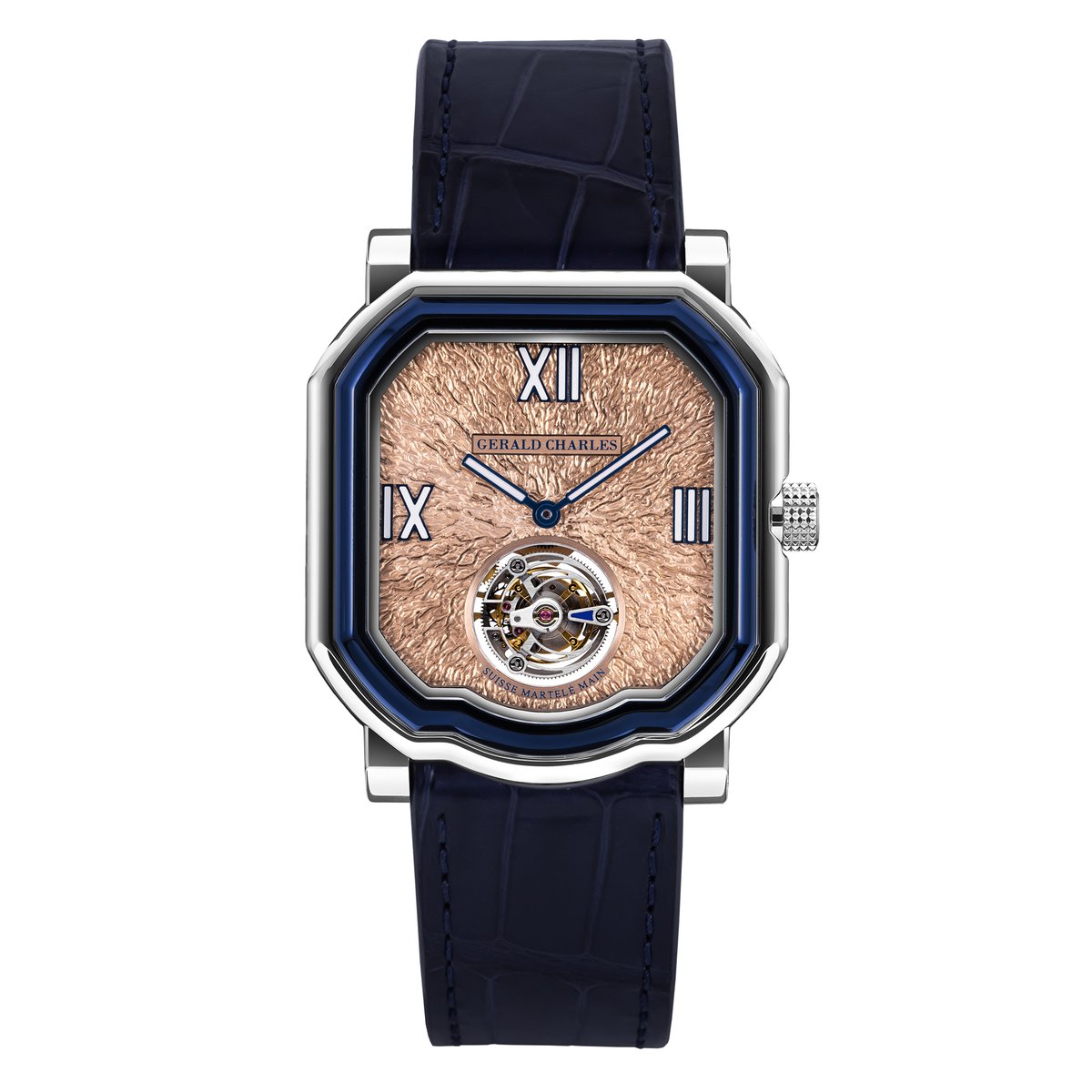
There is a particular kind of confidence in a watch that refuses to shout. The Gerald Charles Maestro 9.0 Roman Tourbillon, reference GC9.0-A-RT-5N, is that kind of watch. It carries a flying tourbillon — the most theatrical of complications — inside a case that reads as sculpture rather than spectacle, and it dresses that movement with Roman numerals borrowed from an altogether more classical era. Nothing about it is accidental, and very little about it is obvious.
Gerald Charles occupies an unusual position in modern watchmaking. It is a maison with a genuine design lineage, a small production, and a complication that most brands at this level buy in rather than develop. The Roman Tourbillon is therefore worth examining closely — not as a status object, but as a piece of engineering and design that has to justify itself on the wrist.
Genta's smile, revisited
Gérald Genta founded Gerald Charles in 2000, naming the company after his own first and middle names after the sale of his eponymous brand to Bulgari. The Maestro case is drawn from his sketches: an asymmetric profile in which the lower edge sweeps away in a curve that the brand has long described as a smile. It is a shape that photographs awkwardly and wears beautifully, because the eye reads balance from the whole rather than from symmetry.
In 5N rose gold, that curve takes on a warmth that a steel case cannot offer. The alloy is rich without being red, and the alternating surface treatment — brushed flanks against polished bevels — gives the case a faceted quality that changes as the light moves across it. The lugs are not lugs in any conventional sense; the strap emerges from the case flanks in a continuous line, which is both the reason the watch sits so well and the reason it looks unlike anything else in the display case.
Case finishing is where small maisons are exposed, and Gerald Charles survives the examination. The transitions between brushed and polished surfaces are crisp and consistent, the bevels are wide enough to catch light without becoming decorative, and the caseback is secured in a way that suggests the watch was designed to be opened by a watchmaker rather than sealed against one. There is no engraving competing for attention.
The dial: numerals as architecture
The Roman Tourbillon takes its name from its dial furniture. Applied Roman numerals anchor the composition, giving the eye a classical reference point against an otherwise contemporary layout. The open aperture at six o'clock frames the flying tourbillon, and because the cage is cantilevered from a single bridge rather than held top and bottom, the aperture reads as genuinely open — light passes through the movement rather than reflecting off a plate.
What impresses most is the restraint. There is no superfluous text, no oversized logo, no decorative guilloché competing with the tourbillon for attention. The hands are slim and legible, the minute track is fine but readable, and the dial surface itself is finished in a way that shifts subtly with angle rather than flashing. It is a dial designed by someone who trusted the case to do the talking.
The Roman numerals will divide opinion, as they always do. They soften the watch considerably — this is not an aggressive object — and they place it firmly in the dress camp rather than the sport one. Collectors who prefer batons or applied indices will find the Maestro 9.0 Tourbillon family offers alternatives; those who appreciate the tension between a classical dial and an asymmetric case will find this the most interesting expression of the reference.
The movement: a flying tourbillon with discipline
The complication is a flying tourbillon, self-winding, with a power reserve of 60 hours and an operating frequency of 21,600 vibrations per hour — three hertz, the traditional beat for a tourbillon and a rate that favours the visual calm of the rotation over the theoretical advantages of a faster escapement. Gerald Charles does not submit this reference for chronometer certification, and no rate specification is published, which is a statement of priorities rather than an omission: this is a watch built around architecture and finishing, not around a certificate.
The architecture itself is the argument. Removing the upper cage bridge eliminates the visual clutter that conventional tourbillons carry, and it places the entire burden of rigidity on a single arm — a construction that demands more of the design and more of the finishing, because there is nowhere to hide. The cage bridge is black polished, a technique that requires a zinc or tin plate, a steady hand and an indifference to failure; any deviation in the surface is immediately visible at any angle. Surrounding bridges receive Geneva stripes, and the anglages — the hand-drawn, hand-polished edges of the bridges — are executed with the kind of consistency that separates a serious maison from an ambitious one.
Winding is automatic, which suits the character of the watch: this is a piece intended to be worn rather than rationed. Sixty hours of reserve means it will survive a weekend in a drawer without needing to be reset, and the absence of a date means there is nothing to correct when it does stop. Setting is simple and the crown offers enough purchase to be operated comfortably.
On the wrist
The Maestro case is a study in how asymmetry can be comfortable. The upper edge sits relatively flat against the wrist while the lower curve sweeps away, so the watch settles rather than perches; the visual mass is offset in a way that keeps the centre of gravity close to the arm. Because the strap is integrated into the case flanks rather than attached to conventional lugs, there is no gap and no overhang, and the line from case to strap is continuous. On smaller wrists this matters enormously — the watch reads as proportionate rather than merely present.
In rose gold the Roman Tourbillon carries real presence without feeling heavy. The deployant clasp is slim enough not to create a lump under a shirt cuff and positive enough in engagement that you trust it, and the leather strap softens quickly without losing shape. This is a watch you forget about by mid-morning, which is the highest compliment one can pay a precious-metal tourbillon. It slides under a double cuff, it looks correct with a knit polo and a jacket, and it does not demand that the rest of your wardrobe rise to meet it.
Living with it: accuracy and service
There is no chronometer certification here, and Gerald Charles does not publish a rate specification for this reference. In practice, a well-regulated three-hertz flying tourbillon of this quality should sit comfortably within roughly -2 to +8 seconds per day depending on position and wear habits, with the constant rotation of the cage averaging out positional variation rather than eliminating it. Expect a settling period of a few weeks from new, and treat anything tighter than that as a bonus rather than a promise.
Servicing a flying tourbillon is not a routine errand. The complication demands a watchmaker with specific training and parts access, and the sensible interval is around five years of regular wear. Budget accordingly — a full service on a piece of this complexity sits in the mid four figures in US dollars, and it should be handled by Gerald Charles or an authorised partner rather than a generalist. The brand's network is concentrated in major cities, which is worth factoring into the decision if you travel or live away from one.
Value and the secondary market
At an approximate retail of $120,000 to $130,000, the Roman Tourbillon sits in a crowded bracket. What it buys is specific: an in-house flying tourbillon, a Genta-authored case in 5N rose gold, and a production volume low enough that you are unlikely to encounter another in the same room. What it does not buy is liquidity. Gerald Charles is a small maison with a thin secondary market, and pre-owned examples typically trade in the $75,000 to $100,000 range depending on condition, completeness and the appetite of the moment.
That is not a criticism so much as a description. Watches at this level from independent and semi-independent houses are rarely efficient assets; they are design objects with mechanical content, and their value is concentrated in authorship and rarity, both of which are slow and illiquid virtues. There is no meaningful auction history for this reference, and buyers should not underwrite one into existence. Buy it because the case is unlike anything else, because the tourbillon is properly finished, and because you intend to wear it.
Verdict
The Maestro 9.0 Roman Tourbillon is the clearest statement of what Gerald Charles is: a design house with a real complication, not a complication house with a borrowed design. It wears beautifully, it is finished with discipline, and it looks like nothing else in its price bracket. The Roman numerals narrow its audience and the service network narrows it further, but neither is a flaw in the watch — they are simply the terms of ownership.
For the collector who has already owned the obvious tourbillons and wants something with a point of view, this is one of the more persuasive arguments available. It is a watch that rewards proximity: the closer you look, the more the black-polished cage bridge and the drawn anglages have to say. That is a rare quality, and it is the reason this reference deserves to be considered on its merits rather than on its badge.