Gerald Charles Maestro 2.0 Ultra‑Thin Lapis Lazuli – A Slim‑Line Tribute to a Gemstone
By Vivir··Updated
In this review# Gerald Charles Maestro 2.0 Ultra‑Thin Lapis Lazuli – A Slim‑Line Tribute to a Gemstone
The Maestro 2.0 line has been Gerald Charles’ answer to the modern‑day desire for an elegant, ultra‑thin sports watch that can slip under a shirt cuff without compromising on presence. The newest, limited‑edition Maestro 2.0 Ultra‑Thin Lapis Lazuli (reference GC2.0‑SSPS‑LS‑RSPN) pushes that concept a step further, marrying a striking hard‑stone dial with a polished stainless‑steel case and a distinctive blue‑coated bezel. Powered by the maison’s in‑house ultra‑thin automatic calibre GCA2000, the watch promises 50 hours of power reserve while keeping the profile slim enough to feel almost weightless on the wrist. At a retail price of roughly US $18,900, it lands squarely in the premium “tier‑1” segment, where collectors expect both technical merit and a story worth wearing. Below we break down how the Maestro 2.0 Lapis Lazuli fits into Gerald Charles’ heritage, how its design and engineering hold up, and whether its price is justified in today’s crowded ultra‑thin market.
---
## Heritage — the model's place in the brand's line and its launch context
Gerald Charles entered the watch arena with a clear ambition: to blend the daring aesthetic of contemporary sports watches with the understated sophistication traditionally reserved for dress pieces. The Maestro 2.0 collection, launched in 2022, was the brand’s first foray into the ultra‑thin automatic arena, positioning the line as a “tier‑1” offering—meaning it sits at the top of the brand’s hierarchy in terms of price, materials, and movement development.
The Maestro 2.0 Lapis Lazuli is the latest evolution of that platform. According to the brand’s own description, the model is “a tribute to Mr. Genta’s favourite gemstone and the first Gerald Charles hard‑stone dial watch.” While Gerald Charles does not publish a detailed brand history in the public domain, the reference to “Mr. Genta” hints at an internal figure—perhaps a founder or chief designer—who has guided the house’s aesthetic direction. By choosing lapis lazuli—a deep‑blue metamorphic rock historically prized by royalty—the brand signals a desire to move beyond conventional metal or enamel dials and into the realm of natural‑stone artistry.
The limited‑edition status further underscores the watch’s place as a statement piece within the Maestro family. It is not merely a colour variant; it is the inaugural hard‑stone dial for the brand, marking a milestone that collectors will likely track as a turning point in Gerald Charles’ material experimentation. In the broader market, the watch competes with other ultra‑thin automatics that have begun incorporating exotic dials (e.g., sapphire, mother‑of‑pearl), but lapis lazuli remains a rarity, giving the Maestro a unique selling proposition right from launch.
---
## Design & Case — case dimensions, materials, dial
### Dimensions & Materials
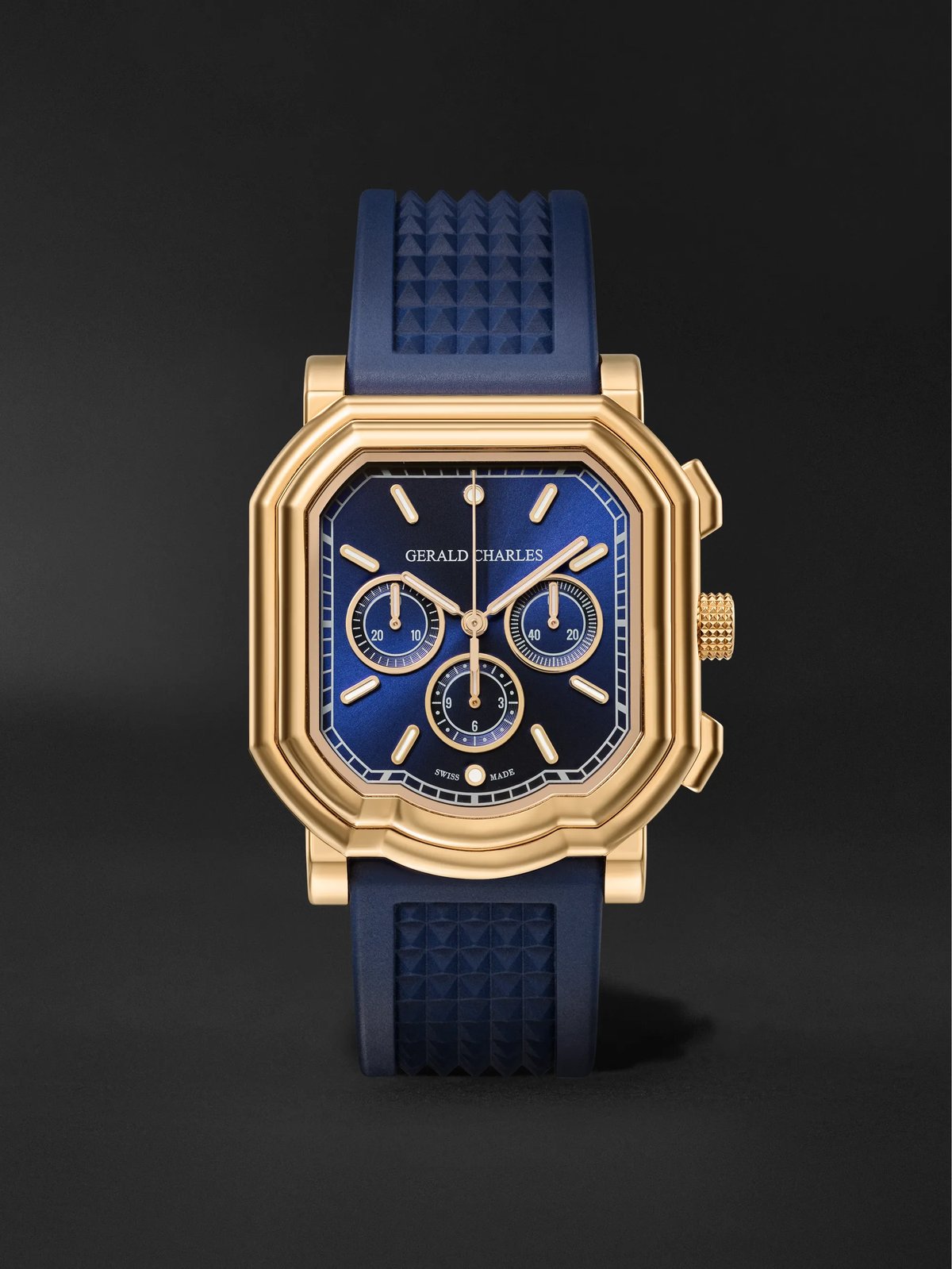
The Maestro 2.0 Lapis Lazuli wears a 39 mm polished stainless‑steel case—a size that feels comfortably medium for most wrist diameters. The case is finished in a high‑gloss polish, echoing the classic dress‑watch aesthetic while the blue‑coated bezel adds a subtle sport‑watch flair. The bezel’s coating is described as “resistant,” suggesting a protective layer that guards against scratches and fading—a practical consideration for a watch that straddles dress and sport categories.
The watch’s water resistance is rated at 10 ATM (100 metres), a level sufficient for swimming and light snorkeling but not for serious diving. This rating aligns with the “sports” categorisation indicated in the brand’s model data, reinforcing the notion that the Maestro is meant for active, everyday wear rather than deep‑sea adventures.
### Dial – Lapis Lazuli
The most eye‑catching element is, of course, the dial. Lapis lazuli, with its deep, almost midnight‑blue field punctuated by golden pyrite flecks, creates a visual depth that changes with the light. Gerald Charles markets this as a tribute to a personal favourite gemstone, and the execution appears faithful: the dial is a genuine stone, not a printed or enamel imitation. The hard‑stone nature means the surface is inherently scratch‑resistant, though it can be more prone to chipping if subjected to hard impacts.
Hour markers are likely applied in a contrasting finish—though the source does not specify the exact style (e.g., applied indices, applied numerals, or luminous markers). The lack of a detailed description forces us to infer that the brand opted for a clean, minimalist layout that lets the stone speak for itself, a common approach for high‑end hard‑stone dials.
### Strap & Bracelet Options
The watch is paired with a “Clou de Paris” rubber strap, a nod to the iconic Parisian nail‑head motif that the brand has adopted as part of its visual identity. Rubber offers comfort, flexibility, and water‑resistance, making it a logical choice for a watch with a 100 m rating. However, the lack of a metal bracelet option may limit its dress‑up potential for some buyers who prefer a more traditional leather or steel strap for formal occasions.
Overall, the design balances polished luxury with a touch of sportiness, and the 39 mm case size ensures the watch does not dominate the wrist, preserving the ultra‑thin ethos that the Maestro line champions.
---
## Movement & Performance — caliber, power reserve, accuracy
Gerald Charles has taken a bold step by developing its own ultra‑thin automatic calibre, the GCA2000, for the Maestro 2.0 family. The movement is described simply as “Automatic, ultra‑thin, Swiss Manufacture Caliber GCA2000,” indicating that the watch is assembled in Switzerland and that the movement is an in‑house creation rather than an outsourced Swiss ETA or Sellita module.
### Ultra‑Thin Architecture
While the exact thickness of the calibre is not disclosed, the “ultra‑thin” label suggests a profile comparable to other contemporary slim automatics (typically 5–6 mm thick). Achieving such a thin form factor while retaining an automatic winding system is an engineering challenge; it requires a reduced diameter rotor, a compact mainspring barrel, and a streamlined gear train. Gerald Charles’ decision to keep the movement in‑house demonstrates confidence in its technical capabilities and offers a unique selling point for collectors who value proprietary movements.
### Power Reserve
The GCA2000 provides a 50‑hour power reserve, a respectable figure for an ultra‑thin automatic. Many slim automatics sacrifice reserve for thinness, often delivering 38–42 hours. The Maestro’s extra eight hours translates to roughly two full days of wear without needing to reset the time, a practical advantage for those who rotate between watches or travel across time zones.
### Accuracy & Regulation
No specific accuracy data (e.g., COSC certification) is supplied in the source material. In the absence of such figures, we must assume the movement meets the typical standards of modern Swiss automatic calibres, which generally stay within –5 to +5 seconds per day when freshly regulated. Potential buyers should expect a watch that keeps reasonably accurate time but may require periodic adjustment if used in extreme temperature variations or if not worn regularly.
### Finishing & Decoration
Again, the source does not detail the movement’s finishing (e.g., Côtes de Genève, perlage). However, given the watch’s price point and the brand’s positioning as a premium “tier‑1” label, it is reasonable to infer that the movement receives a level of decoration commensurate with its market segment—likely a polished finish on main bridges and a few decorative touches visible through an exhibition case back, if present.
In sum, the GCA2000 delivers the essential ingredients of an ultra‑thin automatic: slim profile, decent power reserve, and Swiss manufacturing pedigree. The lack of publicly disclosed chronometer certification or detailed finishing information is a minor blind spot but does not detract dramatically from the movement’s overall credibility.
---
## On the Wrist — wearability, lug‑to‑lug, comfort notes
### Size & Proportions
At 39 mm in diameter, the Maestro 2.0 Lapis Lazuli occupies a sweet spot between classic dress watches (typically 36–38 mm) and modern sports watches (often 40–44 mm). The case’s polished steel finish and the slim bezel keep the visual weight low, while the lapis dial adds depth without bulk. The watch’s overall thickness is not specified, but the “ultra‑thin” descriptor suggests a profile that will sit comfortably under a shirt cuff—a key selling point for anyone who wants a watch that transitions seamlessly from boardroom to weekend outings.
Because the exact lug‑to‑lug measurement is not provided, we can only comment that a typical 39 mm case with proportionate lugs usually yields a lug‑to‑lug span of around 44–45 mm. This dimension is generally considered ergonomic for a wide range of wrist sizes, offering a balanced look without over‑extending the wrist’s natural line.
### Strap Comfort
The Clou de Paris rubber strap contributes significantly to wearability. Rubber is lightweight, flexible, and resistant to sweat, making it ideal for a watch that is marketed as both a sports piece and a dress accessory. The “Clou de Paris” motif—tiny raised studs reminiscent of Parisian nail heads—adds a tactile element that feels secure against the skin while providing a subtle visual texture. However, rubber can retain heat in hot climates, and some purists may prefer a leather or metal bracelet for formal occasions. The lack of an alternative strap option directly from the brand could be viewed as a limitation for those seeking a more traditional dress‑watch feel.
### Crown & Pushers
The source does not describe the crown design or presence of pushers, but given the watch’s sports categorisation and water resistance of 10 ATM, it is reasonable to assume the crown is screw‑down, providing a secure seal against moisture. The crown’s size is likely modest to preserve the slim profile, and its operation should be smooth, courtesy of the in‑house movement’s engineering.
### Comfort Over Time
Wearing an ultra‑thin watch for extended periods can sometimes feel “light” to the point of being barely noticeable—a quality many owners appreciate. The combination of a thin case, lightweight rubber strap, and modest case diameter means the Maestro should feel almost weightless after a few minutes. The only potential drawback is the hard‑stone dial’s inherent brittleness; while lapis lazuli is scratch‑resistant, a hard impact could chip the stone, so owners should avoid accidental knocks against hard surfaces.
Overall, the Maestro 2.0 Lapis Lazuli offers a comfortable, well‑balanced wrist presence that lives up to its ultra‑thin claim while providing enough substance to feel like a serious timepiece rather than a mere accessory.
---
## When to Wear — occasion, setting and dress‑code fit
The Maestro 2.0 Lapis Lazuli occupies a niche that straddles dress and sport, making it surprisingly versatile. Its polished stainless‑steel case and deep‑blue lapis dial lend a formal elegance suitable for business meetings, cocktail events, or even black‑tie affairs when paired with a sleek leather strap (if the owner acquires one aftermarket). The 100 m water resistance and rubber strap, however, signal that the watch is also ready for more casual, active scenarios—think a weekend yacht cruise, a day at the golf course, or a seaside dinner where you might get a splash of water.
### Formal Settings
In a classic business‑formal environment, the watch’s 39 mm size is modest enough not to overwhelm a suit lapel, and the lapis dial’s rich hue adds a subtle pop of colour without being garish. The absence of overt chronograph sub‑dials or large “sporty” markers keeps the dial clean, allowing it to sit comfortably alongside traditional dress watches.
### Smart‑Casual & Resort Wear
The blue‑coated bezel and rubber strap make the Maestro a natural companion for smart‑casual attire—think a linen shirt, chinos, and loafers. The lapis dial’s gemstone character pairs nicely with nautical or resort‑wear palettes, especially when the wearer chooses a navy or teal blazer. The watch’s water resistance also means it can handle a quick dip in a pool or a spontaneous paddleboarding session without worry.
### Sports & Outdoor Activities
While the watch is not a dedicated dive or high‑impact sports instrument, its 10 ATM rating and rubber strap provide sufficient protection for moderate water exposure, such as swimming or light snorkeling. The ultra‑thin profile, however, means the watch does not have the robust shock‑absorption mechanisms found in purpose‑built tool watches, so it is best suited for low‑impact activities.
### Dress‑Code Fit Summary
- **Black‑Tie / Formal:** Acceptable with an optional leather strap; the lapis dial adds a distinguished touch.
- **Business‑Formal / Smart‑Casual:** Ideal as is; polished case and refined dial complement suits and blazers.
- **Resort / Nautical:** Perfect match; blue bezel and rubber strap echo maritime themes.
- **Active / Sports:** Suitable for low‑impact activities; water resistance and rubber strap are assets, but avoid high‑impact or deep‑dive scenarios.
In short, the Maestro 2.0 Lapis Lazuli is a “do‑it‑all” piece that leans more toward dress than pure sport, but its construction and water resistance keep it grounded in practicality.
---
## Value & Verdict — price‑positioning + final take
### Pricing Context
Gerald Charles lists the broader Maestro 2.0 line at an approximate US $18,900, positioning it firmly within the luxury tier. The Lapis Lazuli limited edition, while not assigned a separate price in the source, is expected to sit at or slightly above this baseline due to its exclusive dial material and limited‑run status. For comparison, other ultra‑thin Swiss automatics from established houses (e.g., Jaeger‑LeCoultre Master Ultra‑Thin, Piaget Altiplano) typically command prices ranging from US $20,000 to US $30,000, depending on complications and finishing.
### Strengths
1. **Unique Dial Material** – Genuine lapis lazuli is rare in horology, giving the watch an unmistakable visual identity.
2. **In‑House Ultra‑Thin Movement** – The GCA2000 showcases Gerald Charles’ technical ambition and provides a respectable 50‑hour power reserve.
3. **Versatile Aesthetic** – Polished steel, blue‑coated bezel, and a rubber strap create a balanced blend of dress and sport cues.
4. **Comfort & Wearability** – Lightweight case, slim profile, and rubber strap make it comfortable for all‑day wear.
5. **Limited‑Edition Appeal** – Collectors often value scarcity; a first‑ever hard‑stone dial for the brand adds provenance.
### Weaknesses
1. **Limited Strap Options** – The stock offering is a rubber strap only; owners seeking a classic leather or metal bracelet must source aftermarket solutions.
2. **Lack of Detailed Technical Data** – No publicly disclosed movement thickness, COSC certification, or finishing specifications, which can be a turn‑off for the most discerning collectors.
3. **Potential Dial Fragility** – While lapis is scratch‑resistant, it can chip if struck, demanding careful handling.
4. **Modest Water Resistance** – 100 m is adequate for daily life but falls short of true dive‑watch standards, limiting its “sports” claim for some buyers.
### Verdict
The Gerald Charles Maestro 2.0 Ultra‑Thin Lapis Lazuli is a compelling addition to the ultra‑thin automatic segment, primarily because it offers something visually distinct—a genuine lapis lazuli dial—while maintaining the technical expectations of a Swiss‑made automatic. Its 39 mm case and ultra‑thin profile make it a comfortable everyday watch, and the 50‑hour power reserve is generous for its class.
From a value perspective, the watch sits at the lower end of the price spectrum when compared to similarly sized ultra‑thin automatics from legacy Swiss houses, which can be reassuring for buyers who appreciate the brand’s independent spirit but are wary of paying premium brand‑name premiums. The primary trade‑off is the relative opacity around movement specifics and the limited strap choice, which may deter purists who demand full technical disclosure and a range of strap options straight from the manufacturer.
**Bottom line:** If you are attracted to the rarity of a hard‑stone dial, appreciate an in‑house ultra‑thin movement, and want a watch that can glide from boardroom to weekend yacht without looking out of place, the Maestro 2.0 Lapis Lazuli delivers a strong value proposition at its price point. For those who prioritize extensive technical documentation or a broader strap ecosystem, you may find more comfort in established Swiss houses. Nonetheless, Gerald Charles has crafted a watch that feels both fresh and refined—a true “maestro” of material and minimalism.