The Maestro language, miniaturised
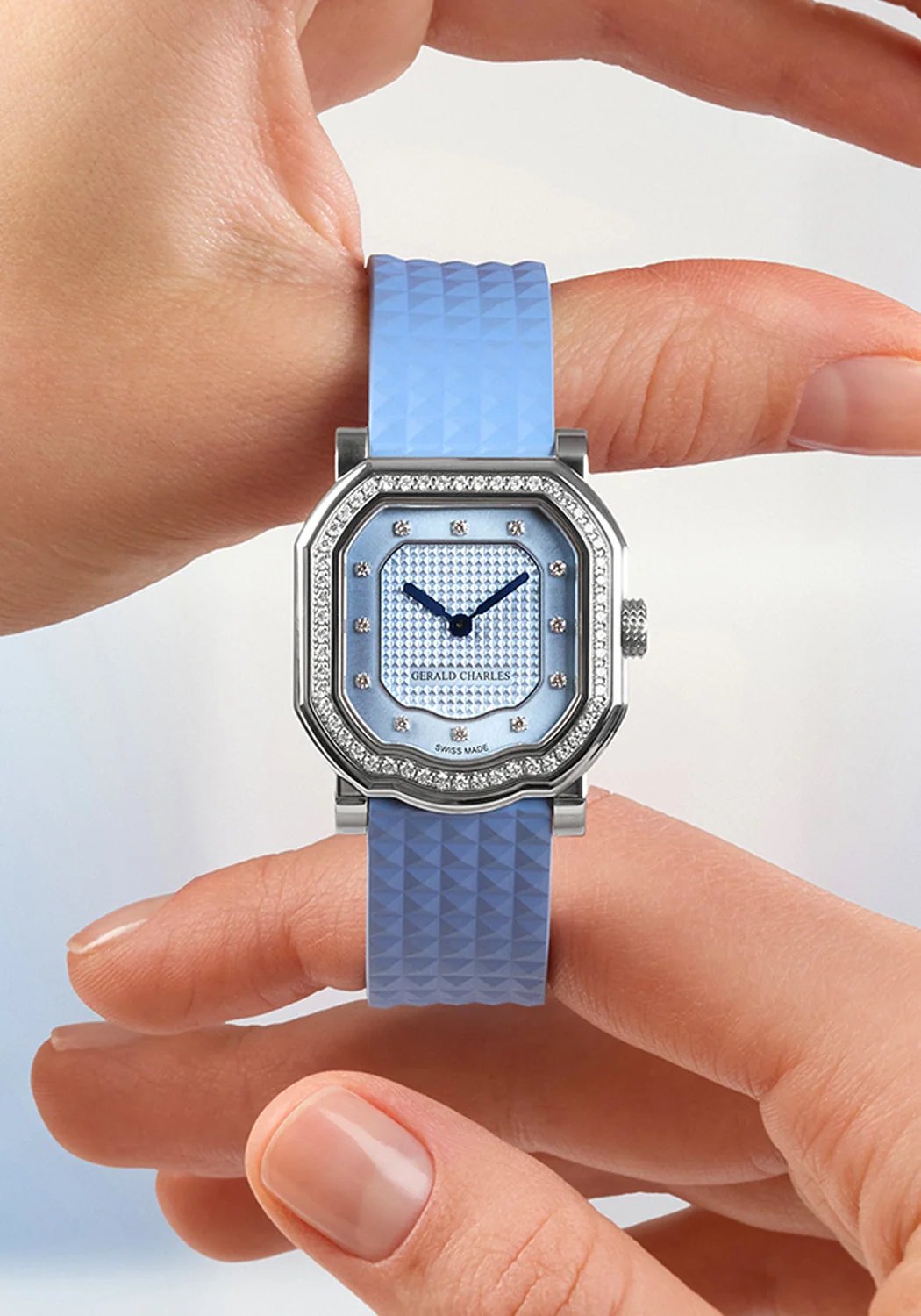
Gerald Charles is one of those brands that rewards a little context. It was founded in 2000 by Gérald Genta, the designer responsible for some of the most recognisable watch shapes of the twentieth century. The Maestro case is often described as his last major design statement, and the asymmetric bezel, the flowing case lines and the almost architectural curve at six o’clock are the visual signatures that separate it from a conventional round watch. The Mini Maestro does not abandon that language. It compresses it.
That compression matters. A lot of smaller versions of large watches fail because they simply scale everything down and lose the proportions that made the original work. The Mini Maestro avoids that trap by keeping the case shape intact and letting the watch read as a smaller expression of the same idea rather than a different watch wearing a familiar badge. The titanium case helps here. It keeps the visual weight low and gives the watch a slightly technical, modern finish that stops it from drifting into precious-jewellery territory.
The dial is clean and uncluttered, which suits the brief. This is not a watch that tries to impress with layers of texture or a dozen different finishes. The hands are legible, the markers are restrained and the overall effect is calm. The Super-LumiNova is present, but this is not a watch built around darkness. It is built around daylight, cuffs and the sort of close-up inspection that happens when you are waiting for coffee. The sapphire crystal is the right choice for a watch at this level, and the case finish has enough variation to catch the light without becoming a fingerprint magnet.
How it actually wears
The first thing you notice is the titanium lightness. The Mini Maestro does not sit on the wrist like a block of steel; it perches lightly and then settles in, which is exactly what you want from a watch with this kind of asymmetric case. The absence of conventional lugs helps the case hug the wrist rather than float above it, and the rubber strap is soft enough that the watch does not need a break-in period. On a smaller wrist it feels natural and almost jewel-like. On a larger wrist it reads as a deliberate, compact dress piece rather than a shrunken sports watch.
The balance is the real achievement. The case has enough visual weight to feel like a Gerald Charles, but the titanium and rubber combination keeps it from becoming a desk ornament. The deployant clasp sits flat, the crown does not dig into the back of the hand, and the watch disappears under a cuff in the best possible way. It is the sort of watch you forget you are wearing until you catch it in a shop window, which is a very good sign for a daily wearer.
The strap choice is also worth calling out. Rubber can feel cheap on a dress watch, but here it makes sense. It gives the Mini Maestro a practical, everyday personality and stops the titanium case from feeling too remote. The deployant clasp is a small luxury that makes the watch easier to live with than a pin buckle, especially if you are taking it on and off through the day. It is not a watch for a black-tie-only existence. It is a watch for people who want one object to do more than one job.
Legibility and daily usability
Legibility is good without being exceptional. The hands are clear, the dial is not overly reflective and the absence of clutter means you can read the time at a glance. The lume is not going to compete with a dive watch, and the watch is not designed for low-light tactical use. But for a dress watch with daily-wear ambitions, it is more than adequate. The real strength is how easy the watch is to read in the contexts where it will actually be worn: in a meeting, in a car, at dinner, on a train.
The time-only display keeps the dial calm, and the automatic movement means there is no ritual of winding before you put it on. The 50-hour power reserve is a practical number. It means the watch can sit from Friday evening to Monday morning without stopping, which is the sort of detail that matters far more in real ownership than a tenth of a second of theoretical precision. The movement is not the star of the show, but it does its job quietly and without fuss.
Accuracy should be judged in that context. This is not a chronometer-certified movement, so do not expect quartz-like precision. A realistic day-to-day expectation is within a few seconds per day in normal wear, with the usual variation depending on position and activity. The automatic winding is smooth enough that a short morning walk is usually all it takes to keep it alive. If you are the kind of owner who swaps watches every day, you will occasionally need to reset it. If you wear it as a daily watch, it will be reliable enough to disappear into your routine.
Occasions and wrist presence
The Mini Maestro is at its best in the spaces between formal and casual. It works with a suit because it is compact and refined. It works with a knit polo and tailored trousers because the titanium and rubber keep it from feeling too precious. It works as a travel watch because it is easy to wear, easy to read and not so flashy that it becomes a liability in a crowd. It is less convincing as a pure sports watch, and it is not trying to be one. The rubber strap gives it a sporty edge, but the case is still a dress-shaped object with a designer’s signature all over it.
Wrist presence is deliberately restrained. This is not a watch that fills the wrist or announces itself from across the room. It is a watch that rewards a closer look. The asymmetric case gives it more character than most small dress watches, and the titanium finish adds a subtle modern edge. On a scale of five, it sits around three: noticeable to people who know watches, invisible to people who do not. That is not a criticism. For many buyers, that is precisely the point.
Ownership, service and value
Gerald Charles is a small independent brand, and that shapes the ownership experience. You are not buying a watch that every authorised dealer in every city can service. You are buying into a low-volume ecosystem where service should be arranged through Gerald Charles or an authorised partner. That is not unusual at this level, but it is something to factor in before you commit. The good news is that the movement is a known GCA-family automatic, not an exotic one-off, so long-term maintenance should be manageable for a brand with the right parts access.
Value is harder to pin down because Gerald Charles does not have the secondary-market liquidity of the biggest luxury names. The Mini Maestro is a taste-led purchase. You buy it because you like the case, the fit and the idea of a Genta-designed watch that does not look like everything else in the safe. You do not buy it because you expect it to appreciate like a steel sports watch from a mainstream brand. The pre-owned market is thin, and pricing is not as transparent as it is for more common references. That is the trade-off for owning something with a little more personality.
If you are comparing it with a Cartier Tank, a Jaeger-LeCoultre Reverso or a Patek Philippe Twenty~4, the Mini Maestro makes its case on design rather than heritage volume. It is more overtly architectural than a Tank, more wearable than a Reverso for some wrists and less conventional than a Twenty~4. It is also more niche than all of them. That niche status is part of the appeal, but it also means you should buy it with your eyes open.
Alternatives and homages
The closest mainstream alternative is probably the Cartier Tank Must. It has a similarly compact, formal feel and a design identity that is instantly recognisable. The Jaeger-LeCoultre Reverso Classic is another small, architectural watch that feels more like jewellery than a tool. The Patek Philippe Twenty~4 Automatic is a more conventional luxury daily wearer with a smaller case and a strong brand name. The Chopard Happy Sport is a jewellery-forward option with a different kind of wrist presence. None of them have the Gerald Charles case shape, which is the whole point.
There are no direct homages to the Mini Maestro that are worth recommending as substitutes, because the asymmetric case is difficult to copy without looking clumsy. The closest affordable option is to buy a small, simple dress watch such as a Seiko SWR053 or a Casio LTP-VT01 and accept that you are getting the mood rather than the design. That is not a criticism of those watches. It is simply a reminder that the Gerald Charles case is the product. If you do not connect with the case, the rest of the watch will not convince you.
Final verdict
The Gerald Charles Mini Maestro GL1.0-TNPS-2118CS-RSDP is a watch that makes sense on the wrist rather than in a spreadsheet. It is compact, light, easy to wear and visually distinct without being loud. The titanium case and rubber strap give it a practical, everyday personality, while the automatic movement and sapphire crystal keep it firmly in luxury-watch territory. It is not the most versatile watch in the world, and it is not the safest financial choice in the category, but it is a genuinely charming object for the right owner.
If you want a small, design-led automatic that slips under a cuff, works with a suit and still feels special on a quiet Sunday, the Mini Maestro deserves a place on your shortlist. If you need a watch that holds value like a mainstream sports model or performs like a tool watch, this is not the one. The Mini Maestro is for the collector who has already bought the obvious watches and now wants something with a point of view. On that terms, it succeeds.