Girard-Perregaux Free Bridge Meteorite: The Collector's Reality Check
Girard-Perregaux is not a brand that chases the same collector as Rolex or Patek Philippe. The Free Bridge Meteorite is a statement piece: a skeletonized, bridge-forward design with a genuine meteorite dial and an in-house automatic movement. For a young collector building a serious horological portfolio, the question is not whether it is interesting. It is whether the market rewards that interest. The short answer is that this is a watch to buy with pre-owned money, not retail money.
At retail, the Free Bridge Meteorite competes with skeletonized sports watches from Zenith, Ulysse Nardin and Roger Dubuis, plus dress-sport alternatives from H. Moser and Chopard. On the secondary market it becomes a different proposition: a distinctive, low-volume in-house piece with a dial that no one else can replicate exactly. That is the sweet spot. If you want a watch that starts conversations and shows movement architecture from the dial side, the Free Bridge Meteorite delivers. If you need resale protection, look elsewhere.
Manufacture history
Girard-Perregaux was founded in 1791 in La Chaux-de-Fonds, Switzerland, making it one of the oldest continuously operating Swiss watch manufactures. Its modern identity rests on two pillars: the Tourbillon with Three Gold Bridges, a 19th-century design that turned movement architecture into a signature, and the Laureato, a 1970s integrated-bracelet sports watch. The Free Bridge sits in the Bridges family, but it translates that heritage into a more accessible, contemporary format. It is not a revival of a vintage reference. It is a modern line that uses the bridge as a visual and structural motif.
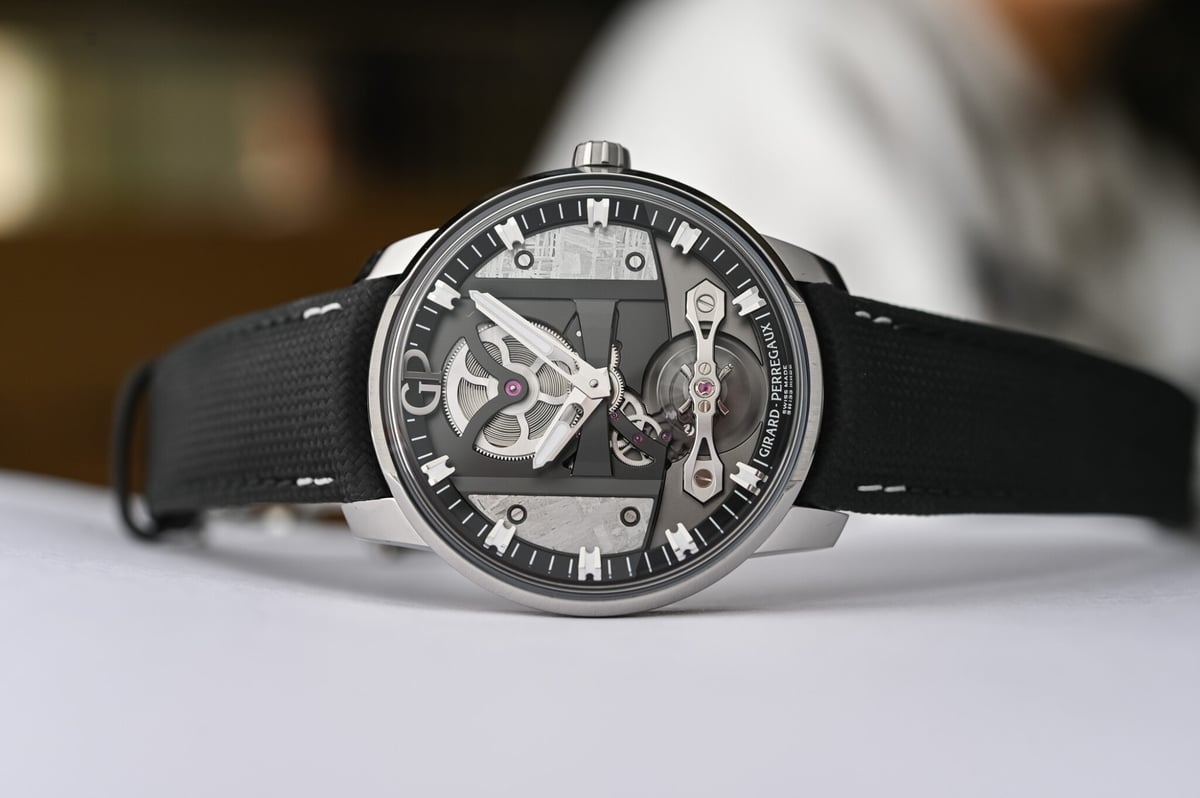
The Meteorite version matters because it gives the Free Bridge a material story. GP has used meteorite before, and the dial here is cut from the Gibeon meteorite, whose Widmanstatten pattern is formed by nickel-iron crystals cooling over millions of years. No two dials are identical, which is exactly the kind of detail that appeals to collectors who are bored by sunburst finishes and printed logos. The brand history is respectable; the model history is short. That matters for investment analysis.
Design and dial
The Free Bridge Meteorite is built around contrast. The case is stainless steel, the crystal is sapphire, and the strap is leather with a folding clasp. The dial is the star: a meteorite surface with the characteristic cross-hatched crystalline pattern, framed by the skeletonized movement and the signature Neo Bridge. The bridge is not a conventional three-quarter plate. It is a sculptural element that appears to float over the movement, and it gives the watch its name. The effect is architectural rather than traditional. There is no applied logo at twelve, no date window, and no lume. This is a watch for people who read a dial as a composition, not as a tool.
The lack of lume is worth noting. The hands and indices are not treated for low-light visibility, so the Free Bridge Meteorite is a daytime and evening piece. It works with a suit, a sport jacket and a dark shirt, but it is not a travel watch in the practical sense. The meteorite dial gives it enough visual texture that it does not need a date or a second time zone. The small seconds display keeps the movement visible and adds a bit of animation. The overall look is polarizing: some collectors see a modern classic, others see a busy skeleton watch with a gimmick dial. That split is part of the resale story.
Movement: Calibre GP01800-1170
The Free Bridge Meteorite uses the in-house Calibre GP01800-1170, an automatic movement with a 54-hour power reserve and a frequency of 28,800 vibrations per hour. It is not COSC-certified, which is normal for GP and for many independent-minded Swiss brands. The movement is the reason to buy the watch. It is skeletonized and finished for dial-side viewing, with a bridge architecture that is specific to the Free Bridge line. The small seconds complication is integrated into the display rather than added as an afterthought.
In-house is not automatically better, but at this price point it matters. The GP01800 family is a known workhorse architecture, and the 54-hour reserve gives it real-world convenience: put it down on Friday night and it is still running on Monday morning. The finishing is done to a high standard, with bevelled edges and a mix of surface treatments that reward close inspection. It is not a hand-finished independent movement at this price, but it is far from a generic ébauche. The watch is a showcase for GP's ability to make a movement that looks good from the front, which is harder than it sounds.
On the wrist
The case measures 44mm in diameter, which puts the Free Bridge Meteorite in the large-sport category. On paper that is a big watch. On the wrist it feels like a statement piece rather than an oversized brick, because the skeletonized movement and the open dial reduce visual mass. The steel case gives it a cool, slightly technical presence, and the leather strap keeps it from feeling like a bracelet watch. The folding clasp is secure and comfortable, and the strap can be changed without tools if you have the right spring-bar setup. The watch does not disappear on the wrist. It is meant to be seen, and it will be noticed.
Comfort is good for a watch of this size, but it is not a lightweight titanium piece. The balance is reasonable, and the strap curves nicely around the wrist. The main caveat is the lack of lume and the modest water resistance. Treat it as a dress-sport watch, not a daily beater for swimming or hiking. The leather strap also means you should keep it away from water and sweat-heavy activities. For a collector with a multi-watch rotation, that is not a problem. For someone looking for a one-watch collection, the Free Bridge Meteorite is less practical than a Laureato or a steel sports watch with a bracelet.
Accuracy and ownership
Because the movement is not COSC-certified, you should not expect chronometer-paper accuracy. In practice, owners of GP01800-based watches report a few seconds per day in either direction, which is acceptable for a luxury automatic. The watch is regulated at the factory, but real-world accuracy depends on wear patterns and temperature. If you are a collector who checks timing daily, you may want to have it regulated by a watchmaker after purchase. If you wear it two or three days a week, it will be close enough.
Service is a specialist matter. The Free Bridge has a skeletonized movement with a proprietary bridge architecture, so it should go to Girard-Perregaux or an authorized service center. Independent watchmakers can work on GP movements, but parts availability and finishing standards favor the authorized route. The service interval is not something to guess; follow GP's recommendation and have the watch checked if it starts losing time or the power reserve drops. The good news is that the movement is a known caliber, not a one-off prototype. The bad news is that skeletonized movements are more expensive to service than closed dials because every component is visible and every scratch matters.
Market and investment case
The retail price is around $27,300. The pre-owned market is where the value conversation gets interesting. Free Bridge Meteorite examples typically trade in the $15,000 to $19,000 range, depending on condition, box and papers, and strap wear. That is a significant discount from retail, and it reflects the broader reality of GP's secondary market: the brand has heritage and in-house credibility, but it does not have the resale liquidity of Rolex, Patek Philippe or Audemars Piguet. The trend is depreciating from retail, with occasional stable periods when a particular reference gets collector attention.
The hold recommendation is straightforward. If you are buying at retail, do it because you love the design and plan to keep it. If you are buying for value, wait for the pre-owned market. At $15,000 to $19,000, the Free Bridge Meteorite is a lot of watch: in-house movement, meteorite dial, sapphire crystal, steel case, and a design that is not copied by every microbrand. At $27,300, you are paying for the new-watch experience and the dealer relationship. There is no major auction history for this reference, and it is not a watch that auction houses treat as a trophy asset. That is not a criticism; it is a classification. It is a collector's watch, not a portfolio asset.
The comparison set matters. A Zenith Defy Skyline Skeleton offers a high-frequency movement and a more conventional sports-watch silhouette. An Ulysse Nardin Freak X offers avant-garde engineering and a similar bridge-forward aesthetic. A Roger Dubuis Excalibur offers more aggressive design and a louder brand statement. On the dressier side, H. Moser & Cie. offers distinctive dials and independent finishing, but not the same skeletonized bridge architecture. The Free Bridge Meteorite sits between these worlds: more artistic than a standard sports watch, less extreme than a Freak X, and less liquid than any of them on the secondary market.
Alternatives and homages
If you want the meteorite look without the GP price, there are affordable options. Boderry and Islander have offered meteorite-dial automatics around the $250 to $300 mark. They do not have the in-house movement, the bridge architecture or the finishing, but they deliver the visual texture of a meteorite dial at a fraction of the cost. These are not homages in the strict sense; they are budget watches with a similar material story. For a young collector, they can be a fun second watch or a way to test whether the meteorite aesthetic works for you before committing to a five-figure purchase.
Within the GP universe, the Free Bridge line is the closest sibling. The Laureato is the brand's integrated-bracelet sports watch and has a much stronger resale profile. The 1966 is the traditional dress watch. The Vintage 1945 is the Art Deco rectangular option. The Tourbillon with Three Gold Bridges is the halo piece and a different financial universe. If you are set on a bridge design, the Free Bridge Meteorite is the most accessible entry point. If you want better resale, the Laureato is the safer GP purchase. That is the trade-off: character versus liquidity.
Pros and cons
The pros are clear. The Calibre GP01800-1170 is in-house, automatic, and has a useful 54-hour power reserve. The meteorite dial is genuine and visually unique. The bridge architecture is a signature GP design. At pre-owned prices, the watch offers a lot of mechanical and aesthetic value. The steel case and sapphire crystal are durable enough for regular wear, and the leather strap gives it a dressy versatility. The cons are equally clear. It depreciates from retail. The design is polarizing. There is no lume and only modest water resistance. The leather strap limits active use. Service is specialist and potentially expensive. And the brand's secondary market is less liquid than its peers.
Final verdict
The Girard-Perregaux Free Bridge Meteorite is a watch for collectors who value design and mechanics over resale spreadsheets. It is not the safest place to park capital, and it is not a one-watch collection. But at pre-owned money, it is one of the more interesting skeletonized watches in its price range. The meteorite dial gives it a story, the in-house movement gives it credibility, and the bridge architecture gives it a visual identity that you will not find at Rolex or Patek. Buy it because you want to wear it, negotiate hard on the secondary market, and keep the box and papers. That is the collector's path.