Girard-Perregaux Laureato Aston Martin ref. 81020-11-001-11A: A Limited Green Chronograph for the Wear-First Collector
The Girard-Perregaux Laureato Aston Martin ref. 81020-11-001-11A sits at an interesting intersection of luxury watchmaking and motorsport marketing. It is a Laureato Chronograph 42 mm at its core, but the Aston Martin edition adds a green dial, a 188-piece production run, and a narrative that appeals to collectors who want something beyond the usual steel chronograph suspects. The watch is not trying to be a Royal Oak killer. It is trying to be a more interesting Laureato, and on that score it largely succeeds.
The market has been rational about it. Early excitement around the Aston Martin partnership pushed interest, but the secondary market has settled into a realistic band. This is not a watch that has run away from retail, and that is precisely why it deserves a closer look from collectors who actually wear their watches. The reference is limited enough to feel special, but not so unobtainable that you need auction-house connections to find one.
The collaboration context
Girard-Perregaux and Aston Martin announced their partnership in 2021, and the Laureato was the natural place to start. The Laureato has always been GP's luxury sports watch, a 1970s integrated-bracelet design that sits comfortably alongside the Royal Oak, Nautilus, and Ingenieur in spirit. The Aston Martin edition takes that platform and gives it a British racing green makeover, along with subtle branding and a limited production count.
The result is not a technical collaboration in the way some motorsport watches are. There is no special chassis-derived material, no F1-derived complication, and no radical case architecture. The Aston Martin connection is primarily aesthetic and emotional. For some collectors that is enough. For others it will feel like a premium for a dial colour and a logo. The honest position is that both views are valid, and the buying decision depends on how much you value the Aston Martin story.
Brand history and the Laureato line
Girard-Perregaux was founded in 1791 in Switzerland and is one of the country's oldest continuously operating watchmakers. Its history includes the Three Golden Bridges tourbillon, a long record of in-house movement production, and a reputation for mechanical engineering that is sometimes overlooked by the mainstream market. The brand has never had the hype engine of Audemars Piguet or Patek Philippe, but it has genuine horological credibility.
The Laureato launched in 1975 during the first wave of integrated steel sports watches. It has been through several generations and now sits as GP's most recognizable modern collection. The Laureato Chronograph 42 mm is the practical heart of the line: large enough to feel sporty, refined enough for daily wear, and powered by an in-house automatic chronograph movement. The Aston Martin edition builds on that base rather than reinventing it.
The movement: GP03300-0139
The reference 81020-11-001-11A uses the Girard-Perregaux Calibre GP03300-0139. This is an in-house automatic chronograph with a date function, a 46-hour power reserve, and a frequency of 28,800 vibrations per hour. It is not a COSC-certified chronometer, and GP does not present it as one. That is fine. The movement is a workhorse with a reasonable service record and enough finishing to satisfy anyone who turns the watch over.
Expect Cotes de Geneve decoration, circular graining, and blued screws under the sapphire caseback. The chronograph action is positive, and the date changes cleanly. The 46-hour reserve means you can take it off on Friday and pick it up on Sunday without needing to reset it. It is not a high-frequency showcase movement, but it suits the Laureato's brief as a luxury daily wearer.
Real-world accuracy should be viewed through the lens of a non-certified automatic chronograph. Most examples will run within roughly -5 to +10 seconds per day, with some doing better and some doing worse depending on position and wear habits. If you are the kind of collector who demands chronometer-paper precision, this is not the watch for you. If you want a reliable in-house chronograph with a comfortable service network, it is entirely fit for purpose.
Case, dial, and bracelet
The case is stainless steel, 42 mm in diameter, and 12.01 mm thick. That thickness is important. It keeps the watch wearable under a shirt cuff while still giving the chronograph pushers and crown enough physical presence. Water resistance is rated at 100 metres, which is more than enough for daily life and light swimming, though you should not treat it as a dive watch. The crystal is sapphire, as expected at this price point.
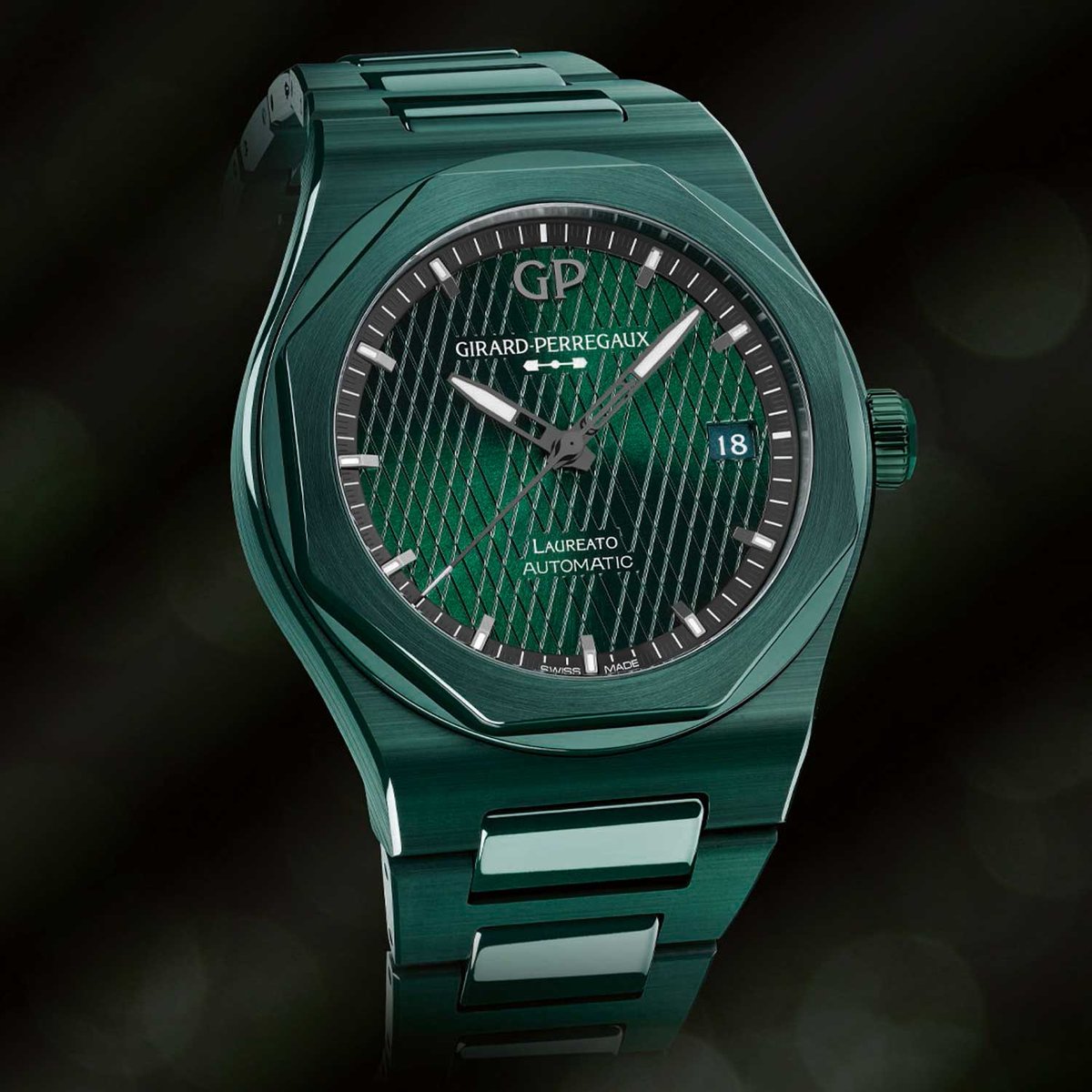
The dial is the headline. It is finished in Aston Martin Racing Green, a deep, slightly muted green that changes character with the light. Under artificial light it can look almost black; in daylight it opens up into a rich British racing green. The layout is familiar Laureato chronograph territory: three sub-dials, a date window, applied hour markers, and lumed hands. The Aston Martin branding is present but not overpowering. It reads as a collaboration watch without turning the dial into a billboard.
The integrated stainless steel bracelet is central to the Laureato experience. It uses the familiar tapered link profile, with brushed outer links and polished center links. The deployant clasp is secure and keeps the bracelet from flapping around. The bracelet is not as sharply finished as an AP Royal Oak, but it is comfortable, adjustable enough for most wrists, and visually coherent with the case. This is a watch that looks as good with a T-shirt as it does with a blazer.
On the wrist
The Laureato Chronograph 42 mm wears like a proper integrated steel sports watch. It has presence, but it does not wear like a brick. The bracelet keeps the case close to the wrist, and the first links articulate well enough that the watch settles quickly. The 42 mm diameter is large enough to feel modern without being oversized, and the 12.01 mm thickness gives it a flat-ish profile that slides under a cuff.
Weight is substantial but not oppressive. You know you are wearing a steel chronograph, but you are not constantly aware of it. The green dial gives it more visual lift than the standard Laureato, and the bracelet's polished center links catch light in a way that makes the watch feel more expensive than its secondary-market price might suggest. The crown and pushers are easy to operate, and the chronograph start-stop action is crisp enough for daily fidgeting.
Wrist presence is a solid 4 out of 5. It is not as instantly recognizable as a Royal Oak, and that is part of the appeal. Collectors who know watches will clock the Laureato shape and the Aston Martin green. Everyone else will just see a well-proportioned steel chronograph with a distinctive dial. That is a good balance for a daily wearer.
Accuracy and daily ownership
As a non-COSC chronograph, the GP03300-0139 should be judged on reliability and consistency rather than laboratory precision. Most owners report reasonable timekeeping in the -5 to +10 seconds per day range, with some examples settling tighter after regulation or service. The chronograph function is smooth, and the date changes without drama. The 46-hour power reserve is adequate for a normal rotation, though it is not a weekend-proof 70-hour movement.
Daily ownership is straightforward. The 100-metre water resistance means you do not need to baby it around water, and the sapphire crystal is resistant to everyday scratches. The bracelet is comfortable enough for all-day wear, and the clasp is secure. The main caveat is service. Girard-Perregaux recommends service through authorized centers, and the chronograph movement benefits from factory-trained watchmakers. Do not hand this to a generalist unless they have proven experience with GP calibers.
Resale and investment view
The retail price for the Laureato Aston Martin ref. 81020-11-001-11A was around 18,900 US dollars when it launched. The secondary market has settled into a range that is broadly in the mid-teens to high-teens, depending on condition, complete set, and timing. That is a realistic outcome for a limited-edition GP. The Aston Martin name adds interest, but it does not create the kind of demand that pushes a watch into blue-chip territory.
The trend is best described as stable to soft. The 188-piece run gives it scarcity, and the green dial makes it more desirable than a standard Laureato Chronograph. But Girard-Perregaux resale is not AP resale. Collectors who buy this watch expecting appreciation are likely to be disappointed. Collectors who buy it because they want a limited-edition integrated steel chronograph with a great dial will be very happy.
From a hold-versus-sell perspective, the answer is simple: buy it to wear. If you already own one and you are considering selling, do not expect a premium. If you are buying, negotiate hard on the secondary market and look for a complete set with box and papers. The limited production count supports liquidity, but it does not guarantee a profit. This is a passion asset, not a financial instrument.
Auction history is essentially non-existent for this reference. There is no meaningful track record of hammer prices, which is typical for modern limited-edition GP collaborations. That lack of auction data makes the secondary market the only real pricing guide. It also means you should rely on dealer comps and private sales rather than auction results when valuing the watch.
Variants and alternatives
The reference 81020-11-001-11A is the Aston Martin edition of the Laureato Chronograph 42 mm. It is the core limited edition for this collaboration, and it is the one most collectors will encounter. The standard Laureato Chronograph 42 mm offers the same case and movement with different dial colours and no Aston Martin branding. If the green dial does not move you, the standard models are a more sensible financial choice.
Within the Laureato family, the three-hand Laureato 42 mm and the Laureato Absolute are the closest siblings. The three-hand model is less complicated and more affordable, while the Absolute is larger, more aggressive, and further removed from the classic Laureato design. The Aston Martin edition sits in the middle: more special than a standard chronograph, less extreme than an Absolute.
If you are cross-shopping, the obvious alternatives are the Audemars Piguet Royal Oak Chronograph 41 mm, the Patek Philippe Nautilus Chronograph 5980/1A, the Vacheron Constantin Overseas Chronograph, and the Chopard Alpine Eagle XL Chrono. The AP and Patek are in a different resale league. The Vacheron is more formal and has stronger collector demand. The Chopard is a softer-market alternative with a similar integrated steel chronograph brief. The GP sits below the AP and Patek on brand heat, but it offers a more distinctive limited-edition story than the Chopard.
For buyers who want the look without the price, homages exist. The Tissot PRX Automatic Chronograph is the most credible affordable integrated-bracelet chronograph on the market, and it captures a similar sport-luxe silhouette. Budget options like the Pagani Design PD-1667 exist for buyers who want the vibe rather than the horology. Neither is a substitute for the GP, but they are useful context for how much of the price is design and brand versus mechanical substance.
Service and long-term ownership
Service intervals for modern automatic chronographs typically fall in the five-to-seven-year range, depending on wear and usage. GP does not publish a single fixed interval for every owner, and the watch will tell you when it needs attention. If the chronograph starts to feel sluggish, the power reserve drops noticeably, or the timekeeping drifts beyond your comfort zone, it is time for a service. Authorized-only service is the safe route, especially for the chronograph module and case finishing.
Long-term ownership should be viewed through the lens of parts availability and brand support. Girard-Perregaux is an established manufacture with a global service network, so you are not buying an orphan. The Aston Martin branding may complicate future servicing if specific dial or case components need replacement, but the underlying movement and case architecture are standard Laureato. That is a good thing. It means the watch can be maintained without relying on a single specialist.
Final verdict
The Girard-Perregaux Laureato Aston Martin ref. 81020-11-001-11A is a well-executed limited edition that knows exactly what it is. It is not the most hyped integrated steel chronograph on the market, and it is not an investment-grade asset. It is a handsome, wearable, mechanically credible watch with a green dial that separates it from the standard Laureato crowd.
For the right collector, that is enough. If you want a 188-piece limited edition with Aston Martin character, an in-house chronograph, and a bracelet that works with everything from denim to tailoring, this is a compelling buy at the right secondary-market price. If you are looking for the next Royal Oak-style appreciation story, keep looking. The Laureato Aston Martin is a watch to wear, not a watch to flip.