Girard-Perregaux Laureato Fifty Tourbillon: The Collector's Verdict
Few integrated sports watches have a cleaner claim to the 1970s design canon than the Girard-Perregaux Laureato. The original arrived in 1975 with an octagonal bezel, an integrated bracelet and a distinctly architectural stance. Fifty years later, the Laureato Fifty Tourbillon takes that silhouette and adds the kind of movement that makes serious collectors pay attention: an in-house automatic tourbillon from a manufacture with genuine old-line credentials. This is not a steel daily beater with a fancy dial. It is a precious-metal statement piece that asks a very different question of its owner.
The commercial question matters as much as the technical one. Girard-Perregaux has deep manufacture history and a signature three-bridge tourbillon architecture, but its secondary market is not in the same league as Audemars Piguet, Patek Philippe or Vacheron Constantin. That makes the Laureato Fifty Tourbillon a watch to buy with eyes open: wonderful object, thinner resale market, and a hold-versus-sell judgment that depends heavily on entry price. In this review we separate the romance from the resale data and explain where this anniversary tourbillon fits in a serious collection.
Why the Laureato Fifty Tourbillon Matters
The Laureato is one of the most distinctive integrated sports watches of the 1970s, and its 50th anniversary is a legitimate milestone. Girard-Perregaux has used the occasion to push the family into tourbillon territory, which is a bigger leap than another dial color or bracelet tweak. The Laureato Fifty Tourbillon sits at the intersection of two GP stories: the architectural sports watch and the high-horology tourbillon. For collectors who like the idea of an integrated bracelet watch but want something less predictable than a Royal Oak or Nautilus, it is a compelling alternative.
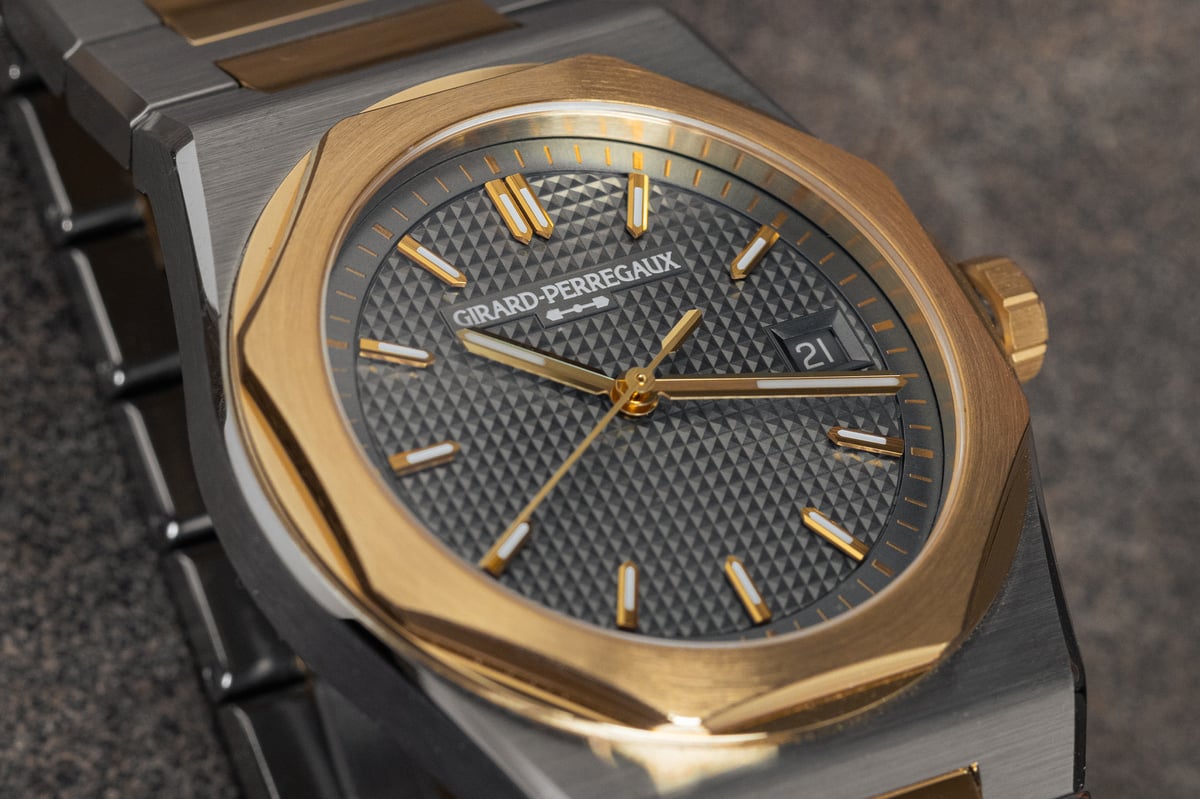
It is also a watch that needs to be understood on its own terms. The Laureato case is visually broad, the bracelet is integrated, and the tourbillon dial is open enough to make the movement part of the design. This is not a discreet dress watch. It has presence, and it will be noticed by people who know watches. The question is whether that presence translates into demand when you decide to sell.
History and Manufacture Credentials
Girard-Perregaux was founded in 1791 in Switzerland, making it one of the oldest continuous watch manufacturers in the world. Its modern reputation rests on in-house movements and the Three Golden Bridges tourbillon, a design signature that gives GP a genuine high-horology identity. The Laureato, launched in 1975, was the brand's answer to the integrated steel sports watch boom. It had an octagonal bezel, a slim profile and a bracelet that flowed into the case, and it has become the brand's most recognizable modern model.
The Fifty Tourbillon draws on both legacies. The Laureato provides the case and bracelet language, while the tourbillon movement provides the collector argument. GP is not a fashion brand dressing up a third-party movement. It is an old-line manufacture with real tourbillon history. That matters when you are spending six figures, and it matters even more when you are trying to justify the purchase to a spouse or an accountant.
Design and Wrist Feel
The Laureato formula is built around a wide, flat-looking bezel, an integrated bracelet and a case that sits visually broad on the wrist. On the Fifty Tourbillon, the precious-metal case and open tourbillon dial change the feel. It is less a sports watch you forget about and more a piece you notice with a jacket cuff. The bracelet integration means the watch balances well at the head, but the gold case adds heft compared with steel Laureatos. Collectors with smaller wrists should try it before committing. The design wears larger than a simple diameter number suggests, and the absence of a consistently published lug-to-lug figure for this exact anniversary reference makes an in-person fit essential.
Comfort is good for a formal-leaning integrated bracelet watch, provided the bracelet is sized properly. The deployant clasp and flat bracelet links distribute pressure well, and the tourbillon aperture does not create a fragile-feeling top-heavy watch. It is not a gym watch and not a travel beater. Think boardroom, dinner, collector events and the occasional weekend with a rollneck, not beach duty. The open dial also means you need to be comfortable with attention. This is a watch that invites conversation, and not all of it will be about the time.
Movement and Accuracy
The Laureato Fifty Tourbillon is powered by Girard-Perregaux's in-house automatic tourbillon calibre, the GP09510 family. It is a self-winding movement with a roughly 52-hour power reserve and a frequency of 28,800 vibrations per hour. The architecture is the main event: GP's three-bridge tourbillon design gives the movement a sculptural quality that is more interesting than a conventional openworked dial. Finishing is haute-horlogerie grade, with anglage, polished bridges and the kind of handwork that justifies the price tag.
Girard-Perregaux does not position this watch as a chronometer, and a tourbillon is not automatically more accurate in wristwear. Expect a well-regulated in-house movement that keeps time within a few seconds per day in normal use, but do not buy this as a precision instrument. The tourbillon is a craft and rarity argument. If you need certified daily accuracy, a COSC or METAS sports watch is the rational choice. If you want a three-bridge tourbillon from an old-line manufacture, this is the point.
Occasions and Wrist Presence
The Laureato Fifty Tourbillon works best in formal and dressy settings, but it is not so fragile that it cannot be worn daily by a careful collector. The integrated bracelet gives it a sporty undertone, and the gold case keeps it dressy. It is an excellent dinner watch, a strong collector-event watch and a reasonable office watch if your office tolerates precious metals. It is not a travel watch in the sense of a GMT or a dive watch, and it is not the piece you take to the beach.
Wrist presence is a five out of five. The octagonal bezel, gold case and open tourbillon make it a room-stopper, but the presence is refined rather than shouty. It reads as expensive to people who know watches, and as a nice bracelet watch to everyone else. That is a good balance for a collector who wants quality without a neon sign.
Variants and Family Context
Girard-Perregaux has not consistently published a single reference code for every market and variant of the Laureato Fifty Tourbillon, so collectors should verify the exact reference with an authorized dealer. The watch sits alongside the broader Laureato family, including the 42mm and 38mm automatic models, the Laureato Chronograph and the Laureato Tourbillon with Three Flying Bridges. The latter is the closest series-production sibling in spirit, with the same three-bridge tourbillon language and a more overtly technical look.
Compared with the standard Laureato, the Fifty Tourbillon is a different ownership proposition. It is more expensive, more fragile, more collectible and less liquid. That is not a criticism; it is simply the nature of a precious-metal tourbillon. If you want a Laureato you can wear without thinking, the steel 42mm is the smarter buy. If you want a Laureato that makes a statement and has a movement worth discussing, the Fifty Tourbillon is the one.
Investment and Resale
Girard-Perregaux does not publish a simple global MSRP for every market, and secondary transaction data for this anniversary tourbillon is thin. We have not fabricated a sticker price. What we can say is that GP tourbillons generally trade at a discount to retail on the secondary market, and the Laureato Fifty Tourbillon is unlikely to be an exception. The limited anniversary status helps, but it does not turn the watch into a Royal Oak or Nautilus. The buyer pool is narrower, the auction record is thin and the brand's resale liquidity is softer than the blue-chip integrated sports watches.
That does not mean the watch is a bad buy. It means the entry price matters. If you can buy below retail, the Laureato Fifty Tourbillon offers a lot of watch for the money: an in-house tourbillon, an iconic 1970s design and genuine manufacture heritage. If you pay full retail and expect short-term appreciation, you are likely to be disappointed. The hold recommendation is straightforward: buy it because you want the object, not because you need the asset to perform. If you already own it, hold for the design and movement rather than for a quick flip.
Service and Ownership
Tourbillon service should go through Girard-Perregaux or a factory-trained specialist. Expect higher-than-standard costs and longer turnaround than a simple three-hand watch. The movement is complex, the finishing is delicate and the parts are specific to GP. Authorized service is the safe route, especially for a watch at this price point. Collectors should budget for service as part of ownership, not as an unpleasant surprise.
Pros and Cons
The pros are clear: an in-house three-bridge tourbillon movement, a 50th-anniversary Laureato design, strong wrist presence and old-line manufacture heritage. The cons are equally clear: thin secondary-market liquidity versus AP and PP, a precious-metal price with no chronometer certification, high service costs and a fit that must be verified because dimensions are not consistently published. This is a watch for a collector who values craft over liquidity and understands that the Laureato name does not carry the same resale premium as the biggest integrated sports watches.
Final Verdict
The Laureato Fifty Tourbillon is a beautiful, old-line alternative to the usual integrated tourbillon suspects, with a movement story that serious collectors can respect. It is not a safe financial asset: GP's resale market is narrower and slower than the blue-chip names. Buy it because you want the Laureato silhouette and a three-bridge tourbillon, not because you expect Royal Oak-style appreciation.