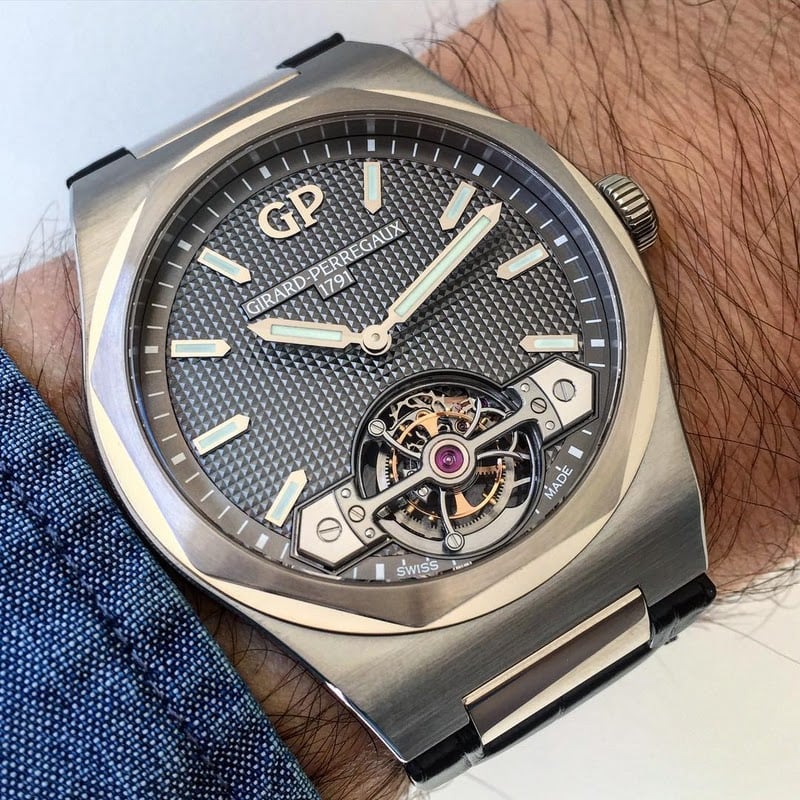
Fifty Years of the Laureato, Now With a Tourbillon
The Laureato was never a quiet watch. When it arrived in 1975, the integrated bracelet and octagonal bezel placed it squarely in the era of architectural sports-luxury design, and over the decades it has become Girard-Perregaux's most recognisable modern shape. The Laureato Fifty Tourbillon Micro-Rotor is the anniversary model that takes that familiar silhouette and loads it with the brand's deepest technical signature: an in-house automatic tourbillon with a micro-rotor.
That combination is the whole story. Plenty of watches have tourbillons. Plenty have integrated bracelets. Very few place a tourbillon inside a case language that was designed for daily wear and then finish the result to a standard that rewards close inspection. The Laureato Fifty Tourbillon Micro-Rotor is not trying to be a racing chronograph or a dive watch. It is a precious-metal object with a mechanical centrepiece, and it makes more sense when you stop thinking of it as a sports watch and start thinking of it as a piece of wearable architecture.
Girard-Perregaux does not publish every consumer-facing figure for this reference, and that is worth saying plainly. Where a dimension, frequency, power reserve, or service cost is not stated, this review does not invent one. The watch is interesting enough without a speculative spec sheet. What matters is the relationship between the Laureato case, the automatic micro-rotor movement, and the finishing that holds the whole thing together.
The Laureato at Fifty
Girard-Perregaux was founded in 1791 in La Chaux-de-Fonds, which gives it one of the longest continuous histories in Swiss watchmaking. Its name is inseparable from the Tourbillon with Three Gold Bridges, a nineteenth-century idea that became a modern signature. The Laureato came much later, in 1975, and it gave the brand a contemporary icon: an octagonal bezel, an integrated bracelet, and a case that looked engineered rather than decorative.
The 50th anniversary is therefore a natural moment for Girard-Perregaux to bring those two strands together. The Laureato Fifty Tourbillon Micro-Rotor is not a re-edition of the 1975 watch. It is a flagship for the anniversary family, and its job is to show that the Laureato can carry haute horlogerie without losing its identity. The bezel is still faceted. The bracelet is still integrated. The dial still has that clean, almost architectural restraint. But the movement is now the reason to look closer.
That is a more difficult balancing act than it sounds. Anniversary watches often become either nostalgic exercises or technical showpieces that forget the original design. This one stays recognisably Laureato. The complication is integrated into the watch rather than bolted onto it, and that is the first sign that the project was approached with some discipline.
Movement Architecture: Automatic Tourbillon With Micro-Rotor
The Laureato Fifty Tourbillon Micro-Rotor uses an in-house automatic movement with a tourbillon and a micro-rotor. The micro-rotor is the quietly important part. A conventional central rotor dominates the back of a movement and adds visual mass. A micro-rotor sits flush with the bridges or mainplate, which leaves more of the movement visible and allows the architecture to remain open. In a watch like this, where the tourbillon is meant to be seen, that matters.
The trade-off is that a micro-rotor has less mass than a full rotor, so the winding system has to be engineered carefully to remain efficient. Girard-Perregaux is not new to this. The brand's movement culture is built on visible mechanics, and the automatic tourbillon layout gives the owner something to study through the sapphire back. The tourbillon itself is a rotating cage that carries the balance and escapement, and in this watch it serves as both a technical signature and a visual anchor. It is not there to promise quartz accuracy. It is there because the rotation of the cage is one of watchmaking's most enduring pieces of theatre, and because Girard-Perregaux has earned the right to use it.
Finishing is where a watch at this level either justifies itself or does not. The movement should show hand-bevelled bridges, polished steel components, circular graining, and a clear separation between matte and reflective surfaces. The best Girard-Perregaux movements have a confident, almost architectural finish: edges are sharp, the geometry is deliberate, and the decoration does not blur into a single shiny mass. The Laureato Fifty Tourbillon Micro-Rotor should be judged the same way. Look at the bevels on the bridges, the quality of the tourbillon cage, the transition between polished and grained surfaces, and the way the micro-rotor sits within the movement rather than on top of it.
There is no COSC chronometer certification here, and that is not a scandal. A tourbillon is a complication, not a guarantee of superlative timekeeping. What matters is regulation, stability, and the quality of the escapement and winding system. The movement is in-house, which gives Girard-Perregaux control over the architecture and finishing, and it places the watch in the small group of integrated-bracelet tourbillons with a genuine manufacture movement.
Case, Dial, and Bracelet
The Laureato case is the constant. The octagonal bezel is the defining element, and it works because it is not a simple polygon. The facets catch light in a way that makes the watch look different from every angle, and the integration between case and bracelet is what gives the Laureato its particular stance. This is not a watch with traditional lugs and a strap. The bracelet is part of the case design, and the eye reads it as one object.
The precious-metal execution adds warmth and weight. The bracelet alternates polished and satin surfaces, and the clasp is a deployant, which is the right choice for a watch at this level. The crystal is sapphire, as expected. There is no lume, which tells you something about the intended use: this is not a sports watch that happens to be expensive. It is a luxury watch with a sporty silhouette. The absence of luminous material keeps the dial clean and reinforces the formal side of the Laureato's character.
The dial is where the tourbillon and micro-rotor layout has to be resolved. The complication needs space, but the Laureato dial also needs to remain legible and balanced. The best version of this design gives the tourbillon an aperture that feels deliberate rather than cut out, and keeps the hour and minute indications clear enough for daily wear. The dial should not look like a skeleton watch with a time display added as an afterthought. It should look like a Laureato that happens to have a tourbillon, which is a subtle but important difference.
The bracelet is the other half of the story. Integrated bracelets are only as good as their articulation, and the Laureato's is one of the better examples of the genre. The links are designed to follow the wrist, and the polished centre elements give the watch a jewellery-like quality without making it fragile. In precious metal, the bracelet also becomes the main source of visual presence. It catches light, it adds heft, and it makes the watch feel more formal than a steel sports watch.
On the Wrist
The Laureato Fifty Tourbillon Micro-Rotor wears like a Laureato first and a tourbillon second. That is a compliment. The integrated bracelet wraps the wrist cleanly, and because the case flows into the bracelet without conventional lugs, there is no awkward gap or overhang to worry about. The watch sits close, the weight is distributed across the bracelet, and the case does not feel top-heavy in normal wear. The octagonal bezel gives it presence, but the watch does not shout from across the room. It is the kind of piece that looks better in person than in a photograph, because the finishing changes with the light.
The precious-metal construction means you feel it on the wrist, but that is part of the point. This is not a lightweight titanium sports watch. It has the density and warmth of gold, and the bracelet makes that density feel controlled rather than clumsy. The tourbillon aperture gives the dial a focal point, but it does not overwhelm the time display. In a formal setting, the watch reads as a refined integrated-bracelet piece. In a casual setting, it reads as an expensive object with a mechanical secret. It is not the watch you choose for a hike or a swim, but it is wearable for a long office day, a dinner, or a collector's gathering.
The micro-rotor movement also has an practical benefit: it keeps the automatic winding system out of the way of the tourbillon view. That means the owner can actually see the architecture rather than a rotor spinning over it. For a watch at this level, that is not a minor detail. It is the difference between a complication you own and a complication you can study.
Accuracy and Daily Ownership
A tourbillon watch should be evaluated on two levels. The first is mechanical stability: does the watch keep a consistent rate, does it wind smoothly, and does it feel solid in daily use? The second is horological meaning: does the tourbillon add something to the experience beyond the spec sheet? The Laureato Fifty Tourbillon Micro-Rotor is clearly stronger on the second point. It is a mechanical object with a visible regulating organ, and that is the reason to own it.
There is no chronometer certification, so owners should not expect a laboratory certificate. What they should expect is a well-regulated manufacture movement that keeps stable time within Girard-Perregaux's tolerances. The automatic micro-rotor winding system makes it practical to wear regularly, and the sapphire caseback means the movement is part of the daily experience. The watch will need to be worn or wound to stay running, and it will benefit from being kept in a watch box or winder if it is part of a larger collection. The key is consistency: check the rate over weeks rather than days, and judge the movement by how it behaves over time.
Daily ownership also means accepting the realities of precious metal. The case and bracelet will show small marks with normal wear, and the polished surfaces will pick up light scratches. That is not a defect. It is the nature of gold. The watch can be worn regularly, but it should not be treated like a tool watch. It is a luxury object with a high-complication movement, and it deserves a little care.
Occasions and Wrist Presence
The Laureato Fifty Tourbillon Micro-Rotor is at its best in formal and dressy settings. The precious metal, the integrated bracelet, and the tourbillon make it a natural companion for a suit, a dinner jacket, or a collector's event. It also works as a daily watch for someone who spends most of the day in an office and does not need a rugged sports watch. The bracelet and sapphire crystal make it practical enough for regular wear, but the absence of lume and the precious-metal finish mean it is not a true sports watch.
On the wrist, its presence is high but not loud. The Laureato shape is recognisable to people who know watches, and the tourbillon adds a second layer of interest for anyone who looks closer. It is not a watch that relies on colour or size to make an impression. It relies on geometry, finishing, and the quiet confidence of a manufacture movement. That makes it a strong choice for a collector who wants something that feels specific rather than generic.
Variants and Family Context
The Laureato Fifty Tourbillon Micro-Rotor sits at the top of the anniversary Laureato family. Girard-Perregaux does not list multiple dial or bracelet variants for this exact model in the consumer materials reviewed, so the watch should be understood as a single anniversary execution rather than a broad collection. The reference code is not publicly disclosed in those materials, which is not unusual for a limited or anniversary release, but it does mean buyers should rely on the authorised dealer for exact documentation.
Within the wider Laureato family, the Tourbillon Micro-Rotor is the high-horology flagship. The standard Laureato 38mm and 42mm models provide the same case language in simpler form. The Laureato Chronograph adds a sportier complication. The Laureato Skeleton Tourbillon explores a more open, technical aesthetic. The Laureato Absolute takes the design in a more contemporary, aggressive direction. Seen against those siblings, the Fifty Tourbillon Micro-Rotor is the most formal and the most mechanically ambitious. It is the Laureato for someone who already understands the collection and wants the version that carries the most watchmaking.
Girard-Perregaux's wider catalogue includes the Tourbillon with Three Gold Bridges, the Vintage 1945, the 1966, and the Cat's Eye. Those models show the brand's range, but the Laureato Fifty Tourbillon Micro-Rotor is specifically a Laureato. Its identity comes from the bracelet and bezel as much as from the movement.
Alternatives to Consider
The most obvious alternative is the Audemars Piguet Royal Oak Selfwinding Flying Tourbillon. It is the benchmark for the integrated-bracelet tourbillon, with a more overtly sporty silhouette and enormous collector recognition. The Laureato is the more understated choice, and for some buyers that is exactly the point. The Chopard Alpine Eagle Flying Tourbillon is another modern integrated-bracelet watch with a tourbillon, and it shares the Laureato's architectural case language. The Vacheron Constantin Overseas Tourbillon is more classical in finishing and offers a travel-friendly interchangeable bracelet system, but it plays in the same luxury-integrated-bracelet space.
Buyers who want a tourbillon with a more traditional dress-watch character may prefer a round case from a brand like Breguet or A. Lange and Sohne. But those watches do not offer the Laureato's particular blend of sporty geometry and bracelet integration. The Laureato Fifty Tourbillon Micro-Rotor is for someone who wants the complication inside a watch that still looks like a Laureato.
For a more affordable integrated-bracelet fix, the Pagani Design PD-1662 captures the octagonal-bezel silhouette at a fraction of the price. It has none of the tourbillon, finishing, or manufacture movement, but it shows how strong the basic design language is. That is not a substitute for the Girard-Perregaux. It is simply a reminder that the Laureato shape works.
Investment and Service
The Laureato Fifty Tourbillon Micro-Rotor is a price-on-request watch, and Girard-Perregaux does not publish a consumer MSRP or current retail figure in the materials reviewed. That makes precise value analysis difficult. What can be said is that high-complication anniversary pieces from established manufactures tend to trade on specialist demand rather than mainstream liquidity. They are not Royal Oak or Nautilus alternatives in the resale market, and buyers should not treat them as short-term investments.
The better reason to buy is the movement. An in-house automatic tourbillon with a micro-rotor is a serious piece of watchmaking, and the Laureato case gives it a distinct identity. If the watch appreciates, that is a bonus. If it does not, the owner still has a rare, finely finished object with a complication that is visible and mechanically meaningful. The pre-owned market for this exact reference is not yet established, and there is no major auction history to cite. The trend should be described as stable rather than appreciating, because the collector base is narrow.
Service is an authorised-only affair. A tourbillon and micro-rotor movement requires trained watchmakers, and Girard-Perregaux does not publish a standard service interval or cost for this reference in the consumer materials. Owners should expect to service through the brand's authorised network and should budget for the complexity of the movement. That is normal for haute horlogerie, but it is part of the ownership cost.
Final Verdict
The Laureato Fifty Tourbillon Micro-Rotor is a successful anniversary watch because it does not try to be everything. It is not a dive watch, a racing chronograph, or a minimalist dress watch. It is a precious-metal Laureato with an in-house automatic tourbillon and a micro-rotor, and it is at its best when you appreciate the movement through the caseback and the geometry of the case on the wrist. The finishing and architecture are the reasons to choose it over a simpler Laureato, and the anniversary context gives it a clear place in the collection.
It is not the rational first luxury watch. It is a collector's object, and it should be bought by someone who values Girard-Perregaux's movement culture and the Laureato's design history. For that buyer, the Laureato Fifty Tourbillon Micro-Rotor is a specific, wearable, and genuinely interesting piece of high horology.