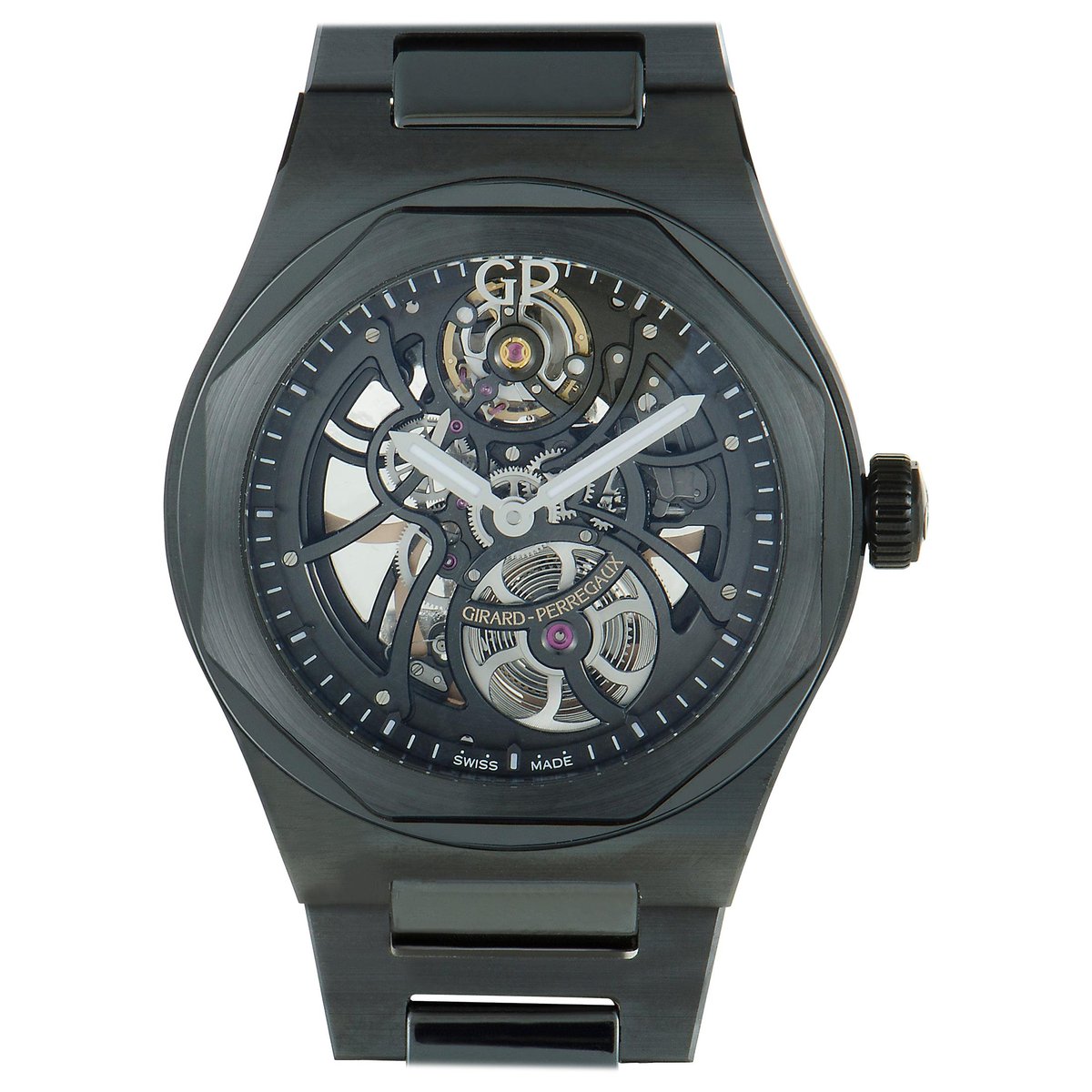
There is a specific kind of collector for whom the Girard-Perregaux Laureato Skeleton Ceramic is the answer: someone who wants the visual drama of an openworked integrated sports watch, who actually wears their watches, and who has no illusions about flipping anything. For everyone else, it is a watch that requires a slightly more careful argument.
The thesis
Girard-Perregaux has spent the better part of a decade trying to convince the market that the Laureato deserves a seat at the integrated-bracelet table alongside the Royal Oak and the Nautilus. Commercially, that campaign has been only partially successful. The Laureato sells, but it sells at a discount, and it sells largely to people who want the silhouette without the AP entry ticket. Where the brand has genuinely succeeded is in making the case for the Laureato as a design object rather than as an asset.
The Skeleton Ceramic is the purest expression of that argument. Take the octagonal bezel, the round case beneath it, and the tapering integrated bracelet, then strip the dial back to a skeletonized movement and execute the whole thing in black ceramic. It is a watch that photographs better than almost anything else in its bracket and, unusually, wears better than it photographs.
It is also a watch that sits in a strange commercial position: expensive enough at retail to compete with serious steel from the major houses, cheap enough on the secondary market to undercut them. Understanding why that gap exists is the entire investment conversation.
Brand context: why this model, why now
GP dates to 1791 and is one of the oldest names in Swiss watchmaking, but its modern identity rests on two things: the Tourbillon with Three Golden Bridges, which is genuinely historic, and the Laureato, which is genuinely commercial. The Laureato launched in 1975, in the first flush of the luxury steel sports watch, and spent the following decades as a footnote before the brand relaunched it with intent in the 2010s.
The skeletonized version arrived as the halo of that relaunch, and the ceramic execution followed — a logical next step, since the entire point of a skeleton is to make the case as visually interesting as the movement. Ceramic does something steel cannot: it removes the reflections. On a steel Laureato Skeleton, the polished bezel and bracelet flanks fight the skeletonized dial for attention. On the ceramic version, the case goes matte and quiet, and the movement finally gets to be the only thing lit up.
That is a real design decision, not a marketing one, and it is the single strongest reason to choose the ceramic over the steel sibling.
Case and bracelet: ceramic as a functional choice
The case is 42mm and executed entirely in ceramic, bracelet included. The finishing alternates brushed surfaces with polished bevels along the octagonal bezel and the link flanks — and here is the thing that separates a good ceramic watch from a bad one: the polished sections. Ceramic is famously difficult to finish because it cannot be deformed or repaired; you either get it right at the sintering stage or you scrap the part. GP gets it right. The bevels catch light cleanly and the transitions between brushed and polished surfaces are crisp rather than soft.
The bracelet is where the watch lives or dies. Integrated bracelets fail when the links are too stiff at the ends, and the Laureato's taper toward the clasp is well-judged — the articulation is generous enough that the watch sits down on the wrist rather than perching on top of it. The folding clasp is flat and unobtrusive.
The trade-off is brittleness. Ceramic does not scratch; it chips and cracks. A hard knock against a door frame is a non-event, but a drop onto tile is a component replacement, not a polish. Buyers who treat their watches casually should think hard about that before committing. Buyers who are simply tired of polishing scratches out of a steel bezel every eighteen months will find ceramic close to liberating.
Movement: the GP01800-0006
The Caliber GP01800-0006 is an in-house skeletonized automatic running at 28,800 vph with a 54-hour power reserve. It is time-only — no date, no complications — and that is exactly the right call. Skeletonization is the complication here, and adding anything on top of it would clutter the one thing the watch exists to display.
The bridges are openworked and treated with an anthracite NAC coating, which gives the movement a dark, technical look that pairs correctly with the black ceramic case. The finishing — anglage on the bridge edges, circular graining, the openworked oscillating weight — is done to a standard that rewards a loupe. This is not a movement that only looks good in press images. Under magnification there is genuine handwork visible, and the contrast between the dark coating and the bright chamfers is well resolved.
Power reserve is 54 hours, which is adequate rather than generous — put it down Friday night and it will still be running Monday morning, but only just. It is not COSC certified, and GP does not submit this caliber for chronometer testing.
On the wrist
The first surprise is the weight. Ceramic is meaningfully lighter than steel, and because the bracelet is also ceramic, the watch does not have the head-heavy feel that integrated bracelets often produce. It sits balanced on the wrist rather than pulling on it.
The second surprise is restraint. In photographs the Skeleton Ceramic looks aggressive; in person, black ceramic absorbs light and the watch reads as dark and architectural rather than loud. It slides under a shirt cuff in a way that a polished steel Royal Oak simply does not. At 42mm it wears true to size — substantial on a smaller wrist, comfortable on a larger one — and the bracelet taper means it does not overhang.
The third surprise, and the only real negative, is legibility. Skeletonized dials are inherently harder to read, and the openworked hands against an openworked background offer very little contrast in low light. There is no lume at all, which is not a defect in a watch like this — it is a stated design position. But if you check the time in a dark restaurant, you will be doing it by feel and angles.
Accuracy and ownership expectations
The GP01800 is not a chronometer movement, and buyers should set expectations accordingly. Real-world examples typically run in the range of roughly -5 to +10 seconds per day depending on position, with well-regulated and recently serviced pieces doing better. That is fine for a piece of this type — the value proposition is finishing and design, not timekeeping precision.
Service should go through GP's authorized network. The movement itself is within reach of a capable independent, but the ceramic case components are not, and a watchmaker who damages a ceramic link during a service is a conversation nobody wants to have. GP's service intervals and pricing are best confirmed directly with the brand at the time of purchase rather than assumed, since they vary by region and by the condition of the watch.
Market and resale: the honest numbers
This is where the Laureato Skeleton Ceramic becomes interesting, and where the market-driven reader should pay closest attention.
At retail — GP's asking price has crept into the high-$30,000s — the watch competes directly with serious steel from brands with vastly stronger resale performance. At secondary pricing, dealer asking has clustered in the low-to-mid $20,000s, with clean, full-set examples commanding the top of that band. That is a substantial discount, and it is not an anomaly. It reflects a structural reality: GP is a brand with excellent products and limited collector liquidity, and skeletons are the least liquid segment within any brand's catalog.
The steel Laureato Skeleton trades softer still, which tells you the ceramic premium is real and worth paying — just not at retail. The ceramic version is the one collectors will want in ten years, because it is the version that solved the design problem. The steel version is the version that will be available cheaply forever.
On trend: depreciating, and likely to stay that way in the near term. GP has been pricing the Laureato upward, which helps the retail narrative but does nothing for secondary values on already-sold stock. There is no meaningful auction history to speak of — Laureato Skeletons rarely appear at Phillips, Christie's or Sotheby's, and when they do they trade as commodity stock rather than as collectible lots. This is a dealer-channel watch, and it will remain one.
The practical implication is straightforward. If you want this watch, buy it used from a reputable dealer, insist on box and papers, and pay a price that already reflects the fact that you will take a haircut if you ever sell. At secondary money, you are getting an in-house openworked automatic in a full ceramic case and bracelet for less than many steel chronographs from the major houses. That is genuine value — it is just value you realize on the wrist rather than on the balance sheet.
The competition
The obvious comparison is the Audemars Piguet Royal Oak Openworked, which is the watch that invented this category and which costs three to five times as much on the secondary market. The AP has better liquidity, better brand equity and better finishing — and the gap in finishing is smaller than the gap in price. If you can afford the AP without thinking about it, buy the AP. If the AP means stretching, the GP is a genuinely intelligent alternative rather than a consolation prize.
Within reach and more affordable, the Zenith Defy Skyline Skeleton offers a similar architectural brief at a lower price point, and the Bell & Ross BR 05 Skeleton Black Ceramic delivers the black-ceramic-skeleton formula at roughly half the GP's secondary value. Neither carries GP's finishing standard. The Hublot Big Bang Integrated Black Magic chases the same black ceramic integrated thesis with more aggression and comparably soft resale.
For collectors building toward this watch, the Maurice Lacroix Aikon Automatic Skeleton is the honest stepping stone, and the Tissot PRX Powermatic 80 is the entry point to the silhouette — though neither is a substitute for what the GP does.
Verdict
The Laureato Skeleton Ceramic is the best-executed watch in GP's current lineup and, at retail, one of the harder purchases to justify. Those two facts are not contradictory — they describe a watch whose value is entirely in the wearing.
As an object, it is excellent. The ceramic case removes the scratch anxiety that makes steel integrated sports watches age badly. The GP01800 is properly finished rather than merely openworked, and the anthracite treatment gives the movement a coherence with the case that the steel version lacks. It wears light, sits balanced, and reads as expensive without being loud — a combination that very few watches in this bracket achieve.
As an investment, it is not one. Buy at secondary pricing in the low-to-mid $20,000s and you are making a smart, non-obvious purchase that will reward you every time you put it on. Buy at retail and you are funding the next owner's discount. The recommendation is simple: if you love it, buy it used, wear it hard, and do not watch the listings.