Girard-Perregaux has spent the last several years doing something quietly brave: taking the most recognisable silhouette in Swiss watchmaking — the three arrow-shaped bridges Constant Girard drew in the 1860s — and letting young people wear it. Not as a museum piece in a safe, but as a titanium object on a wrist at a gallery opening, at a track day, on a red-eye to Tokyo.
The Neo Bridges was that project's hinge. It inverted the Bridges idea: instead of a movement hidden under a dial with the bridges visible only from the back, the bridges became the face. The Earth to Sky edition pushes the concept further, treating the dial side as a horizon — a graduated field that turns movement architecture into landscape. It is, in the most literal sense, a watch about a view.
Why the Bridges still matter
Girard-Perregaux dates to 1791 in Neuchâtel, which makes it one of the oldest continuously operating names in Swiss watchmaking. But its real identity was forged in the 1860s, when Constant Girard designed a pocket-watch movement with three parallel arrow bridges and made them structural and decorative at once. That watch won a gold medal at the 1889 Paris Exposition Universelle, and the shape has been the house's fingerprint ever since.
For a long time that fingerprint was a problem. The Bridges became a trophy object — tourbillons in gold, priced for the auction catalogue, admired and rarely worn. The 2017 Neo Bridges changed the register. Shorter, more architectural, less reverent: it treated the three bridges as a piece of industrial design rather than a relic, and it appealed to exactly the collector GP had been failing to reach — someone in their thirties with a decent eye and an allergy to heritage theatre.
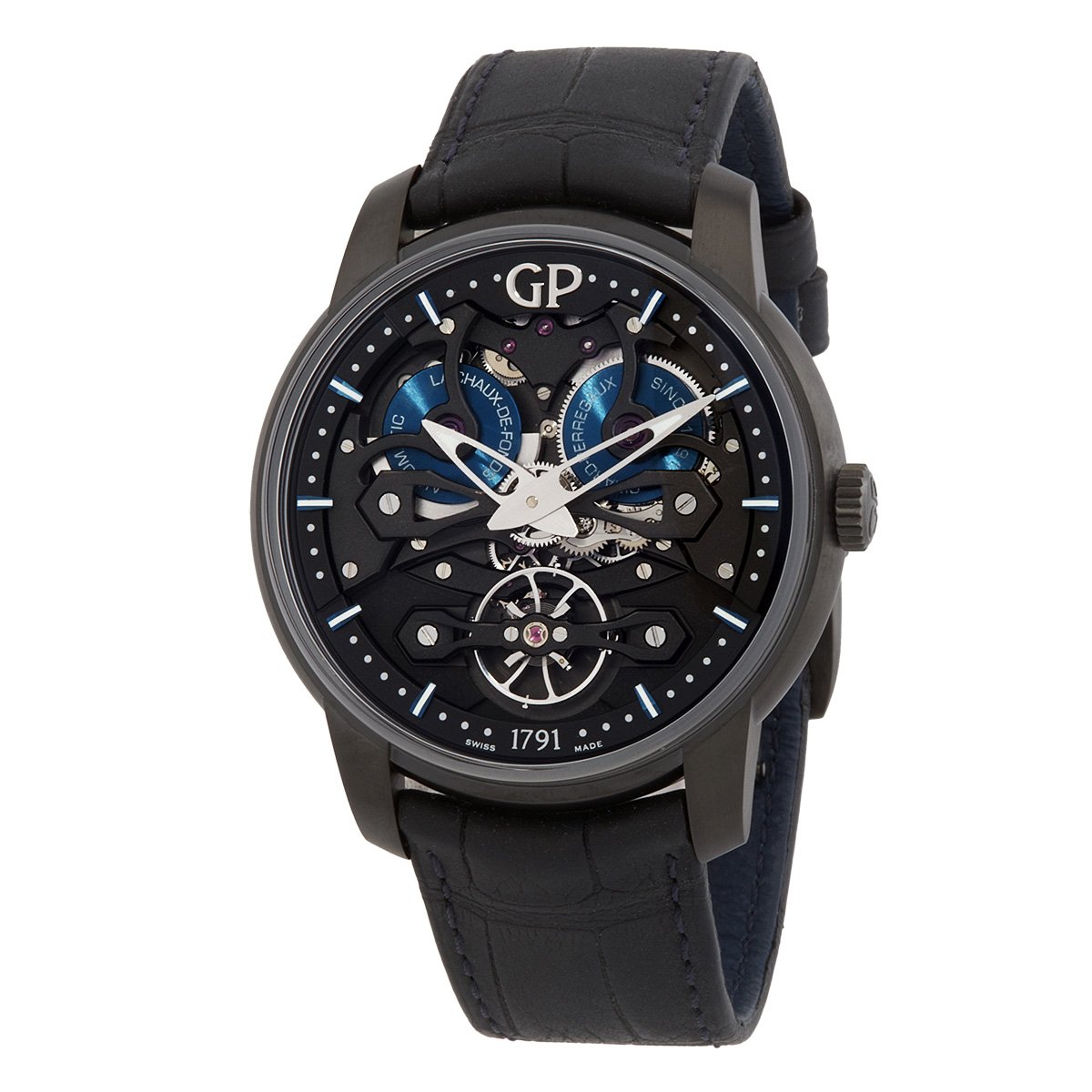
The Earth to Sky is a direct descendant of that rethink. It takes the same open-worked, micro-rotor architecture and adds the one thing the standard model lacked: atmosphere. Where the base Neo Bridges is all steel-and-shadow contrast, this edition sets the movement against a graded sapphire that shifts from deep, shadowed earth tones at the base toward a paler, higher-altitude blue at the top. The result is a dial that behaves like a sky at dusk — darker where it meets the case, opening up as your eye moves across it.
The movement: an arrow bridge you can read
Underneath sits the in-house Calibre GP08400-0002, an automatic with a micro-rotor and a 54-hour power reserve, running at 21,600 vibrations per hour. The specification matters less than the arrangement. Because the rotor is sunk into the movement rather than sweeping over it, the bridges get the whole stage. There's no oscillating weight blocking the view, no need to squint past a slab of metal to find the interesting part.
The finishing is the part that separates this from the wave of open-worked watches that have flooded the market. GP bevels and polishes the bridge edges and leaves the flats with a contrasting surface, so the watch catches light along lines rather than planes. In photographs it reads graphic. In person, under a restaurant downlight, it reads almost liquid — the edges flare as your wrist moves and then go dark again. That is the correct order of operations for a skeleton watch, and plenty of brands twice the price get it wrong.
Because the architecture is exposed on both sides, this is also a movement you can inspect for craft rather than just decoration. The barrel, the gear train, the balance at the base of the dial — all of it is on show and all of it is finished to a standard you can actually assess. There is no date, no second time zone, no chronograph. Two hands and a view. GP has been disciplined about that, and the watch is better for it.
On the wrist: the titanium argument
The case is titanium, and that decision defines the entire wearing experience. A Bridges in gold is jewellery you protect; a Bridges in titanium is an object you live in. The head is light enough that the alligator strap does most of the work of keeping it in place, and the case sits close and flat rather than perching. Cuffs close over it. Jackets don't fight it. On a long day it disappears in a way that a gold Neo Bridges simply doesn't.
That lightness will read as insubstantial to anyone who equates heft with value — an increasingly outdated position, but a persistent one. The counter-argument is balance. The mass is centred, the strap breaks in fast, and there's no bezel overhang to snag on a shirt. It's a watch designed to be worn by someone with an active life and a dress code that runs from smart-casual to black tie, and it handles both ends without looking like it's slumming it.
Two caveats. First, there is no lume, and nothing in the design suggests GP was ever tempted — this is not a watch for a dark cinema or a midnight taxi rank. Second, there's no meaningful water resistance story here, so it comes off before the pool and stays off. Neither is a flaw; they're just the terms of the deal. If you need a one-watch collection, this is not it. If you need a third or fourth watch that does the talking at dinner, it's a very strong candidate.
Legibility, honesty, and the small print
Open-worked dials always trade readability for spectacle, and the Earth to Sky is no exception. The baton hands are polished and skeletonised, which means they occasionally dissolve against the busiest parts of the movement, and the gradient makes the contrast inconsistent across the dial. You learn the angles. You tilt your wrist. It becomes second nature within a week, and most owners will tell you it's a fair price for a dial that looks like nothing else in the room.
Accuracy expectations should be realistic. The GP08400 is not chronometer-certified, and an in-house micro-rotor at 3 Hz will typically run somewhere in the range of five to ten seconds a day depending on wear and rest position. With no running seconds to audit, most owners simply don't care — you set it when you notice, and you get on with your life. This is a watch that rewards a relaxed relationship with timekeeping.
Servicing goes through authorised channels, at roughly five-year intervals, and the exposed bridge finishing plus the micro-rotor assembly make it a factory job rather than a local one. Budget accordingly. It's not an expensive watch to own by high horology standards, but it is a watch that wants proper care.
Where it sits in the market
The Neo Bridges family has always been GP's most defensible modern line, because the design cannot be confused with anything else. The Earth to Sky sits at the top of that line's colour story. Secondary pricing on modern Neo Bridges tends to soften after the first owner and then plateau rather than collapse, which is a more honest description of the Bridges' position than the appreciation narrative some dealers like to spin. If you want a Bridges, the pre-owned market is where the value is; if you want this specific edition, be prepared to pay retail and enjoy it.
Against the competition, the case is straightforward. The Bulgari Octo Finissimo Skeleton is thinner and more severe — a designer's watch, less romantic about colour. The Parmigiani Tonda PF Skeleton is quieter and more restrained, aimed at the collector who wants to be recognised only by people who know. The Zenith Defy Skyline Skeleton is the sportier, cheaper gateway. What none of them replicate is the specific GP trick: three arrow bridges, read as a landscape, on a watch light enough to forget.
Auction history for this edition is effectively nil — it's too recent and too niche to have a track record. What gives the family its credibility is the vintage market: original Three Bridges pocket watches still surface at the major houses and still command serious money, which is the halo that lets a modern titanium Neo Bridges be taken seriously at all.
The verdict
The Neo Bridges Earth to Sky is the rare skeleton watch that doesn't feel like a flex. It's a landscape painting with a balance wheel in it, executed with in-house finishing that justifies the badge and a colour treatment that makes the whole architecture legible in a new way. It's not a do-everything watch, and it isn't trying to be. It's the watch you reach for when you want to look like you know something nobody else at the table does.
Buy it for the silhouette. Buy it because a horizon on the wrist is a better idea than another date window. Buy it, wear it hard, and let the titanium take the knocks — that's what it's for.