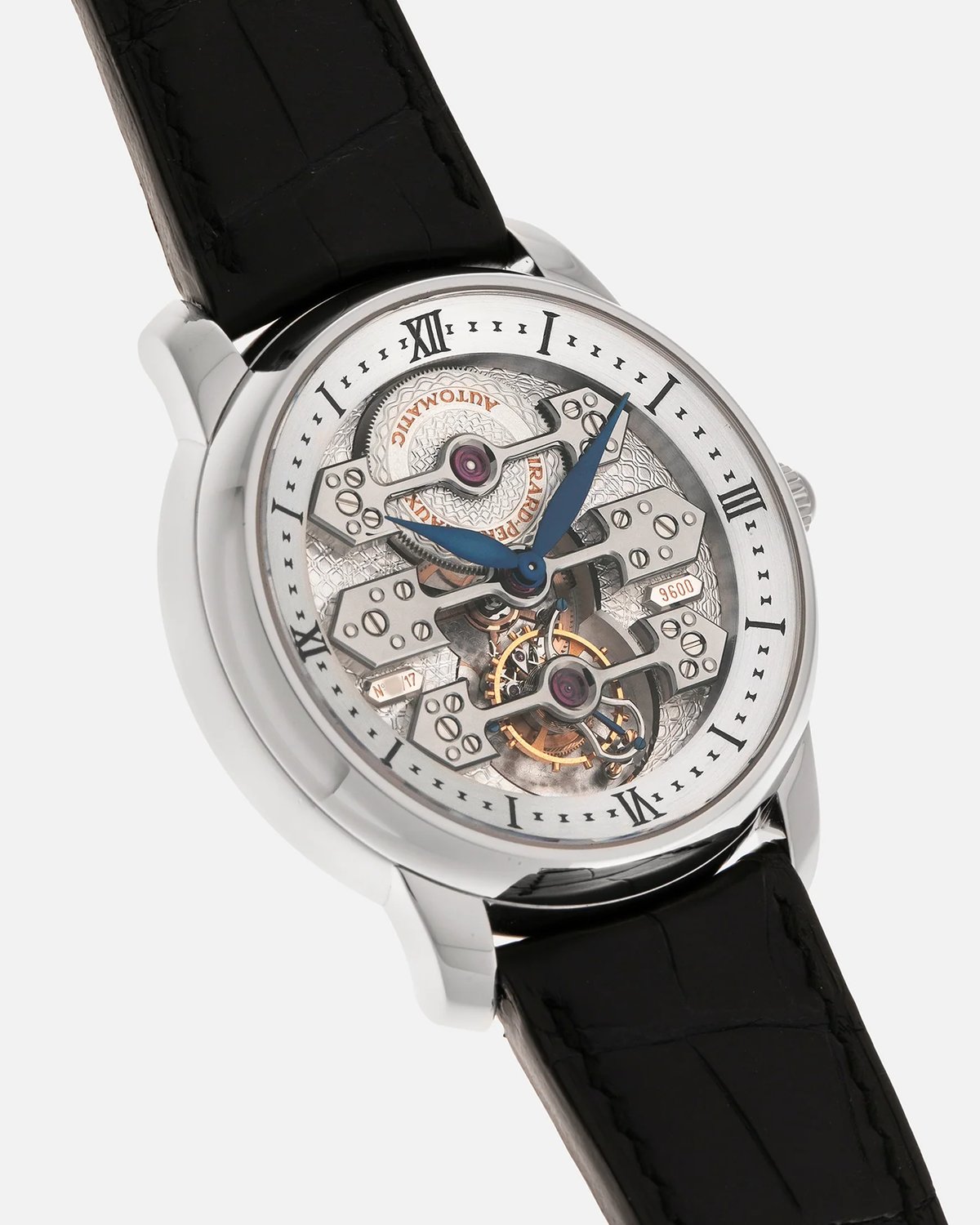
The Architecture That Refused to Hide
Most high complications are built to be discovered. You buy the dial, you live with the dial, and the movement stays a private matter between you and your watchmaker. The Girard-Perregaux Tourbillon with Three Gold Bridges inverts that contract entirely. There is no dial to hide behind. Three parallel bridges of solid gold span the movement like a viaduct, the going train sits beneath them in plain view, and a one-minute tourbillon hangs at six o'clock under the third and shortest of them. You do not own this watch for what it conceals. You own it for what it refuses to.
The design is not a modern conceit. Constant Girard presented a tourbillon with three parallel gold bridges at the 1867 Paris exhibition, and the layout he established — three bridges, arrow-shaped at their ends, aligned with the barrel, the gear train and the tourbillon respectively — was radical because it treated a movement as a composition rather than a container. It earned a gold medal at the 1889 Exposition Universelle. It also fell out of fashion for the better part of a century, which is why the modern version, reintroduced in the early 1990s and refined steadily since, still feels less like a revival than a correction.
Why Three Bridges, Technically
The three-bridge layout is not purely aesthetic. In a conventional movement, the going train is supported by a mainplate on one side and a series of separate cocks and bridges on the other. Constant Girard's insight was to consolidate the upper support into three rigid, parallel members that run the length of the movement and terminate in pointed ends. Rigidity is the point: a bridge that resists flex keeps the gear train in alignment, and the arrow-shaped taper removes material where it carries no load.
Making those bridges in solid gold rather than gilded brass is what turns a good idea into a demanding one. Gold is soft. Every bevel has to be drawn with a file and then polished without rounding the edge; every interior angle has to be worked with a shaped peg until it is crisp rather than smeared. On a steel component a slipped bevel is a nuisance. On a solid gold bridge it is an expensive conversation with the person who owns the watch. The reason so few houses attempt this architecture is not that the concept is difficult to understand. It is that the execution has nowhere to hide.
Movement: Calibre GP9600
Inside is Girard-Perregaux's Calibre GP9600, a hand-wound tourbillon movement built around the bridge architecture rather than adapted to it. It runs at 21,600 vibrations per hour — three beats per second, a deliberately classical cadence for a tourbillon and the pace at which so many of the great mid-century tourbillons were regulated — and carries a power reserve of roughly three days, which makes winding a twice-weekly habit rather than a daily chore.
The essential fact about the GP9600 is that the bridges are not ornament applied to a finished movement. They are the movement's structural skeleton, machined from solid rose gold in the reference reviewed here and finished by hand. The flats are mirror-polished to a black gloss. The flanks are bevelled until the edge catches light in a single unbroken line. The interior angles, where the arrow points meet, are worked until they read as geometry rather than as wear.
Beneath the bridges the mainplate is finished in a darker, granular tone that pushes the gold forward visually. The gear train wheels are chamfered and their crossings smoothed; the screws are polished. The tourbillon cage is a lightweight assembly with timing screws set into its rim, rotating once a minute and carrying the balance and escapement around a fixed fourth wheel. None of this is unusual in isolation. What is unusual is that all of it is exposed, on both sides, permanently.
The Case and the Absence of a Dial
The reference reviewed here pairs a rose gold case with rose gold bridges, which is the most traditional and, to my eye, the most successful configuration. Sapphire covers the front. There is no dial in any conventional sense — only the bridges, the train, and the hands passing above them. Reading the time asks for a half-second of patience while your eye separates gold hands from gold structure behind them. It is a small tax, and one that owners of the three-bridge design have paid happily for over a century.
The case itself is classical in silhouette rather than fashionable: round, softly shouldered, with a slim bezel that keeps the aperture as wide as possible and lugs that curve down rather than out. The caseband is polished, which is the correct call — a brushed flank would fight the mirror-polished bridges and muddy the whole composition. Flip the watch over and the architecture reads again from behind, the underside of the bridges and the cage visible through sapphire, which is where you notice how much of the finishing budget went into surfaces nobody sees while the watch is being worn.
On the Wrist
Wearing the Three Bridges is a different experience from wearing a conventional dress watch, and not only because people notice it. The case is generous and the aperture is almost entirely open, so there is no visual mass in the centre of the watch. The weight lives in the caseband and the lugs, and the whole thing balances on the wrist rather than pressing down on it. On a thin alligator strap with a gold deployant, the watch sits flat and stays there. It does not slide, it does not torque, and it does not feel as heavy as its gold content suggests.
The trade is that it wears like what it is: a statement. There is no dial to soften the watch in a room, no sunburst to catch the light politely. The gold bridges and the rotating cage draw the eye from across a table. If you want a tourbillon that whispers, this is not it; if you want one that argues its case in public, this is one of the very few with the historical standing to get away with it.
The strap deserves a word of its own. Girard-Perregaux fits a thin, tapered alligator that suits the case proportions rather than overwhelming them, and the deployant keeps the tail tidy under the wrist. It is the right pairing. A bracelet would turn an architectural object into a piece of jewellery, and a rubber strap — however fashionable — would read as an apology for the formality of the thing.
Accuracy and Daily Use
A tourbillon was invented to average out the positional error of a pocket watch that lived in a waistcoat, and it does not magically make a wristwatch more accurate. What it does do is signal that everything else in the movement was built to a standard. Expect a well-regulated GP9600 to hold within a few seconds a day on the wrist, with the usual caveats about resting position and how much you move. The 3 Hz escapement gives the running seconds a slightly more deliberate feel than a modern 4 Hz movement. There is nothing wrong with that, but it is a different temperament, and worth understanding before you buy.
The hand-winding is the part I would miss most if it went away. The crown is large enough to grip properly, the ratchet is clean, and the act of putting three days of energy into a movement you can watch the entire time is a small ceremony that an automatic winding system would quietly steal from you. Wind it in the morning. Let it run down if you are not wearing it. Do not leave a tourbillon sitting stopped for months on end and then expect it to behave.
Ownership: Service, Value, and the Secondary Market
This is a watch that goes back to Girard-Perregaux or an authorized service centre when it needs attention — not because the work is exotic in the abstract, but because parts for a gold-bridge tourbillon are not sitting on an independent watchmaker's bench. Budget for the proposition accordingly: a full service on a tourbillon is a four-figure-to-five-figure exercise anywhere in haute horlogerie, and solid gold bridges mean even a minor intervention is handled with more care than a three-hand watch requires. Set the expectation before you buy, not after.
On value, the honest reading is that the Three Gold Bridges holds better than most of the Girard-Perregaux catalogue and worse than its retail price suggests. The design is historically important, the finishing is genuinely hand-work, and the watch is instantly recognizable to anyone who knows watches. But the brand does not carry the auction gravity of Patek Philippe or Vacheron Constantin, and pre-owned examples trade well below boutique pricing. Buying new is buying the object and the experience; buying pre-owned is buying the object and a discount. Neither is wrong, but only one of them is an investment, and it is not the first.
Alternatives Worth Considering
Within classical tourbillons the field is crowded at this price. Breguet's Classique Tourbillon Extra-Plat offers a hand-guilloché dial and a more conventional reading of the complication — it places its tourbillon in plain sight at five o'clock rather than building the watch around it. Jaeger-LeCoultre's Master Ultra Thin Tourbillon is quieter and more wearable in a boardroom. Vacheron Constantin's Traditionnelle Tourbillon is the Geneva alternative, equally serious, with a more orthodox bridge layout and a more conservative effect on the wrist.
What none of them offer is the specific pleasure of a movement whose structural members are the ornament. In every one of those watches the dial is the face and the movement is the secret. In the Three Bridges the two are the same thing, and that is a design position no competitor has been willing to occupy for a century and a half.
Verdict
The Girard-Perregaux Tourbillon with Three Gold Bridges is not a sensible watch and has never pretended to be. It is a piece of nineteenth-century engineering philosophy, made in gold, finished by hand, and worn on the wrist as a continuous argument that a movement can be beautiful without a dial to hide behind. Buy it because you want to look at it every day, because the history is real, and because there is nothing else quite like it at the price. Do not buy it because you think it will appreciate. Buy it because you will still be looking at it in ten years.