Girard-Perregaux: More History Than Heat
Girard-Perregaux dates to 1791, which puts it in the very small group of Swiss houses that can claim uninterrupted heritage rather than a revived nameplate. Its reputation was built on the Tourbillon with Three Gold Bridges, a piece so distinctive that it still functions as the brand's visual signature. But heritage is not the same as market heat, and GP has spent the last twenty years in an awkward position: respected by collectors, under-loved by the broader market, and consistently producing watches that look better on the wrist than they do on a price sheet.
That context matters enormously for this review. The Traveller WW.TC was never going to be a waitlist watch. It was built for a buyer who wanted a genuine complication set from a serious manufacture and was not particularly interested in what the forum said about residuals. That buyer got a good watch. The market, however, did what the market does with anything that is not a hyped steel sports piece: it marked it down hard.
The Traveller Line and the WW.TC Brief
The Traveller collection arrived in the middle of the last decade as GP's attempt to build a coherent modern travel family. The naming was deliberate — this was not a dress watch with a GMT hand bolted on, it was a line conceived around the idea that the wearer moves between time zones and wants the watch to reflect that. The WW.TC badge carries its own history within the brand, having appeared on earlier world-time chronographs, and its revival here was a statement of intent: GP was going to make a proper travel instrument rather than a decorated dress piece.
The result is what you see here. A single watch that answers three questions at once — what time is it at home, what time is it where I am going, and how long has this leg actually taken. That is a genuinely useful brief, and it is the reason the watch still makes sense a decade after launch even as the collection itself has faded from the catalogue.
Movement: GP03300 and the WW.TC Module
Underneath the dial sits Girard-Perregaux's in-house GP03300 automatic, carrying an additional module to deliver the world-time city ring and the chronograph. The base calibre is well known within the GP catalogue and has powered everything from the 1966 to the Laureato, which is exactly what you want from a workhorse: proven, serviceable, and supported. It beats at 28,800 vibrations per hour and delivers around 46 hours of power reserve, which is adequate rather than generous — if you rotate watches, expect to set it every time you come back to it.
Finishing is honest rather than spectacular. There are Geneva stripes on the bridges and a decorated rotor visible through the caseback, but this is industrial finishing executed well, not haute horlogerie executed obsessively. What matters more is the architecture: the module approach means the complication stack sits on top of a reliable base rather than being integrated into a bespoke calibre, which keeps production cost down and, in theory, keeps servicing within the realm of the possible. It is not chronometer-certified, and GP does not market it as such.
Dial, Case and the World-Time Layout
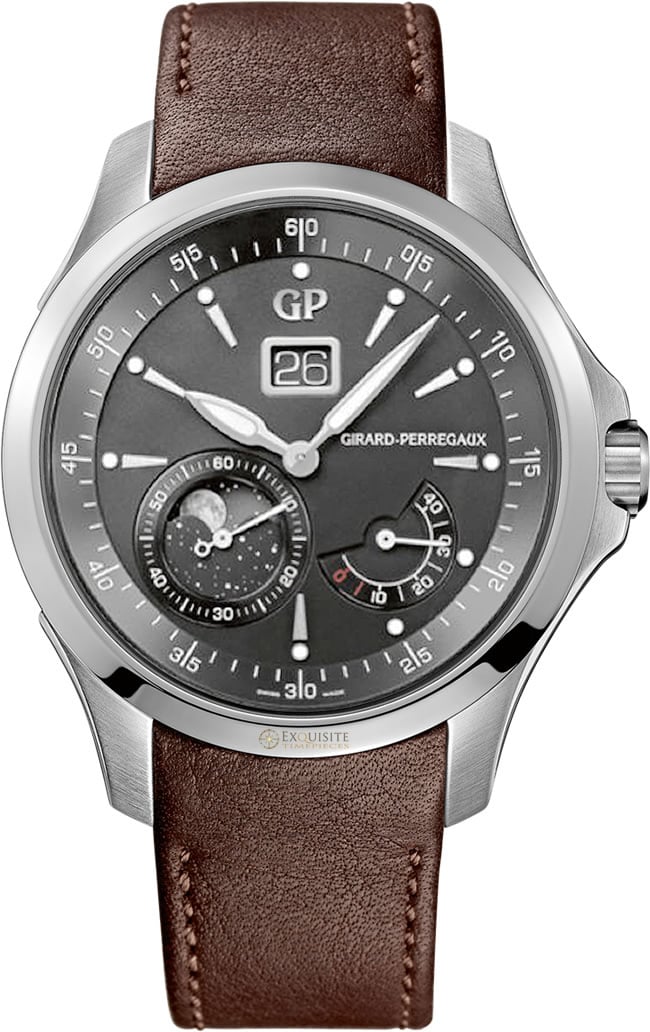
The dial is where this watch either wins you or loses you. There is a lot going on: a city ring, a 24-hour indication, chronograph registers, and a big date display that has to be legible without overwhelming everything else. GP handled the hierarchy reasonably well — the big date is prominent and easy to read at a glance, which is more than can be said for some competitors, and the city ring is legible without requiring a loupe. The overall effect is dense but coherent, and the deep blue tone keeps it from feeling like an instrument panel.
The case is stainless steel with a broad polished bezel, and the finishing is a mix of brushed surfaces on the flanks and polished accents that catch light in the way luxury watches are supposed to. The bracelet is a highlight: solid links, a deliberate taper, and a folding clasp that feels engineered rather than stamped. Girard-Perregaux has always made good bracelets and this one is no exception. It is also worth noting what the case is not — it is not a dive watch, it is not built for the pool, and it should be treated as a travel and dress piece that happens to be made of steel.
On the Wrist
The Traveller WW.TC is a substantial watch and it does not pretend otherwise. The case is wide, the bezel is broad and polished, and the dial is given over almost entirely to information, so the visual footprint reads larger than the raw numbers would suggest. The lugs are shaped and angled rather than slab-sided, which keeps the watch from looking like a disc on the wrist, but the case is not thin — it sits proud, and that height is the first thing you notice under a shirt cuff.
On the bracelet the watch is well balanced. The links are solid, the taper is deliberate, and the folding clasp keeps the head from rotating during the day. On leather it feels noticeably lighter and dressier, but you lose some of the presence that makes the steel version work. Comfort is good for a watch of this size; the real constraint is cuff clearance, not wrist fatigue. If you wear French cuffs regularly, try before you buy. If you wear a jacket with a looser sleeve, it will settle in fine.
Presence is a four out of five. It commands attention through size and dial density rather than flash, which means it reads as a serious tool to people who know watches and stays essentially invisible to everyone else. That is a very specific and, for many collectors, a very desirable quality.
Accuracy and Daily Ownership
The GP03300 is not chronometer-certified in this application, and owners should set expectations accordingly. Expect roughly within ten seconds a day in either direction, with the usual positional variation — dial-up tends to run a little differently from crown-down, and the world-time and chronograph modules add a small amount of drag that can soften amplitude over a long service cycle. Nothing here is a dealbreaker. If you need guaranteed rate performance, this is not the watch that delivers it; if you can live with a routine regulation at service time, the movement is perfectly civilised in daily use.
Operationally, the complication set rewards familiarity. Setting a world-time chronograph is not difficult, but it is a sequence, and doing it wrong means resetting everything. Once you have the routine down, the watch becomes genuinely useful — the city ring answers the time-zone question faster than a phone, and the big date is one of the more satisfying date implementations in the segment. The chronograph is a column-wheel-free, cam-actuated arrangement, so the pusher feel is positive rather than silky. Nobody buys a GP travel chronograph for pusher tactility.
When to Wear It
This is a travel watch first and foremost, and that is where it makes the most sense — on a plane, in a meeting in a different time zone, at a hotel bar where you need to know whether it is a reasonable hour to call home. It works as a daily wearer for anyone whose daily life involves a jacket, and it works as a formal piece because the dial, dense as it is, is composed rather than busy.
It does not work as a sports watch in any meaningful sense, and it is not the watch you take to the beach. Treat those as category boundaries rather than flaws. The Traveller was never designed to be everything.
Variants and the Wider Family
The steel-on-steel reference reviewed here is the one you will find most often, and it is arguably the most coherent expression of the concept — the complication set suits the toolish case material. The pink gold version on leather is rarer, dressier and considerably harder to price, because the pool of comparable sales is thin and dealers have more room to hold out. Within the Traveller family, the Large Date, Moon Phases sibling trades the world-time and chronograph for a big date and moon phase; it is a lighter, more romantic watch and a weaker proposition for anyone who actually travels.
Beyond the Traveller line, GP's identity lives in the Laureato, which is where the brand's secondary-market liquidity actually sits, and in the 1966 and Vintage 1945 for dress, with the Bridges pieces operating at the top of the catalogue as halo objects. If you are buying your first GP, the honest advice is that the Laureato will be easier to own and easier to sell. The Traveller is the connoisseur's detour.
The Market: What the Numbers Actually Say
Here is the part that matters. When it was current, the steel Traveller WW.TC sat in the high-teens of thousands of US dollars at retail — roughly $18,500 depending on market and year. Today, as a discontinued reference, there is no current retail price at all; the only market is the secondary one. And that market has been unforgiving. Clean steel examples on bracelet typically change hands in the mid single-digit thousands, with the strongest examples pushing toward the top of that band and watches with incomplete service history settling well below it.
That is a brutal depreciation curve, and it is not unique to this reference — it is what happens to complicated steel watches from brands without a collector queue. The important question for a buyer today is not what it lost, but whether it has further to fall. The honest answer is that the floor is soft rather than firm. Prices have largely stabilised because the entry point is now low enough that the watch competes on specification rather than on prestige, but there is no catalyst on the horizon that would push values upward. Girard-Perregaux would need a genuine collector revival to change that, and while the brand has been making the right noises, a revival is not something you underwrite.
So the hold-versus-sell judgment is straightforward. If you already own one, sell only into strength or when you have stopped wearing it — do not expect a recovery that will reward patience. If you are buying, buy at the secondary price, buy the best-conditioned example with documented service, and buy it because you want to wear a world-time chronograph from a serious manufacture for the price of a mid-tier sports watch. That is a legitimate and satisfying reason to buy. Capital appreciation is not.
Service and the Cost of Complication
The module-based construction means this is a service-centre watch rather than a neighbourhood watchmaker watch. Parts access for the world-time and chronograph assembly realistically pushes you toward Girard-Perregaux authorised partners, and that has two consequences: you will pay more than you would for a simple three-hander, and you will wait longer. When evaluating a pre-owned example, service documentation is worth more than cosmetic perfection — a scratched bracelet is cheap to fix, a seized module is not.
Alternatives Worth Considering
If your priority is residuals, the Rolex Sky-Dweller is the obvious answer and a completely different financial proposition. If you want a modern world-time dial with better daily robustness, the Omega Seamaster Aqua Terra Worldtimer is the more practical object. The Jaeger-LeCoultre Polaris Geographic World Time offers a cleaner, more restrained execution from a house with comparable complications pedigree. All three will cost more than this GP on the secondary market, and all three will hold value better.
What none of them offer is the specific combination of in-house manufacture, complication density and outright affordability that the Traveller WW.TC delivers. That is the niche, and it is a real one.
The Verdict
The Traveller WW.TC is the watch Girard-Perregaux should have sold in far greater numbers and almost certainly did not. It is complicated, well made and genuinely useful for anyone who crosses time zones regularly, and yet it trades at a fraction of its original cost because the market has never rewarded GP's travel line the way it rewards the Laureato. For a serious collector that is precisely the argument for buying — provided you go in knowing this is a wear-it-and-enjoy-it purchase, not a store of value. Buy the best example you can find, keep the service history, and do not expect the market to thank you.