Brand history and context
Glycine was founded in Bienne, Switzerland, in 1914, and its name became most closely associated with the Airman, one of the defining pilot's watches of the twentieth century. That history matters because Glycine has always been at its best when making legible, purposeful instruments. The Combat Sub line continues that tradition in a dive-watch format, and the 3997 is a direct expression of the brand's utilitarian instincts.
The model is not a boutique object. It does not chase hand-finishing or limited-production mystique. Instead, it offers the sort of honest Swiss engineering that once defined the mid-market tool watch: a dependable movement, a sapphire crystal, meaningful water resistance, and a case designed to be read at a glance. That is the correct context for evaluating the 3997.
Case, bezel, and dial
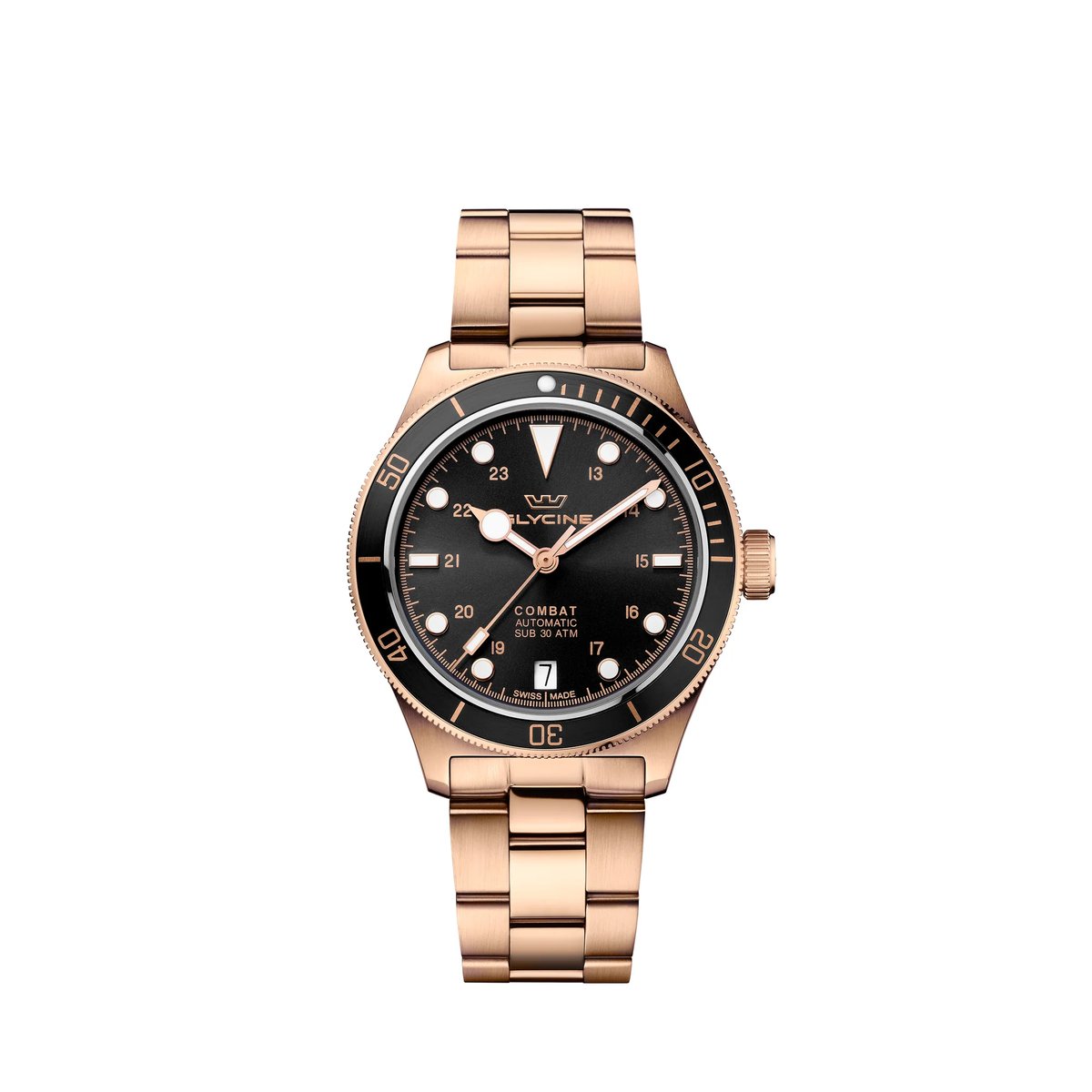
The 3997 uses a 42mm stainless steel case, which places it in the familiar modern diver category without drifting into oversized territory. The case finishing is appropriately mixed: brushed surfaces dominate the sides and upper planes, while polished accents catch light at the edges. It is not jewelry-level finishing, but it is clean and consistent with the price. The bezel is the functional centerpiece, with a clear dive scale and enough grip to operate with wet fingers. The action is positive rather than silky, which suits the watch's tool-watch brief.
The dial is where the 3997 earns its keep. Glycine has resisted the temptation to over-decorate. The indices are large and luminous, the hands are broad enough to read in low light, and the date window at 3 o'clock is integrated without disrupting the symmetry too badly. The black dial provides maximum contrast, and the Super-LumiNova lume is applied generously enough for real-world evening use. The sapphire crystal is a welcome specification at this price, and it gives the dial a clear, slightly cool presentation.
Water resistance is rated to 300m, which is more than most owners will ever need but exactly what a dive watch should offer. The screw-down crown and caseback construction support that rating, and the overall sense is of a watch built to tolerate swimming, snorkeling, and the general abuse of daily life. The 3997 does not feel fragile.
Design details that matter
The 3997 succeeds because its details are chosen for use rather than ornament. The bezel insert is clearly printed, the markings are easy to align, and the grip is practical even when wet. The crown is protected by modest guards, and the caseback is solid, which is the right decision for a watch at this level. There is no exhibition window to distract from the tool-watch brief, and no decorative flourishes that would look out of place on a dive watch.
The dial architecture is similarly disciplined. The hour markers are large enough to be read at a glance, and the hands have enough surface area for lume to do its job. The date window is a practical addition rather than an afterthought, though purists may prefer a no-date dial. The overall impression is of a watch that was designed by people who understand how a dive watch is actually used. It is not sterile, but it is uncluttered, and that is a virtue.
Movement and architecture
Inside the 3997 is Glycine's GL224 automatic movement. The GL224 is a proven Swiss caliber derived from the ETA 2824-2 family, and that lineage is a strength rather than a compromise. It is a robust, serviceable architecture with a practical date function and a long record in the field. Power reserve is approximately 38 hours, and the frequency is 28,800 vph. The movement is not COSC-certified, and it is not in-house, but those facts matter less than the ownership experience: parts and service knowledge are widely available, and the movement has a reputation for dependability.
Finishing on the GL224 is industrial. You will not find the hand-bevelled bridges or black-polished screws of a haute horlogerie caliber, and that is entirely appropriate here. The movement is hidden behind a solid caseback, and the design priority is clearly durability and ease of maintenance. In a watch at this level, a familiar Swiss automatic is a more sensible choice than an exotic caliber with limited service support. The 3997's movement is the kind of engine that lets you wear the watch without anxiety.
On the wrist
The 42mm case gives the 3997 a substantial but not overwhelming presence. On the leather strap, the watch feels more compact than its dimensions might suggest because the strap visually narrows the case and softens the transition to the wrist. The balance is good, and the watch sits comfortably under a cuff when needed. It is not a slim dress watch, but it is also not a brick. The leather strap is a sensible pairing for the reference, and the pin buckle keeps the package simple and traditional.
The wearing experience is best described as reassuring. The bezel, crown, and case all feel solid, and the watch has the tactile confidence of a proper tool. The 42mm diameter gives it enough wrist presence to read as a dive watch, while the leather strap prevents it from feeling purely technical. It works with a T-shirt and jeans, with a field jacket, and even with a casual blazer. It is not a formal watch, but it is versatile in the way that good everyday watches often are.
Wrist presence is about 4 out of 5. The 3997 looks like a serious diver on the wrist, but it does not shout. It has the quiet confidence of a watch that knows what it is for. Collectors who prefer smaller vintage proportions may find it a touch large, while those who wear modern divers will find it familiar and easy.
Strap and hardware
The leather strap is a major part of the 3997's character. It softens the watch visually and makes it feel less like a dedicated dive instrument and more like a daily companion. The leather is thick enough to balance the case, and the pin buckle is simple, secure, and easy to replace if desired. The strap will break in over time, and owners who prefer a bracelet can always source a suitable stainless steel option, though the leather gives the reference a distinctive identity.
The hardware is not overbuilt, but it is appropriate. The pin buckle is traditional and unobtrusive, and the strap keepers are sturdy. There is no quick-release system, which is a small inconvenience for people who like to swap straps, but it is also one less point of failure. For a watch in this price range, the strap and buckle feel honest and well matched to the case.
Accuracy and daily performance
The GL224 is not a chronometer-certified movement, so exact accuracy will vary from example to example. In real-world use, a healthy 3997 should run within a few seconds to low tens of seconds per day, depending on position, temperature, and wear habits. That is normal for a non-COSC Swiss automatic in this class. If precision matters, a watchmaker can regulate the movement during service, and the ETA 2824-2 architecture makes that straightforward.
Day-to-day, the 3997 is easy to live with. The date function is useful, the dial is legible in almost any light, and the 300m water resistance means you do not have to think about rain, swimming, or washing your hands. The 38-hour power reserve is adequate for a daily wearer, though it means the watch will stop if left unused for a weekend. That is a minor inconvenience rather than a flaw, and it is consistent with the proven movement architecture.
Living with the 3997
This is a watch that rewards routine wear. It does not demand special handling, and it does not attract attention in the way that a precious-metal diver might. The black dial and steel case are discreet enough for the office, and the 300m rating gives it genuine capability for the water. The leather strap means it is not the ideal choice for repeated swimming, but the watch itself is more than capable. A quick strap change would make it a proper vacation watch.
The 3997 also works well as a one-watch option for someone who wants a Swiss automatic with real utility. It is not as refined as a Tudor or as distinctive as an Oris, but it is more affordable than both and easier to service than many microbrand alternatives. For a young collector building a first serious collection, that combination is appealing. It offers a taste of proper Swiss watchmaking without the anxiety of owning something fragile or rare.
Ownership, service, and value
The 3997 is a watch to buy and wear. Its value proposition is strongest on the secondary market, where clean examples typically trade for a fraction of the original retail price. The original MSRP was around $1,150, and pre-owned examples generally fall in the $450 to $700 range depending on condition, accessories, and strap or bracelet configuration. That puts the 3997 in direct competition with entry-level Swiss divers and with well-made microbrand alternatives.
Service is straightforward. The GL224 is serviceable by Glycine's authorized network and by many independent watchmakers. Owners should budget for a standard clean, lubricate, and regulate when timing drifts or after several years of hard use. The movement is common enough that parts are not a major concern, and the watch does not require specialist care. That is one of the quiet advantages of buying a proven caliber rather than an exotic one.
From an investment perspective, the 3997 is stable but not appreciating. It has no major auction history, and it is unlikely to become a collector's trophy. That is not a criticism. The watch's value lies in utility: it delivers a Swiss automatic movement, sapphire crystal, 300m water resistance, and genuine dive-watch credibility for modest money. Buyers should expect to hold it because they enjoy wearing it, not because it will fund a future purchase.
What to check on the secondary market
When buying a 3997 pre-owned, condition matters more than rarity. Check the bezel action for looseness or misalignment, inspect the crystal for chips, and make sure the crown screws down smoothly. Ask about service history if available, and factor in the cost of a routine service if the watch has been worn heavily. Original box and papers add appeal but should not command a huge premium on a watch in this price class.
The strap is also worth checking. Leather wears out, and a replacement strap is inexpensive, but an original Glycine strap can add completeness. If the watch is being sold on a bracelet, confirm that the end links fit properly and that the clasp is correct. These are small details, but they matter when you are buying a tool watch that is meant to be used rather than displayed.
Alternatives and homages
Within the Swiss dive-watch market, the Tudor Black Bay 58 offers a more refined case, stronger finishing, and greater collector cachet at a significantly higher price. The Oris Divers Sixty-Five brings a more distinctive vintage-inspired design and a comparable tool-watch character. The Longines HydroConquest is a more mainstream alternative with a polished daily-wear personality and comparable water resistance. Each of these watches makes sense in a different budget and for a different owner.
For buyers who want the look without the Swiss price, homages are plentiful. The San Martin SN008-G offers a well-made tribute to the Submariner formula with comparable case proportions and lower finishing. The Pagani Design PD-1661 is a budget option that captures the silhouette but not the movement or the finishing. These watches are not substitutes for the Glycine in terms of brand history or movement quality, but they show how widely the dive-watch template has been interpreted.
Final verdict
The Glycine 3997 is a thoroughly sensible watch. It is not trying to be a luxury object, and it does not need to be. Its strengths are the ones that matter in daily use: a legible dial, a robust case, meaningful water resistance, sapphire crystal, and a proven automatic movement. The leather strap gives it a softer, more versatile character than a bracelet, and the 42mm case is substantial without being cumbersome.
For a discerning young collector, the 3997 represents an honest entry into Swiss automatic dive watches. It rewards someone who values movement architecture and practical design over hype. It will not appreciate like a Submariner, and it will not impress anyone who reads only logos. But it will do the job, day after day, with a quiet competence that is increasingly rare. That is a recommendation.