The doctrine of the 24-hour dial
For a certain kind of collector, the Glycine Airman is not a watch so much as a doctrine. Introduced in 1953 — the same year as the Rolex Submariner and the Blancpain Fifty Fathoms, though conceived for an entirely different mission — the Airman was built around a single, stubborn premise: that a pilot crossing time zones needs to read the hour on a 24-hour scale, not a 12-hour one. Where dive watches solved for pressure, the Airman solved for disorientation. A 24-hour hand does not strictly tell you whether it is morning or evening; it tells you, unambiguously, where you are in the day. For an aviator, that is the difference between a correct ETA and a wrong one.
The Airman Worldtimer Purist is the modern heir to that idea, and the cleanest expression of it in Glycine's current catalog. Strip away the commemorative dials, the military re-editions, the co-branded specials, and what remains is a 24-hour pilot's watch with a second time zone, a rotating 24-hour bezel, and almost nothing else competing for attention. It is, in the literal sense of the word, a purist's watch — and it is all the more legible for it.
This is not an expensive watch, and it does not pretend to be. But expensive and cheap are not the axis on which a pilot's watch should be judged. Legibility, robustness, and a movement that can be serviced anywhere are. On those terms, the Airman Worldtimer Purist asks a fair question: what exactly does a collector gain by spending four or five times as much for the same function?
A short history of the Airman
Glycine was founded in Bienne in 1914 by Eugène Meylan, a watchmaker who specialized in small, high-quality movements and, later, in automatic winding systems. For four decades the brand built a quiet reputation for technical competence rather than showmanship. Then, in 1953, it found its defining product. The original Airman paired a 24-hour dial with a rotating 24-hour bezel and a locking crown, giving pilots a way to track a second time zone without arithmetic. It was adopted by military aviators — most famously in the Vietnam era — and became one of the few genuine tool watches to emerge from the 1950s with a design brief rather than a marketing brief.
The mechanics of the original were clever in a way that still commands respect. The crown at four o'clock could be pulled to hack the seconds and set the 24-hour hand independently, allowing a pilot to synchronize precisely with a radio time signal. That combination of hacking and independent 24-hour adjustment was rare for the period, and it established the template that later Airman models refined rather than replaced.
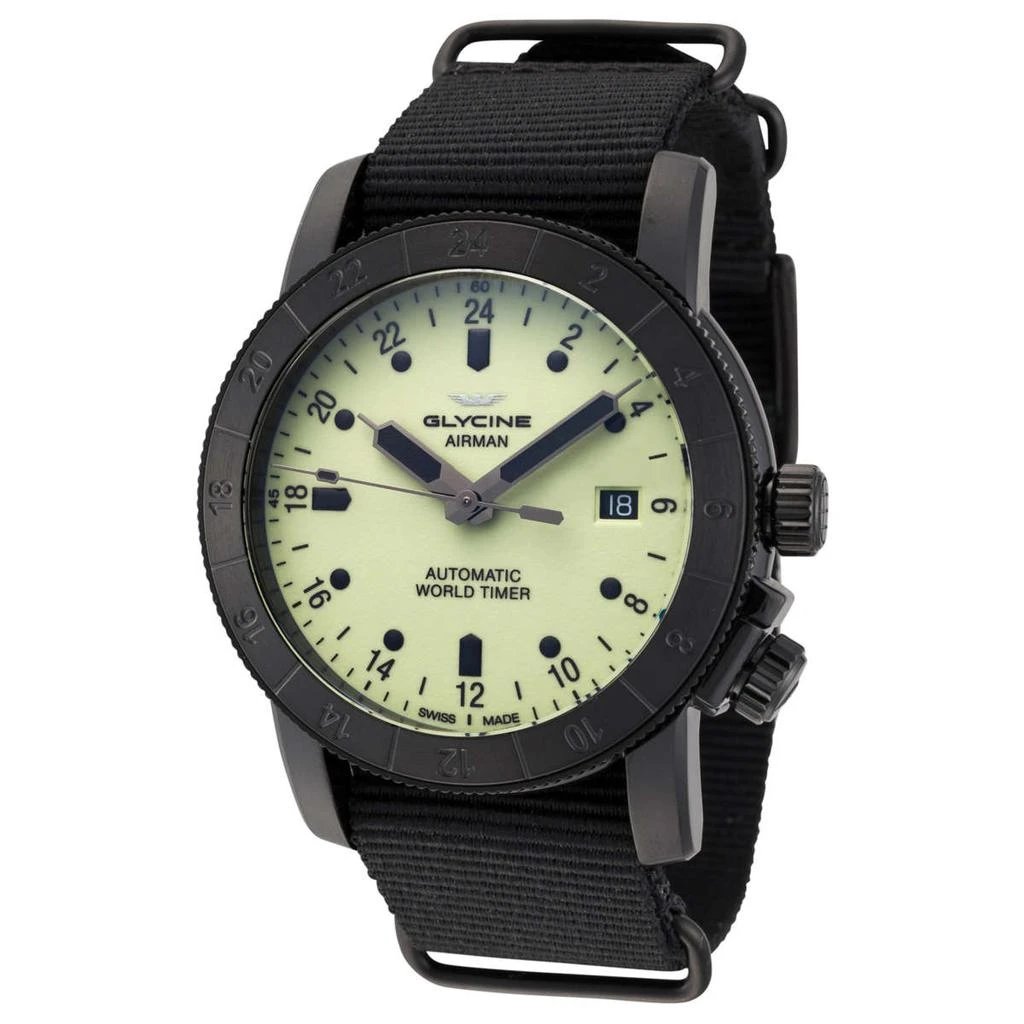
Glycine was acquired by Invicta in 2016, a move that reshaped distribution and pricing while leaving the Airman's core architecture largely intact. The Worldtimer line extended the formula with a second time zone and a rotating bezel, and the Purist variant trims the dial back to the essentials: 24-hour numerals, luminous hands and markers, a discreet date at three o'clock, and a bezel that rotates with conviction.
Movement: the GL293
Inside the Airman Worldtimer Purist beats Glycine's GL293, which is the brand's designation for the ETA 2893-2. This is a known quantity in watchmaking: a 21-jewel automatic with a 42-hour power reserve, a frequency of 28,800 vibrations per hour, a 24-hour hand, and an independent date. It is not COSC-certified, and Glycine does not pretend otherwise. What it is, instead, is reliable, well-understood, and — crucially for a tool watch — serviceable almost anywhere in the world.
The architecture is conventional in the best sense. The 2893-2 is essentially a 2892 base with a GMT module layered over it, which keeps the movement thin relative to its capability and preserves the winding efficiency that made the 2892 family a mainstay. Finishing is industrial: perlage on the bridges, a signed rotor, blued screws visible through the caseback. None of it is decorative in the grand manner, and none of it needs to be. This is a movement designed to be opened, regulated, and returned to service for decades, and the widespread availability of parts and expertise is a genuine ownership advantage that no amount of hand-finishing can match.
Case, dial, and bezel
The case is stainless steel, restrained in its proportions and free of the slab-sided bulk that plagues so many modern GMTs. It is protected by a sapphire crystal and finished with the kind of straightforward brushing and polishing that reads as purposeful rather than precious. The bezel is the watch's defining instrument: a 24-hour scale that rotates with a firm, reassuring click, allowing a second or third time zone to be read without touching the crown.
The dial is where the Purist earns its name. A full 24-hour track frames the perimeter, with luminous numerals and markers that glow cleanly in low light thanks to Super-LumiNova. The 24-hour hand is unmistakable, and the second time zone is indicated without clutter. A discreet date aperture at three o'clock is the only concession to everyday practicality, and it is small enough not to interrupt the dial's rhythm. There is no busy world-city ring, no superfluous text, no complication that exists for the brochure rather than the wrist.
That restraint is deliberate, and it is the correct choice. A pilot's watch is read under stress and in poor light, often with one hand. Every element that does not aid that reading is a liability. The Purist understands this in a way that many more expensive dual-time watches do not.
On the wrist
The Airman Worldtimer Purist wears like a tool watch should: moderate in diameter, balanced on the wrist, and free of the slab-sided bulk that plagues so many modern GMTs. The case sits close to the wrist, the bezel turns with a firm, reassuring click, and the leather strap softens quickly without feeling flimsy. On smaller wrists it reads as a proper pilot's watch rather than a statement piece; on larger wrists it may feel almost modest.
The real comfort story is the dial. Because the 24-hour scale is read at a glance, the watch never demands a second look — no squinting at a sub-dial, no hunting for a date under a reflector. That absence of friction is what separates a genuine pilot's watch from a watch that merely looks like one, and it is the reason the Purist ends up on the wrist more often than expected.
Accuracy and ownership
The GL293 is a proven, robust caliber rather than a chronometer-grade one. Expect it to run within roughly ten to fifteen seconds a day out of the box, with the usual variance across positions. A competent watchmaker can regulate it comfortably inside that window, and because the base is an ETA 2893-2, parts and expertise are abundant. This is a movement you live with rather than fuss over — reliable, serviceable, and honest about its tolerances.
Service intervals of roughly five years are reasonable, at an approximate cost of a few hundred dollars depending on the watchmaker. The watch does not require an authorized service center; any competent independent can handle it, which is a meaningful advantage for a watch at this price point.
The variants
The Purist is offered in a small number of configurations. The core reference, GL0162, pairs the black 24-hour dial with a leather strap and a pin buckle — the most traditional and, arguably, the most coherent expression of the design. The GL0163 mounts the same head on a stainless steel bracelet, adding heft and a more overtly sporty character. Both share the same movement, bezel, and dial architecture; the choice is essentially one of strap versus bracelet, and the bracelet version is the more versatile daily wearer.
Value and the secondary market
At a retail price around the low four figures, the Airman Worldtimer Purist is one of the more honest propositions in mechanical watchmaking. It delivers a genuine 24-hour pilot's display, a second time zone, a rotating bezel, and a proven Swiss automatic for less than the cost of a quartz fashion watch from a luxury maison. Pre-owned examples typically trade in the mid-hundreds to high-hundreds, which makes the entry point even more accessible.
But honesty cuts both ways. Glycine is not a brand that appreciates, particularly in the wake of the Invicta acquisition, and the Purist should be bought to wear rather than to hold. Collectors who need their purchases to retain value should look elsewhere; collectors who want a legitimate tool watch at a fair price will find few better arguments.
The verdict
The Airman Worldtimer Purist succeeds precisely because it refuses to be more than it is: a legible, robust, dual-time pilot's watch with a 24-hour dial and a bezel that does exactly what it should. It will not impress at a dinner party, and it will not appreciate in a safe. What it will do is tell you the time in two zones at a glance, every day, for years — and that, for a pilot's watch, is the whole point.
In a market increasingly crowded with overcomplicated dual-times and under-engineered lifestyle pieces, the Purist is a reminder that the Airman's original brief was never about adornment. It was about knowing where you are. That the watch still answers that question so cleanly, seven decades later, is the highest compliment one can pay it.