The Dutch Masters Behind the One Hertz
Grönefeld was founded in 2008 by brothers Bart and Tim Grönefeld. Hailing from Oldenzaal in the Netherlands, they are third-generation watchmakers. Before launching their own brand, they spent years restoring vintage watches and working for major maisons. That experience shows in every component of the One Hertz.
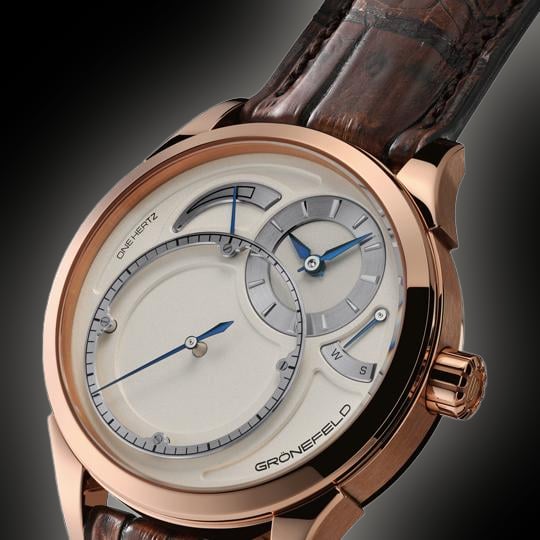
The One Hertz, introduced in 2010, was their first wristwatch. It was a manual-wind wristwatch with an independent deadbeat seconds—a complication that had rarely been seen in a modern wristwatch. It put Grönefeld on the map as a serious independent, alongside the likes of F.P. Journe and Kari Voutilainen.
The Contemporary ref. 1896 is a later evolution. It takes the One Hertz formula and dresses it in a stainless steel case with a modern dial. It’s a more approachable version of a high-complication independent, but it loses none of the magic.
What sets Grönefeld apart is their commitment to traditional hand-finishing. In an era where many brands rely on CNC machining and minimal handwork, the Grönefeld brothers still finish their movements by hand. The One Hertz Contemporary is a testament to that philosophy.
What Is a Deadbeat Seconds?
Most mechanical watches have a seconds hand that sweeps smoothly around the dial. The deadbeat seconds, also known as jumping seconds, advances once per second. It’s a deliberate, ticking motion that feels almost quartz-like—except it’s entirely mechanical.
The challenge is that the balance wheel typically beats at a much higher frequency. To make the seconds hand jump once per second, you need a separate gear train that releases the hand at precise intervals. This is complex, and it requires additional components and careful regulation. Grönefeld’s solution is elegant: a secondary gear train dedicated to the jumping seconds, independent from the main going train.
The result is a seconds hand that jumps with a satisfying snap. It’s hypnotic. Once you see it, you’ll understand why collectors pay a premium for the One Hertz.
Historically, deadbeat seconds were used in precision clocks and some pocket watches. Bringing them to a modern wristwatch is a feat of micro-engineering. Grönefeld didn’t just revive the complication; they made it their own.
The Movement: Caliber G-02
At the heart of the One Hertz Contemporary is the Caliber G-02. It’s a manual-wind movement, which is fitting for a watch that celebrates traditional watchmaking. The absence of a rotor keeps the case profile manageable and allows the movement to be admired through the sapphire caseback.
The G-02 has a power reserve of 56 hours. That’s generous for a manual-wind watch, and it means you can take it off for the weekend without worrying about resetting it. The balance wheel beats at 21,600 vibrations per hour (3 Hz), while the deadbeat seconds hand advances at 1 Hz. That’s the One Hertz name.
Finishing is exceptional. The bridges are frosted, the bevels are polished, and the screws are blued. The deadbeat seconds mechanism is visible, and it’s a joy to watch. This is not a movement that was designed to be hidden.
Complications include the deadbeat seconds and a power reserve indicator. There’s no date, which keeps the dial clean and symmetrical. The movement is in-house, and it’s not COSC certified—but that’s not the point. Grönefeld regulates each movement by hand to a high standard.
The G-02 is composed of hundreds of parts, each finished to a level that rivals the best of traditional watchmaking. The deadbeat seconds mechanism alone is a small watchmaking miracle. It’s the kind of movement that makes you want to turn the watch over and stare.
Design and Wrist Feel
The One Hertz Contemporary is housed in a stainless steel case. It’s a departure from the precious metals often used for high-complication independents, but it makes the watch more wearable and more modern. The sapphire crystal is domed, and the dial is a rich blue with applied indices.
On the wrist, it feels substantial but not clumsy. The sculpted lugs curve to the wrist, and the absence of a rotor keeps the profile manageable. The leather strap is supple, and the pin buckle keeps it secure. It’s the kind of watch you can wear to a board meeting or a collector’s dinner.
There’s no lume, which is typical for a dress watch. This is not a sports watch. It’s a piece for formal occasions and daily wear for those who work in offices rather than on oil rigs. The jumping seconds is the star of the show, and it draws the eye every time you glance at your wrist.
Wrist presence is a solid 5/5. It’s not oversized, but it has a commanding presence thanks to the unique complication and the quality of the finishing.
The dial is legible and balanced. The power reserve indicator is integrated into the design, and the hands are polished and easy to read. The overall aesthetic is modern but timeless. It’s a watch that will look as good in twenty years as it does today.
Accuracy and Daily Wear
Real-world accuracy is likely within a few seconds per day. Grönefeld doesn’t publish a specific rate for the One Hertz, but independent brands often regulate their movements to chronometer-like standards. The deadbeat seconds makes setting the watch precise: when the hand jumps, you know exactly where you are.
The 56-hour power reserve is a practical touch. It means you can wear it in rotation without constantly winding it. The manual-wind action is smooth, and the crown is easy to grip. The power reserve indicator on the dial lets you know when it’s time to wind.
Daily wear is a pleasure, but it’s not a beater. The stainless steel case is durable, but the watch is not water-resistant to any significant depth. You should avoid swimming or showering with it. It’s a watch for the office, the dinner table, and the collector’s meetup.
The leather strap is comfortable and breaks in nicely. The pin buckle is traditional and secure. If you prefer a deployant clasp, you can always swap it, but the pin buckle suits the watch’s vintage-inspired soul.
Variants and Family
The One Hertz family includes several variants. The original One Hertz established the template. The One Hertz 1912 added a vintage-inspired dial. The One Hertz Techniek opened up the dial to show more of the movement. The Contemporary ref. 1896 is the modern stainless steel edition.
Each variant shares the same core: the deadbeat seconds, the manual-wind caliber, and the hand-finishing. The Contemporary is the most wearable of the bunch, thanks to its stainless steel case and versatile dial.
If you’re considering a One Hertz, you can’t go wrong with any of them. But the Contemporary is the one to get if you want a modern daily wearer that still feels special.
Other notable Grönefeld models include the 1941 Remontoire, which features a constant-force remontoire; the 1941 Grönograaf, a chronograph; and the 1941 Principia, a time-only piece. Each is a masterpiece in its own right, but the One Hertz remains the brand’s signature complication.
Similar Watches to Consider
The deadbeat seconds is a niche complication, but there are a few alternatives. The Habring2 Dead Beat Seconds is a more accessibly priced independent with a true jumping seconds. It’s not as finely finished as the Grönefeld, but it’s a great entry point.
The De Bethune DB25 Deadbeat Seconds is another high-end option. It has a futuristic design and a similar complication. It’s a different aesthetic, but it’s worth a look if you want something more avant-garde.
Kari Voutilainen’s Vingt-8 Deadbeat Seconds is perhaps the closest rival in terms of finishing and independent pedigree. It’s more expensive and harder to find, but it’s a masterpiece.
As for homages, there’s no true homage to the One Hertz. The deadbeat seconds is too complex for mass-market brands. The closest you’ll get is a dressy automatic like the Seiko Presage Cocktail Time, which offers a vintage vibe but no jumping seconds.
If you want a jumping seconds but can’t afford the Grönefeld, the Habring2 is your best bet. It’s a true independent with a similar complication, and it’s made in Austria by a husband-and-wife team. It’s not the same level of finishing, but it’s a legitimate alternative.
Investment Value
Grönefeld is a small independent, and its production is limited. The One Hertz Contemporary ref. 1896 is not a mass-produced watch. That scarcity helps it hold value. Pre-owned examples typically trade in the $45,000 to $60,000 range, depending on condition and completeness.
The trend is stable. Independent watchmaking has a loyal collector base, and Grönefeld is one of the most respected names in the field. The One Hertz is a signature model, so it should continue to be sought after.
There’s no major auction history for this specific reference, but that’s not unusual for a modern independent. The primary market is the collector-to-collector market. If you buy one, keep the box and papers. Complete sets always command a premium.
Our hold recommendation: buy it if you love it, and hold it. It’s not a quick flip. It’s a long-term relationship. The independent watch market can be volatile, but the best pieces—like the One Hertz—tend to weather the storms.
Compared to a mass-produced steel sports watch, the One Hertz Contemporary offers something more personal. It’s a watch that reflects the taste and knowledge of the owner. That intangible quality is what drives its value in the long run.
Service and Maintenance
Service intervals for the One Hertz are not officially published, but high-complication independents typically require periodic service. The deadbeat seconds mechanism is complex, so service should be handled by Grönefeld or an authorized independent specialist. Do not take it to a local watchmaker who hasn’t worked on independent movements.
The cost of service is not publicly listed, but expect it to be significant. This is a watch that requires skilled hands. The good news is that Grönefeld has a reputation for excellent after-sales support.
If you’re buying pre-owned, ask for service records. A well-maintained One Hertz is a joy to own. A neglected one can be a costly headache. Always buy the seller as much as the watch.
Who Is It For?
The Grönefeld One Hertz Contemporary is for the collector who has moved beyond the usual suspects. It’s for someone who appreciates independent watchmaking, hand-finishing, and mechanical ingenuity. It’s not for the person who wants a one-watch collection. It’s for the person who wants a special piece for special occasions.
It’s also for the person who loves the idea of a jumping seconds. There’s something magical about watching the seconds hand tick once per second, knowing that a complex mechanism is responsible. It’s a conversation starter, and it’s a watch that will never be mistaken for anything else.
Pros and Cons
Pros:
- Unique deadbeat seconds complication
- Superb hand-finishing and independent pedigree
- Limited production and strong collector appeal
- Stainless steel case makes it wearable
- 56-hour power reserve
Cons:
- Not a sports watch; no lume or water resistance to speak of
- Service can be costly and requires specialist care
- Pricing is high and availability is limited
- No date may be a dealbreaker for some
Final Verdict
The Grönefeld One Hertz Contemporary ref. 1896 is a masterclass in independent watchmaking. It’s not for everyone, but for the collector who wants a jumping seconds and a story, it’s a compelling choice. The stainless steel case makes it wearable, and the hand-finished movement makes it special. If you can find one, buy it.
In a world of interchangeable steel sports watches, the One Hertz Contemporary stands out. It’s a watch that rewards the wearer with a moment of mechanical wonder every second. And that’s worth the price of admission.
Whether you’re a seasoned collector or a newcomer to independents, the One Hertz Contemporary deserves a spot on your radar. It’s a piece that will bring joy for years to come.