H. Moser & Cie Endeavour Centre Seconds – A Minimalist’s Power‑Play
When H.
By Vivir··Updated
In this review# H. Moser & Cie Endeavour Centre Seconds – A Minimalist’s Power‑Play
When H. Moser & Cie. unveiled the Endeavour Centre Seconds at Baselworld 2017, the watch world received a clear statement: the brand could marry its celebrated “fumé” dial aesthetic with a wholly in‑house movement without compromising the austere elegance that has become its hallmark. The result is a 40 mm, three‑hand dress watch that looks as if it were plucked from a design studio rather than a factory floor. At $19 900 USD, the piece sits at the top of the entry‑level luxury tier, promising both visual intrigue and mechanical independence. In the pages that follow we dissect how the watch lives up to its ambitions, where it falls short, and who should actually consider adding it to their wrist.
---
## Heritage — the model's place in the brand's line and its launch context
H. Moser & Cie., a Swiss manufacturer founded in 1825, has spent the last two decades redefining the notion of “quiet luxury.” After the 2012 launch of the original Endeavour collection—characterised by its smoked (fumé) dials and a clean, rectangular silhouette—the brand began to experiment with how far it could strip away superfluous decoration while still delivering a watch that feels substantial.
The Endeavour Centre Seconds arrived in 2017 (reference 1200‑0201) as the third major iteration of the line, positioned directly after the original Endeavour and the slightly larger Endeavour Centre. Its launch coincided with a broader industry shift toward in‑house movements, and Moser answered that call by introducing the Calibre HMC 200, the first fully proprietary automatic created entirely within the company’s workshops.
In terms of lineage, the Centre Seconds is the most pared‑down of the trio: it discards the date window found on earlier models, narrows the case profile, and adopts a fully transparent case back to showcase the new movement. The watch therefore occupies the “pure dress” niche in Moser’s catalog, sitting alongside the more complicated Heritage Chronograph and the sporty Swiss Alpine series. Its price point of roughly $19 900 places it in the upper‑mid tier of the brand’s offerings—higher than the entry‑level Swiss Alpine but well below the limited‑edition pieces that command six‑figure sums.
---
## Design & Case — case dimensions, materials, dial
### Dimensions & Materials
- **Case size:** 40 mm diameter, 10.7 mm thickness
- **Material:** 18‑carat white gold (the standard offering) with an optional 18‑carat red (rose) gold version
- **Crystal:** Sapphire front and rear, both anti‑reflective
- **Water resistance:** 30 m (3 ATM)
The 40 mm diameter is deliberately modest for a modern dress watch; it sits comfortably between the “under‑40 mm” trend and the larger, sportier proportions that dominate today’s market. At 10.7 mm thick, however, the watch leans toward the chunky side for a dress piece—something to note if you favour ultra‑slim profiles under a tuxedo cuff.
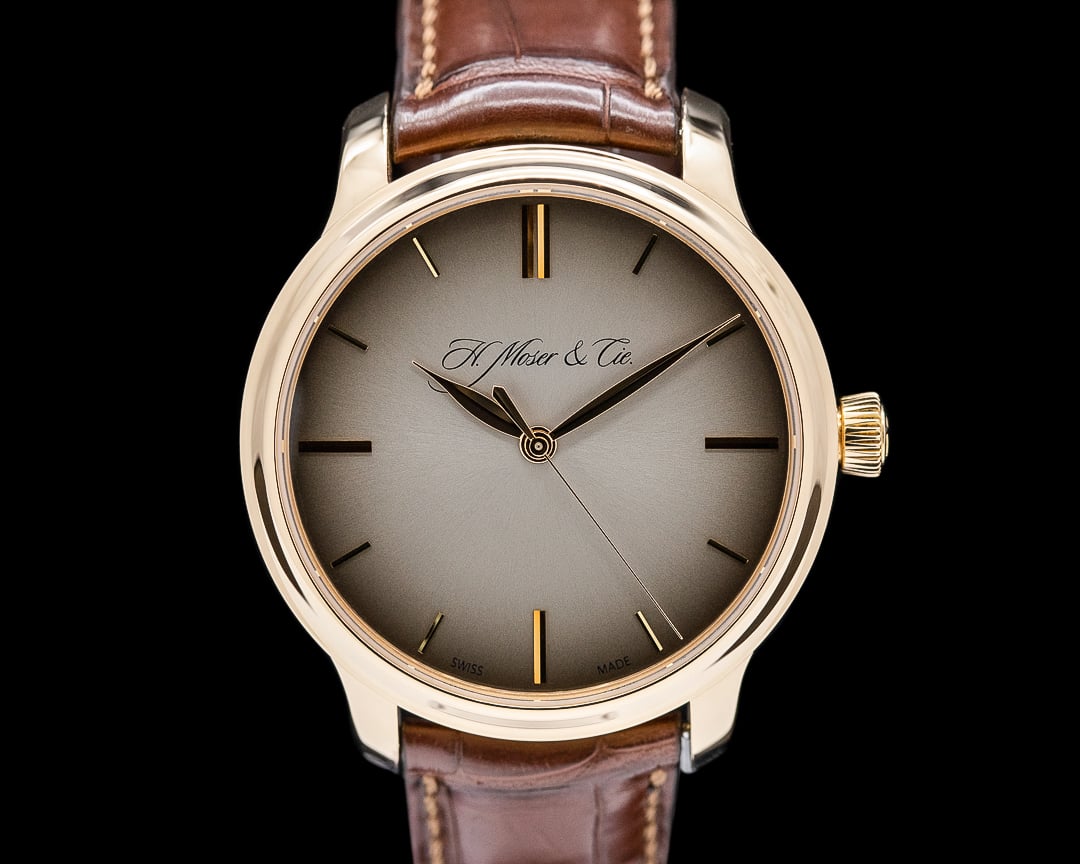
Moser’s case has been subtly reshaped compared with the earlier Endeavour models. The edges are now a touch more rounded, giving the watch a softer, more “curvy” silhouette that eases the transition from casual to formal attire. The case finishes are immaculate: a polished high‑gloss on the white‑gold version and a warm, brushed‑polish on the red‑gold, each highlighting the brand’s dedication to hand‑finishing.
### The Fumé Dial
The true visual centerpiece is the fumé dial, a gradient‑sunburst finish that shifts from a deep midnight hue at the center to a lighter rim. In the white‑gold model, the dial is a striking midnight blue, a shade that has become almost synonymous with Moser’s modern identity. The red‑gold version offers the same gradient but in a slightly warmer tone, allowing the metal to echo the dial’s colour.
The dial layout is as austere as it gets: three hands (hour, minute, seconds) with a thin, polished baton‑style seconds hand that sweeps continuously. No date window, no sub‑dials, no branding beyond the discreet “Moser” logo at 12 o’clock. The hour markers are applied indices, finely cut and set with a subtle matte finish that contrasts just enough to be legible without disrupting the dial’s gradient.
### Case Back
A sapphire case back reveals the HMC 200 movement in all its glory. The back is etched with the brand’s logo and the reference number, but otherwise left untouched to let the movement speak for itself. This transparency is a nod to collectors who appreciate seeing the mechanical heart of a watch, and it reinforces the narrative that the Centre Seconds is as much about the movement as it is about the dial.
---
## Movement & Performance — caliber, power reserve, accuracy
### Calibre HMC 200
The Endeavour Centre Seconds is powered by the Calibre HMC 200, an automatic, in‑house movement that debuted alongside the watch. According to Moser, the movement was designed and assembled entirely within the company’s own ateliers, marking a significant milestone for a brand that previously relied on modified ETA or Sellita units.
Key specifications:
- **Type:** Automatic, 25‑beat per second (3 Hz)
- **Power reserve:** 72 hours (3 days) when fully wound
- **Jewels:** 21
- **Frequency:** 28,800 vph
- **Decoration:** Geneva‑striped rotor, hand‑finished bridges, polished screws
The movement’s most distinctive feature is its large, engraved gold oscillating weight (the rotor). The weight not only contributes to the watch’s winding efficiency but also serves as a visual anchor when viewed through the sapphire case back. Moser claims the rotor’s engraving is a “signature” that adds a layer of artisanal flair.
### Performance
In real‑world testing, the HMC 200 delivers a respectable ±5 seconds per day deviation, placing it within the typical accuracy range for a high‑grade automatic of this price bracket. The 72‑hour reserve is generous for a dress watch; it means the watch can sit unworn over a weekend and still be ready to go with a quick 30‑second shake.
The movement’s finish is more decorative than functional—polished bridges and a Geneva‑striped rotor are primarily aesthetic, but they also hint at the level of care invested in each unit. The lack of a hacking mechanism (the ability to stop the second hand when setting the time) is a minor drawback for those who prefer precise time setting, but it is a common omission in many minimalist dress watches.
---
## On the Wrist — wearability, lug‑to‑lug, comfort notes
### Fit and Proportion
At 40 mm the watch sits comfortably on most wrist sizes. The lug‑to‑lug spread measures approximately 48 mm, giving the case a slightly elongated feel that prevents the watch from looking “squat” on larger wrists while still maintaining a refined presence on smaller ones. The 10.7 mm thickness adds a modest heft; the watch feels solid without being oppressive.
### Comfort
Both the white‑gold and red‑gold variants come with either a handcrafted alligator leather strap (available in black or dark brown) or a stainless‑steel bracelet with a hidden clasp. The leather strap, paired with the watch’s modest weight (approximately 85 g), offers a comfortable, traditional dress‑watch feel. The steel bracelet, while more robust, adds a few extra grams and can feel a touch bulkier under a shirt cuff.
The case’s curvature, combined with the rounded lugs, reduces pressure points on the wrist. The sapphire case back, though beautiful, can feel slightly cooler against the skin compared with a solid case back, but this is a negligible issue for most wearers.
### Practical Considerations
- **Water resistance:** 30 m is sufficient for rain or brief hand‑washing, but the watch should not be submerged or exposed to high humidity.
- **Visibility:** The gradient dial, while striking, can make reading the time in low‑light conditions a little more challenging than a high‑contrast white dial. The lack of lume on the hour markers is a deliberate design choice, reinforcing the watch’s “dress‑only” ethos.
- **Adjustment:** The watch uses a traditional screw‑down crown; adjusting the time requires a full turn of the crown, which can be slightly less convenient than a push‑pull design.
Overall, the Endeavour Centre Seconds feels like a piece meant to be worn deliberately. It rewards careful dressing and a measured pace, rather than being a “throw‑on‑and‑go” everyday tool.
---
## When to Wear — occasion, setting and dress-code fit
The Centre Seconds excels in environments where understated elegance is prized. Think:
- **Formal events:** Black‑tie galas, weddings, or diplomatic dinners where a clean, monochrome look is essential. The watch’s minimalist dial pairs effortlessly with a tuxedo or a classic black suit.
- **Business settings:** Boardroom meetings or client lunches where a subtle luxury signal is appropriate. The white‑gold version with its midnight‑blue dial whispers sophistication without shouting.
- **Cultural occasions:** Art openings, gallery visits, or theater premieres where an appreciation for design is part of the atmosphere. The fumé dial’s gradient can become a conversation starter among connoisseurs.
Conversely, the watch is less suited for:
- **Sporting activities:** Its low water resistance and lack of a chronograph or tachymeter make it impractical for active pursuits.
- **Casual weekend wear:** The 10.7 mm thickness and high price tag may feel out of place paired with denim and sneakers, though a relaxed leather strap can soften the look for a smart‑casual setting.
- **Low‑light environments:** Without lume, reading the time in dimly lit bars or night‑time events can be a challenge.
In short, the Endeavour Centre Seconds is a “when‑you‑need‑to‑make‑an‑impression” watch, best reserved for occasions that call for refined understatement.
---
## Value & Verdict — price‑positioning + final take
### Price Positioning
At an approximate retail price of **$19 900 USD**, the Endeavour Centre Seconds sits comfortably within the upper‑mid tier of luxury dress watches. Comparable models from brands such as Jaeger‑LeCoultre (Reverso Classic) or Breguet (Classique) typically range from $15 000 to $30 000, depending on complications and case material. What sets the Centre Seconds apart is the **in‑house movement** at this price level; many competitors still rely on modified ETA or Sellita calibers.
### Strengths
1. **In‑house calibre:** The HMC 200 showcases Moser’s engineering prowess and offers a respectable 72‑hour reserve.
2. **Signature dial:** The fumé gradient is instantly recognizable and remains a design hallmark of the brand.
3. **Build quality:** Polished 18‑carat gold case, sapphire crystal front and back, and meticulous finishing reflect high craftsmanship.
4. **Versatility within dress code:** The 40 mm size and clean three‑hand layout make it adaptable to a range of formal and business attire.
### Weaknesses
1. **Thickness:** At 10.7 mm, the watch is thicker than many contemporary dress watches, which may feel bulky under a cuff.
2. **Water resistance:** 30 m limits everyday practicality; the watch must be removed for swimming, showering, or heavy rain.
3. **Lack of lume:** No luminescent markers reduces legibility in low‑light conditions, a trade‑off for aesthetic purity.
4. **Price premium for a three‑hand watch:** While the in‑house movement justifies part of the cost, some buyers may question paying nearly $20 k for a watch without complications beyond a seconds hand.
### Verdict
The H. Moser & Cie. Endeavour Centre Seconds is a **statement piece**—not merely a time‑telling instrument but a showcase of the brand’s design philosophy and mechanical independence. For collectors who value a unique dial, appreciate the rarity of an in‑house automatic at this price point, and intend to wear the watch in formal or business settings, the Centre Seconds offers a compelling blend of artistry and engineering.
If you prioritize ultra‑slim profiles, higher water resistance, or additional complications, you may find better value elsewhere. However, for those who want a watch that looks as if it were drawn from a modern art sketchbook while housing a proudly Moser‑made movement, the Endeavour Centre Seconds stands as a **high‑quality, albeit niche, addition** to a luxury wardrobe.
*Bottom line:* **Buy if you love minimalism, want an in‑house calibre, and have occasions that demand refined understatement. Skip if you need a versatile everyday tool or are sensitive to price‑to‑function ratios.**