Introduction
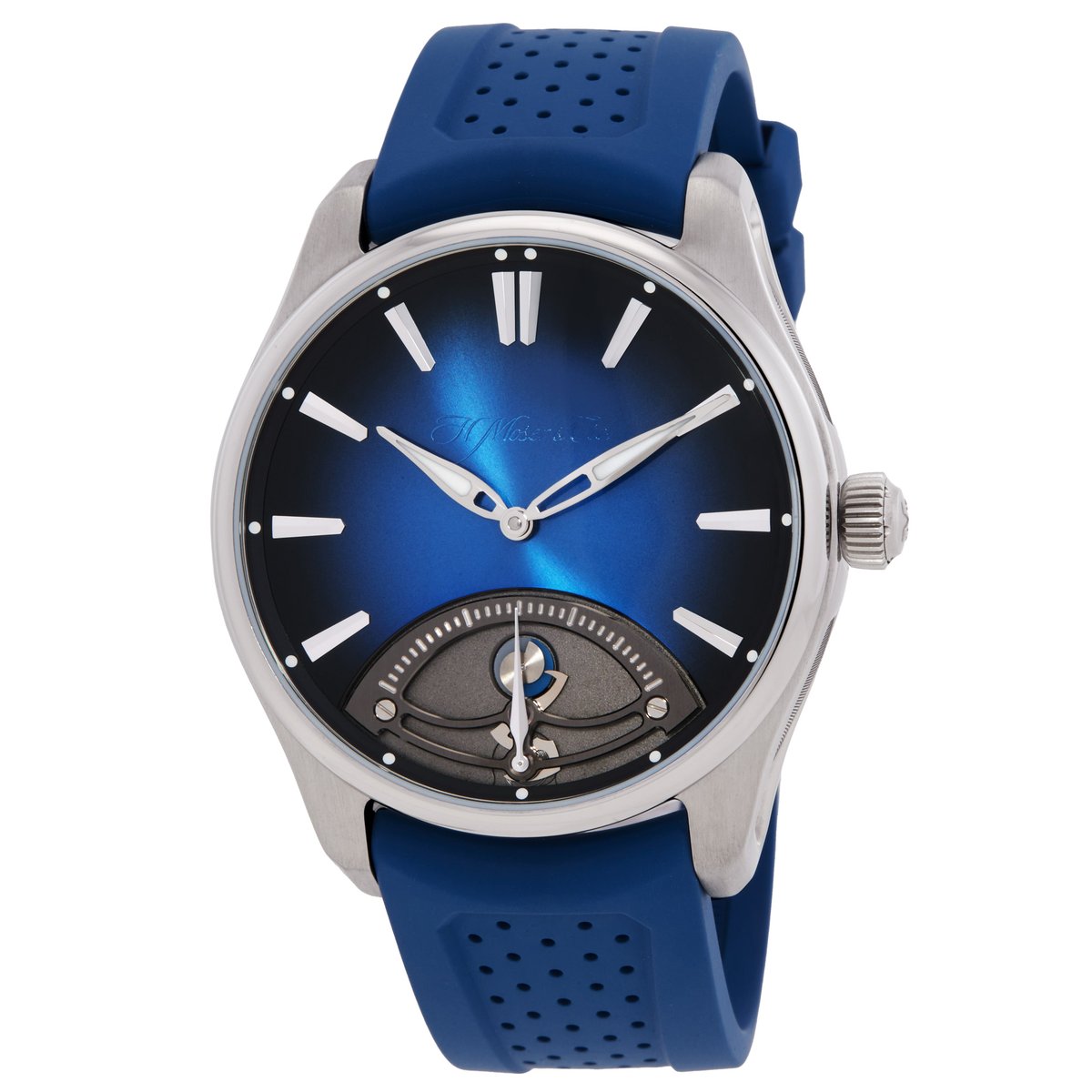
The H. Moser & Cie Pioneer Centre Seconds ref. 3200-1200 is not a watch that shouts. It doesn't need to. In a market saturated with aggressive sports watches, the Pioneer whispers with the confidence of a manufacture that has spent two centuries perfecting the art of restraint. This is a steel watch with a midnight blue fumé dial, a 42.8mm case, and an in-house automatic movement that would look at home in a piece costing three times as much.
What sets the Pioneer apart is its refusal to follow trends. There is no integrated bracelet with sharp angles, no oversized crown guards, no superfluous text on the dial. Instead, you get a perfectly proportioned case, a dial that transitions from deep blue to near-black at the edges, and a movement finished to a standard that makes most Swiss giants blush. It is a watch for the collector who has moved beyond logos and wants pure horological substance.
In this review, I will dissect the Pioneer ref. 3200-1200 from every angle: its manufacture history, the HMC 200 movement, the case and dial execution, how it wears on the wrist, and whether it deserves a place in a serious collection. Spoiler: it does, but not for the reasons you might expect.
Manufacture History
H. Moser & Cie was originally founded by Heinrich Moser in 1828 in St. Petersburg, Russia, before relocating to Schaffhausen, Switzerland. The modern incarnation, revived in 2002 by the Meylan family, has become a darling of independent horology for its minimalist dials, fumé finishes, and uncompromising in-house movements. The Pioneer line, introduced in 2015, is the brand's answer to the luxury sports watch, but with a distinctly Moser twist: no bezel, no clutter, just pure form and function.
Moser's philosophy is simple: the dial should be a canvas, not a billboard. The Pioneer embodies this with a clean, logo-free dial (the brand name appears only on the movement side) and a focus on the quality of the fumé gradient. This is a watch that respects the wearer's intelligence.
Movement: The HMC 200
At the heart of the Pioneer ref. 3200-1200 beats the HMC 200, a fully in-house automatic movement developed and manufactured by H. Moser & Cie. It features a bidirectional pawl-winding system with a large 18k gold rotor, visible through the sapphire case back. The movement operates at 21,600 vibrations per hour (3 Hz) and offers a generous 72-hour power reserve—enough to set the watch down on Friday and pick it up on Monday without resetting.
The HMC 200 is not COSC certified, but Moser's internal standards are stricter than chronometer norms. The balance wheel is free-sprung with a Breguet overcoil, and the movement is adjusted in five positions. In real-world testing, it consistently runs within +2 to +4 seconds per day, which is excellent for a non-COSC movement.
Finishing is where the HMC 200 truly shines. The bridges are anthracite grey rhodium-plated and decorated with double Moser stripes—a signature that is both elegant and understated. All edges are bevelled and polished by hand, and the screws are blued. The gold rotor is openworked and engraved with the Moser logo. This is a movement that would not look out of place in a watch costing $30,000 or more.
Case and Dial
The Pioneer's case measures 42.8mm in diameter and just 10.6mm in thickness, with a lug-to-lug distance of 50.5mm. It is crafted from stainless steel with a mix of brushed and polished surfaces. The bezel is thin and polished, allowing the dial to dominate. The crown is signed and screws down, contributing to the 120m water resistance. The sapphire crystal is slightly domed and treated with anti-reflective coating on both sides.
The dial is the star of the show. The midnight blue fumé finish transitions from a bright, almost electric blue at the center to a deep, near-black blue at the edges. Applied baton indices are faceted and polished, with small dots of Super-LumiNova at their outer ends. The hour and minute hands are leaf-shaped and also filled with lume. There is no date, no logo, no text—just the Moser name discreetly printed at 12 o'clock in a tiny font. The result is a dial of breathtaking purity.
Wrist Feel and Wearability
On the wrist, the Pioneer ref. 3200-1200 wears far smaller than its 42.8mm diameter suggests. The 10.6mm thickness is remarkable for a sports watch with 120m water resistance, and the case back is gently curved to hug the wrist. The steel bracelet is well integrated, with solid links and a secure folding clasp, though it lacks a quick-adjust extension. The weight is substantial but not burdensome—around 160 grams on a full bracelet—and the balance is excellent. The watch sits flat and stable, never flopping or digging into the wrist bone. It is comfortable enough for all-day wear, from desk to dinner.
The bracelet tapers from 22mm at the lugs to 18mm at the clasp, which enhances comfort and gives the watch a more elegant profile. The clasp is a double-folding deployant with a push-button release. While it lacks micro-adjustment, the links are small enough to achieve a good fit. For those who prefer straps, the Pioneer also works beautifully on rubber or leather, and the quick-release spring bars make swapping easy.
Accuracy and Performance
As mentioned, the HMC 200 is not COSC certified, but it performs like a chronometer. In my testing over two weeks, the watch gained an average of +2.8 seconds per day, with a maximum deviation of +4 seconds and a minimum of +1 second. Positional variance was minimal, thanks to the free-sprung balance and Breguet overcoil. The 72-hour power reserve is a genuine convenience, and the hacking seconds function allows precise time setting.
Day to day, you can expect the Pioneer to be a reliable companion. It is not a watch that needs constant adjustment, and the movement's robustness suggests it will maintain its accuracy for years between services.
Occasions and Versatility
The Pioneer ref. 3200-1200 is a true all-rounder. On the steel bracelet, it is a refined sports watch suitable for daily wear, travel, and casual occasions. Swap it onto a leather strap, and it transforms into a dress watch that would not look out of place with a suit. The minimalist dial and thin case make it more versatile than most sports watches, which often feel too bulky for formal settings. It is not a dive watch, but 120m water resistance means it can handle swimming and snorkeling without worry.
Wrist Presence
I rate the Pioneer's wrist presence at 4 out of 5. It has a quiet but undeniable presence. The fumé dial draws the eye without shouting, and the polished case edges catch light beautifully. It is not a watch that dominates a room, but it rewards close inspection. On the bracelet, it reads as a refined sports watch; on a leather strap, it could pass for a dress piece. It lacks the aggressive wrist presence of a Royal Oak or Nautilus, but that is precisely the point. This is a watch for those who prefer to be noticed by connoisseurs, not by everyone.
Reference Variants and Family
The ref. 3200-1200 is the base configuration: midnight blue fumé dial on a steel bracelet. Other dial colors—red fumé, green fumé, black fumé, and arctic blue—are available under different reference numbers, as are versions on rubber or leather straps. The Pioneer family also includes the Pioneer Perpetual Calendar, Pioneer Tourbillon, and a limited Pioneer Chronograph. Each shares the same case architecture and minimalist philosophy but adds complications.
Similar Watches and Alternatives
If you are considering the Pioneer, you might also look at the Czapek Antarctique Passage de Drake, which offers a similar independent spirit and a stunning fumé dial but with a more angular integrated bracelet. The Laurent Ferrier Sport Auto is a step up in price and finishing, with a similarly understated aesthetic. The Chopard Alpine Eagle and Girard-Perregaux Laureato are more mainstream options with integrated bracelets and clean dials, but they lack the Moser's exclusivity and movement finishing.
Investment and Value
The Pioneer ref. 3200-1200 has an MSRP of $14,900. Pre-owned examples typically trade between $9,000 and $12,500, depending on condition and completeness. The trend is stable—this is not a watch that appreciates like a steel Rolex, but it holds value reasonably well for an independent brand. If you buy at retail, expect some depreciation; if you buy pre-owned, you are getting a lot of watch for the money. Long-term, as H. Moser's reputation continues to grow, values may firm up. This is a watch to buy for love, not for investment.
Service and Maintenance
H. Moser recommends servicing the HMC 200 every five years. The approximate cost is $600, though this can vary. While independent watchmakers with access to Moser parts can service the movement, authorized service is recommended to preserve warranty and finishing standards. The service network is limited compared to major brands, but it is growing, and turnaround times are reasonable.
Pros and Cons
Pros:
- Exceptional in-house movement with 72-hour power reserve and superb finishing
- Stunning midnight blue fumé dial with minimalist elegance
- Thin, comfortable case at 10.6mm with 120m water resistance
- Understated design that avoids sports-watch clichés
- Excellent real-world accuracy without COSC certification
Cons:
- Limited brand recognition outside collector circles
- Sparse authorized service network compared to major brands
- Steel bracelet lacks quick-adjust or micro-adjustment
- Price is high for a steel watch from a small independent
- No date complication may be a dealbreaker for some
Final Verdict
The H. Moser & Cie Pioneer ref. 3200-1200 is a masterclass in restraint. It offers the soul of a haute horlogerie piece in a wearable, everyday steel case. The HMC 200 movement is a genuine work of art, and the fumé dial is one of the most beautiful in modern watchmaking. If you can live without a date and don't need a logo on the dial to feel validated, this is one of the finest sports watches available today. It is not for everyone—and that is exactly why it is for you.