H. Moser & Cie. x Studio Underd0g Passion Project: A Wrist Review
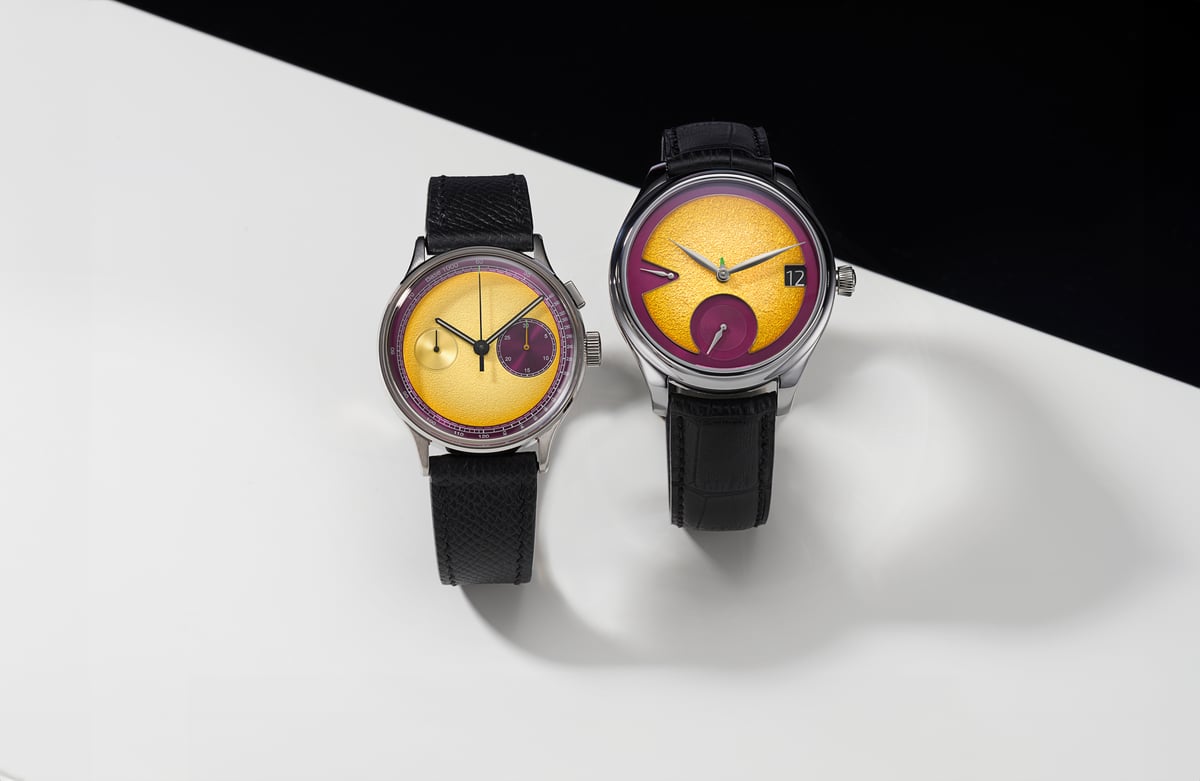
The Passion Project is one of those releases that should not work on paper. H. Moser & Cie. is a serious independent known for fumé dials, in-house movements and a very Swiss sense of restraint. Studio Underd0g is a British microbrand known for playful chronographs and dials that look like desserts. Put them together and you get a 100-set collaboration that pairs a Moser Endeavour Centre Seconds with a Studio Underd0g chronograph. The Moser half is ref. 1800-1200, and it is the watch I have focused on for this review.
This is not a standard catalogue Moser. The dial is loud in the best possible way, the branding is kept minimal, and the whole package is designed to be worn rather than stored. But it is still an Endeavour at heart, which means an in-house automatic movement, a restrained case profile and the kind of finishing you expect from a small independent. The interesting question is whether the collaboration premium makes sense on the wrist rather than in a display case.
I have treated it as a real daily-wear watch: office days, dinners, travel days and weekends. The short answer is that it is charming, comfortable and far more versatile than the Passion Fruit colour suggests. The longer answer involves the set-only sales structure, the premium over a standard Endeavour and the fact that this is a watch you buy for the story as much as the specification.
The collaboration in context
H. Moser & Cie. was founded in 1828 in Schaffhausen by Heinrich Moser and was revived as a modern independent in 2005. The brand has built its modern reputation on fumé dials, concept dials with almost no branding and in-house movements that are finished to a high standard. It is not a brand that usually does playful collaborations. That is exactly why the Studio Underd0g project works: it is a controlled departure from the house style without turning the watch into a novelty item.
Studio Underd0g brings the colour and the sense of humour. The collaboration was sold as a pair, limited to 100 sets, and the Moser was not available on its own. That matters for collectors because it means the watch is tied to the set, the packaging and the story. It also means the buyer profile is narrow: you have to want both watches, or at least want the Moser badly enough to accept the Studio Underd0g alongside it.
The set was priced around $65,000 at launch. That is a significant premium over a standard Endeavour Centre Seconds, and it is the first thing any rational buyer should consider. You are not just buying a watch; you are buying a numbered collaboration, a second watch and a piece of Moser's more playful side. Whether that is worth it depends on how much you value the story.
Case, dial and strap
The case is stainless steel, which is unusual for Moser in this part of the catalogue and part of what makes the collaboration feel different. It is polished and restrained, with the kind of smooth bezel and curved lugs that let the dial do the work. The sapphire crystal is clear and sits close to the case, and the overall impression is of a dress watch that has been given a licence to be fun.
The dial is the main event. It takes its cue from passion fruit, with a saturated gradient that shifts across the surface and a playful attitude that is immediately recognisable. The layout is clean: no date, no clutter, just the hours, minutes and central seconds. Legibility is strong in daylight because the hands are simple and the dial is not overloaded. At night, there is no lume, so this is not a watch for reading in bed or finding your way around a dark hotel room.
The strap is leather, and the pin buckle keeps the package traditional. I like that Moser did not try to make the strap a gimmick. A bright dial needs a quieter strap, and the leather does that job. If I owned the watch, I would probably order a second strap in black or dark brown to make it easier to wear with a suit. The bright collaboration strap is fun, but it narrows the wardrobe.
Moser does not publish a full set of dimensions for this collaboration reference in a way that I can verify consistently, so I have left the millimetre figures out of this review. The important point is that the Endeavour case is not a chunky sports watch. It sits close to the wrist, the lugs curve down, and the crown is easy to use without digging into the back of the hand. That is what matters for daily wear.
Movement
The watch uses the HMC 200, Moser's in-house automatic. It beats at 21,600 vibrations per hour and has a 72-hour power reserve. That is a sensible, modern specification for a dress watch: long enough to survive a weekend off the wrist, slow enough to feel mechanical rather than frantic, and backed by a brand that knows how to finish a movement.
The HMC 200 is not COSC-certified, so you should not expect chronometer paperwork. In practice, a well-regulated example should run within a few seconds per day, with the usual sensitivity to resting position. The lack of a date means there is no midnight jump and no extra setting step. It is a clean, simple engine for a clean, simple watch.
Finishing is in line with Moser's house style: restrained, architectural and more about quality than spectacle. You do not buy this watch for a skeletonised movement or a dramatic display back. You buy it because the movement is in-house, serviceable and appropriate to the case. That is exactly what the HMC 200 delivers.
On the wrist
The Endeavour case is the reason this watch works as a daily wearer. It is not a chunky sports watch, and the lugs curve down in a way that keeps the case close to the wrist. On my wrist it feels balanced and unobtrusive, even with the vivid dial doing most of the talking. The strap is soft from the start, and the pin buckle is easy to live with, though I would swap the bright collaboration strap for black leather when I wanted the watch to disappear under a cuff.
Comfort is excellent for a dress watch, and the caseback sits flat enough that it does not rock around during a long day. The crown is easy to grip without being oversized. The only real wrist-feel compromise is the height of the dial furniture and the fact that the bright colour draws comments. This is not a stealth watch. But if you are comfortable with that, it is one of the more wearable Moser cases in the current line-up.
Wrist presence is strong without being heavy. The watch reads as a conversation piece rather than a status symbol, which is part of its charm. It works with a shirt cuff, a knit and a casual jacket. It does not work with a wetsuit, and it does not pretend to. Moser positions the Endeavour as a dress watch, so I would not take it into the pool or the sea. Treat it as a fair-weather daily and it will be happy.
Accuracy and daily behaviour
The HMC 200 is not COSC-certified, so do not expect chronometer paperwork. In normal wear I would expect a well-regulated example to run within a few seconds per day, with the usual sensitivity to resting position overnight. The lack of a date means there is no midnight jump to worry about, and the no-date layout keeps the dial clean. For a watch of this type, accuracy is more than adequate; the real appeal is the 72-hour reserve and the convenience of an automatic winding system.
The 72-hour reserve is genuinely useful. If you take the watch off on Friday evening and put it back on Monday morning, it should still be running. That makes it a better daily wearer than a short-reserve dress watch, and it means you do not have to reset it every time you rotate it into the week. The automatic winding is smooth, and the crown operates without any sharpness or vagueness.
Legibility is strong in daylight, but the lack of lume is a real limitation at night. If you are the kind of person who checks the time in a dark cinema, this is not the watch for you. If you mostly wear it during the day and in well-lit rooms, the clean dial and simple hands are easy to read at a glance.
When to wear it
This is a formal and daily watch with a playful streak. It works beautifully with a suit, especially a navy or charcoal suit where the dial becomes the only point of colour. It works with smart casual, a knit polo and trousers. It works for dinners, gallery openings and long lunches. It is not a sports watch, and it is not a travel watch in the utilitarian sense because there is no date, no GMT and no lume.
The occasions where it struggles are the ones where you want to be invisible. If you work in a conservative office and you do not want to answer questions about your watch, this is not the one. If you travel through airports and want a robust grab-and-go watch, a standard Endeavour or a sports watch makes more sense. But if you want a watch that makes you smile every time you look down, it delivers.
My recommendation is to wear it as a three-season watch and treat it as a dress watch with a sense of humour. It is at its best with a jacket, but it does not feel precious. That is a rare combination in high horology, and it is the reason the collaboration works.
Collecting and value
The Passion Project is a limited edition of 100 sets, sold as a pair. That gives it a clear collector story, but it also limits liquidity. The Moser half is not available on its own, so anyone who wants ref. 1800-1200 has to buy the set or find a set on the secondary market. That makes the watch more exclusive, but it also makes it harder to value in isolation.
The launch price was around $65,000 for the set. Current retail is effectively zero because the collaboration is sold out. Pre-owned data is scarce, and there is no major auction history. My expectation is that the set will trade in a stable range rather than explode in value. The limited number supports long-term collectability, but the set structure and the niche appeal of the dial mean it is not a guaranteed investment.
Buy it for the object and the story, not for a short-term flip. If you love Moser and you love the idea of a playful collaboration, the premium is easier to justify. If you are purely rational, a standard Endeavour Centre Seconds gives you the same case and movement for less money. The Passion Project is the emotional choice, and that is fine as long as you know what you are buying.
Service
Service should go through H. Moser & Cie. or an authorized partner. The movement is a standard HMC 200, so the watch is not a service nightmare, but the collaboration adds a layer of paperwork and provenance. Keep the set packaging, the certificate and any correspondence. If you ever sell, the completeness of the set matters.
Moser does not publish a fixed service interval that I can verify for this reference, so I have left the interval blank in the specification table. In practice, follow the brand's recommendation and have the watch checked if it starts losing time or if the winding feels rough. Authorized service is the safe route for a watch at this level.
Alternatives and homages
If you want the Moser experience without the collaboration premium, the standard Endeavour Centre Seconds Concept is the obvious alternative. It has the same case family and the same HMC 200 movement, but without the Passion Fruit dial and the set-only sales structure. The Parmigiani Fleurier Tonda PF Micro-Rotor is another understated high-end daily wearer with a textured dial and a very different personality. The Chopard L.U.C XPS is a more classical dress watch with an in-house movement and a clean dial.
At the affordable end, the Studio Underd0g 01Series Chronograph shares the playful, colour-forward design language at a fraction of the price. It is not a homage to the Moser, but it scratches a similar itch. The Seiko Presage Cocktail Time is a more traditional affordable gradient-dial dress watch and a sensible entry point for someone who likes the look but cannot justify the set.
Pros and cons
- Pro: Wearable Endeavour case with a genuinely joyful dial.
- Pro: In-house HMC 200 automatic with a 72-hour reserve.
- Pro: Limited 100-set collaboration with a strong collector story.
- Pro: No-date layout is clean and legible.
- Con: Only sold as a two-watch set, so buyers cannot choose one.
- Con: No lume and a leather strap make it a fair-weather daily.
- Con: Premium priced versus a standard Endeavour Centre Seconds.
- Con: Bright dial and strap are not for every wardrobe.
Final verdict
The Passion Project is not the rational Moser purchase; it is the fun one. It puts a serious in-house automatic in a playful, collaboration-specific package that actually wears well. The HMC 200 is a sensible engine, the case is comfortable, and the dial is a genuine mood-lifter. The set-only structure is the main hurdle, because it forces you to buy two watches when you may only want one.
If you can buy the set and you love the story, it is a charming long-term hold. If you want one watch for the rest of your life, the standard Endeavour Centre Seconds makes more sense. The Passion Project is for the collector who already has the rational watch and wants something that makes them smile.