The Architecture of Minimalism
To understand the H. Moser & Cie Venturer Small Seconds, one must first understand the philosophy of its creators. Based in Neuhausen am Rheinfall, Moser operates with a degree of vertical integration that is the envy of brands ten times its size. This independence is not merely a marketing slogan; it is the foundation upon which the Venturer is built. The reference 2327-0220 is a testament to this, housing a movement that is as much a piece of engineering as it is a work of art.
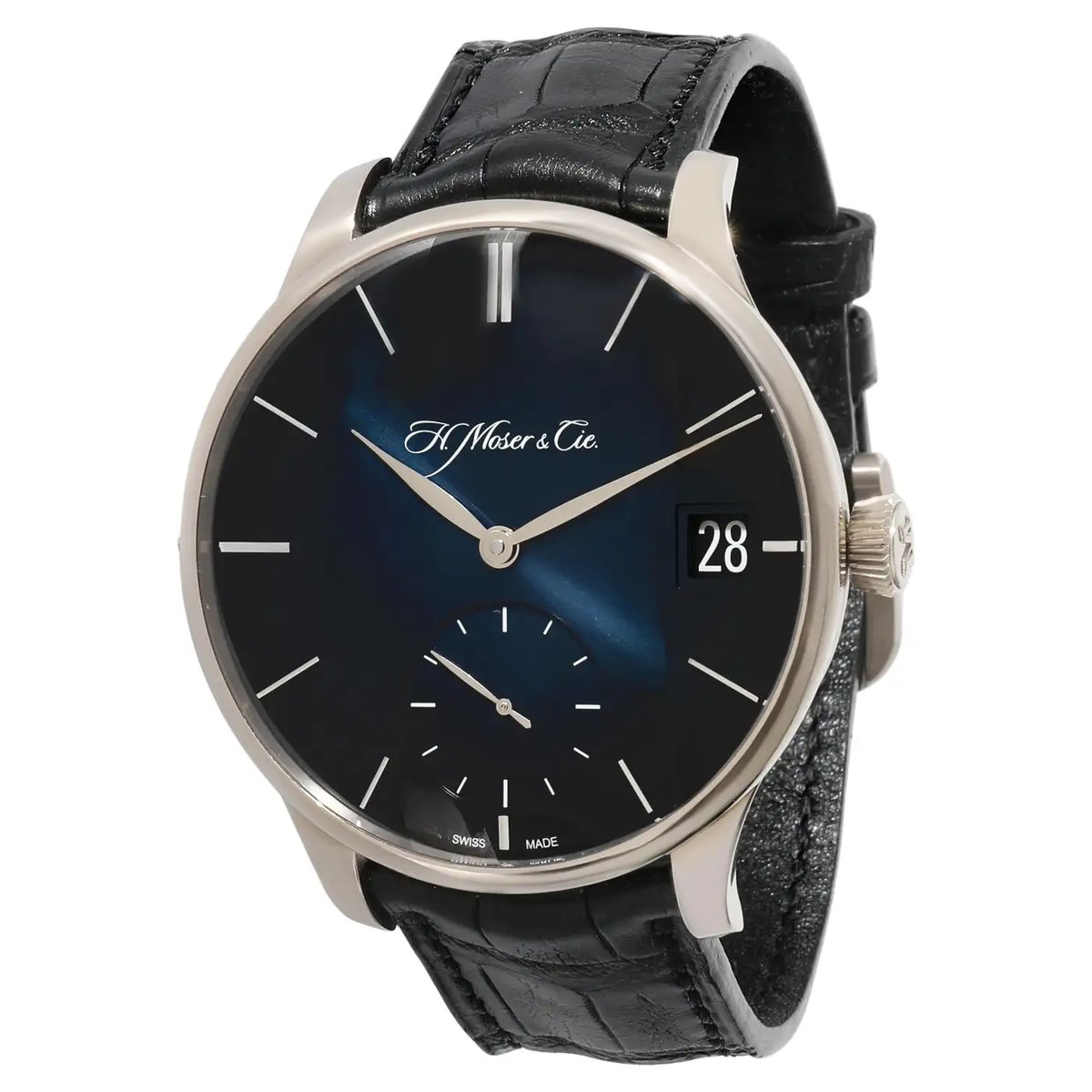
The case of the Venturer is crafted from 18-karat white gold, a material chosen for its understated luxury. Unlike stainless steel, white gold possesses a warmth and a specific gravity that communicates its value through touch rather than flash. The 39mm diameter is a conscious nod to the mid-century era, specifically the 1960s, where watches were sized to be elegant rather than aggressive. However, Moser has modernized this silhouette with a convex sapphire crystal that mirrors the curve of the dial beneath it, creating a sense of depth that is rarely achieved in such a slim profile.
The Dial: A Masterclass in Fumé
The 'Funky Blue' fumé dial is, for many, the primary draw of this reference. The process of creating a fumé dial is arduous, involving the application of multiple layers of lacquer and meticulous polishing to achieve a gradient effect that transitions from a vibrant, electric blue at the center to a deep, midnight navy at the periphery. This is not a static dial; it reacts to every change in ambient light, shifting from a matte denim to a brilliant sunburst depending on the angle of the wrist.
The layout is intentionally sparse. There is no logo—a hallmark of Moser’s 'Concept' philosophy, even if this specific reference retains the subtle markers. The leaf-shaped hands are long and elegantly curved, following the contour of the dial. The small seconds sub-dial at 6 o'clock is slightly recessed, providing a textural contrast that breaks up the expanse of the blue field without cluttering it. This is horological minimalism at its finest, where every element is required to justify its existence.
Movement: The HMC 327
Turning the watch over reveals the HMC 327 caliber, a manual-wind movement that demonstrates Moser's technical depth. The architecture is traditional, with large bridges that allow for the display of the signature Moser stripes. These stripes are broader than the standard Côtes de Genève, giving the movement a more masculine, industrial feel that contrasts beautifully with the polished anglage (beveling) on the edges of the bridges.
Technically, the HMC 327 is a slow-beat movement, oscillating at 18,000 vibrations per hour. This choice is deliberate, allowing the owner to observe the rhythmic pulse of the balance wheel. It also contributes to the impressive 72-hour power reserve. Perhaps the most significant feature is the modular escapement. This allows a watchmaker to remove the entire escapement unit during service and replace it with a pre-regulated one, significantly reducing the time the watch spends away from the owner. The inclusion of an original Straumann Hairspring—produced by Moser's sister company, Precision Engineering AG—ensures that the heart of the watch is as Swiss as the mountains surrounding the manufacture.
Wrist Experience and Versatility
On the wrist, the Venturer ref. 2327-0220 is a chameleon. While its gold construction and dial refinement suggest a formal setting, the use of a raw kudu leather strap injects a dose of ruggedness. This juxtaposition allows the watch to be worn with a navy suit or a simple cashmere sweater and denim. The lug-to-lug distance of 46.5mm ensures that it fits comfortably on a wide range of wrist sizes, avoiding the 'overhang' that plagues many modern 40mm+ watches.
The tactile experience of winding the HMC 327 is a daily ritual for the enthusiast. There is a distinct resistance to the crown that feels mechanical and intentional. Unlike automatic movements that can feel disconnected, the manual wind creates a direct link between the wearer and the energy stored within the mainspring. The power reserve indicator, located on the movement side, is a pragmatic touch; it keeps the dial clean while providing the necessary information to the wearer when the watch is off the wrist.
Investment and Market Context
In the current market, H. Moser & Cie occupies a unique position. While they produce fewer than 2,000 watches per year, their brand recognition has skyrocketed. The Venturer Small Seconds is often seen as the gateway to the brand's more complex offerings. While it may not see the immediate speculative growth of a stainless steel sports watch, its value proposition lies in its rarity and the integrity of its manufacturing. For the sophisticated collector, the 2327-0220 represents a stable asset that offers far more horological 'meat' than its peers from larger, more commercial houses.
Conclusion
The H. Moser & Cie Venturer Small Seconds ref. 2327-0220 is not a watch for someone seeking status through a logo. It is a watch for the individual who finds beauty in the curve of a crystal and the slow beat of a balance wheel. It is a masterclass in the 'less is more' school of design, executed with a level of technical sophistication that justifies its place among the elite of independent horology. In an era of excess, the Venturer is a refreshing reminder that true luxury is often found in the quietest details.